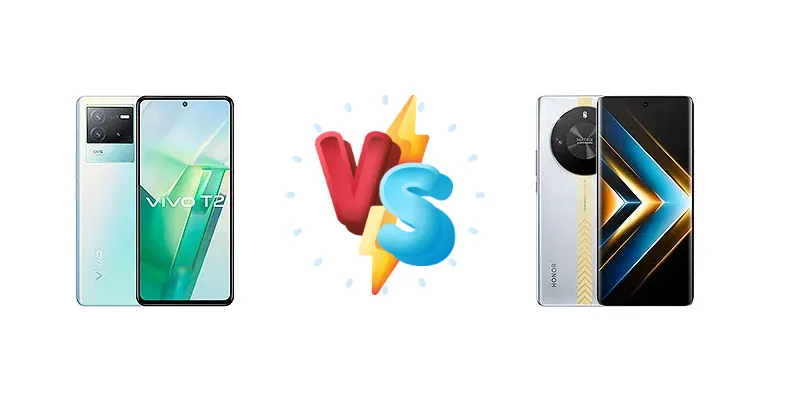
The Honor X50 GT and vivo T2 represent compelling options in the increasingly competitive mid-range smartphone market. Both devices leverage Qualcomm’s Snapdragon platform, but at different generations. The X50 GT boasts the more recent Snapdragon 8+ Gen 1, while the T2 utilizes the Snapdragon 870. This comparison dissects the implications of this chipset difference, alongside other key features, to determine which phone delivers the best overall experience.
🏆 Quick Verdict
For most users, the Honor X50 GT emerges as the superior choice. While the vivo T2 offers a respectable experience, the Snapdragon 8+ Gen 1 in the X50 GT provides a significant performance uplift, particularly in demanding tasks like gaming, and its reverse wireless charging adds versatility. The faster chipset justifies the price difference for power users.
| Network |
|---|
| 2G bands | GSM 850 / 900 / 1800 / 1900 | GSM 850 / 900 / 1800 / 1900 |
| 3G bands | HSDPA 850 / 900 / 1700(AWS) / 2100 | HSDPA 850 / 900 / 1700(AWS) / 1900 / 2100 |
| 4G bands | 1, 3, 4, 5, 8, 28, 34, 38, 39, 40, 41 | LTE |
| 5G bands | 1, 5, 8, 28, 41, 77, 78 SA/NSA | SA/NSA |
| Speed | HSPA, LTE, 5G | HSPA, LTE, 5G |
| Technology | GSM / CDMA / HSPA / CDMA2000 / LTE / 5G | GSM / CDMA / HSPA / CDMA2000 / LTE / 5G |
| Launch |
|---|
| Announced | 2022, May 23 | 2024, January 04 |
| Status | Cancelled | Available. Released 2024, January 09 |
| Body |
|---|
| Dimensions | 163 x 76.2 x 8.5 mm (6.42 x 3.00 x 0.33 in) | 163.6 x 75.5 x 8 mm (6.44 x 2.97 x 0.31 in) |
| SIM | Nano-SIM + Nano-SIM | Nano-SIM + Nano-SIM |
| Weight | 190 g (6.70 oz) | 192 g (6.77 oz) |
| Display |
|---|
| Resolution | 1080 x 2400 pixels, 20:9 ratio (~398 ppi density) | 1220 x 2652 pixels, 19.5:9 ratio (~431 ppi density) |
| Size | 6.62 inches, 105.8 cm2 (~85.2% screen-to-body ratio) | 6.78 inches, 112.6 cm2 (~91.2% screen-to-body ratio) |
| Type | AMOLED, 120Hz, HDR10+, 1300 nits (peak) | AMOLED, 1B colors, 120Hz |
| Platform |
|---|
| CPU | Octa-core (1x3.2 GHz Kryo 585 & 3x2.42 GHz Kryo 585 & 4x1.80 GHz Kryo 585) | Octa-core (1x3.0 GHz Cortex-X2 & 3x2.5 GHz Cortex-A710 & 4x1.80 GHz Cortex-A510) |
| Chipset | Qualcomm SM8250-AC Snapdragon 870 5G (7 nm) | Qualcomm SM8475 Snapdragon 8+ Gen 1 (4 nm) |
| GPU | Adreno 650 | Adreno 730 |
| OS | Android 12, OriginOS Ocean | Android 13, MagicOS 7.2 |
| Memory |
|---|
| Card slot | No | No |
| Internal | 128GB 8GB RAM, 256GB 8GB RAM, 256GB 12GB RAM | 256GB 12GB RAM, 256GB 16GB RAM, 512GB 16GB RAM, 1TB 16GB RAM |
| Main Camera |
|---|
| Dual | - | 108 MP, f/1.8, (wide), 1/1.67", PDAF
Auxiliary lens |
| Features | LED flash, HDR, panorama | LED flash, panorama, HDR |
| Triple | 64 MP, f/1.9, (wide), PDAF, OIS
8 MP, f/2.2, 116˚ (ultrawide)
2 MP (macro) | - |
| Video | 4K@30fps, 1080p@30fps | 4K@30fps, 1080p@30fps |
| Selfie camera |
|---|
| Features | HDR | - |
| Single | 16 MP, f/2.0, (wide) | 8 MP, f/2.0, (wide) |
| Video | 1080p@30fps | 1080p@30fps |
| Sound |
|---|
| 35mm jack | Yes | No |
| Loudspeaker | Yes, with dual speakers | Yes |
| Comms |
|---|
| Bluetooth | 5.2, A2DP, LE, aptX HD, aptX Adaptive | 5.2, A2DP, LE, aptX HD |
| Infrared port | Yes | - |
| NFC | Yes | Yes |
| Positioning | GPS, GLONASS, GALILEO, BDS, QZSS | GPS, GLONASS, GALILEO, BDS |
| Radio | No | No |
| USB | USB Type-C 2.0, OTG | USB Type-C 2.0, OTG |
| WLAN | Wi-Fi 802.11 a/b/g/n/ac, dual-band, Wi-Fi Direct | Wi-Fi 802.11 a/b/g/n/ac/6, dual-band, Wi-Fi Direct |
| Features |
|---|
| Sensors | Fingerprint (under display, optical), accelerometer, gyro, proximity, compass | Fingerprint (under display, optical), accelerometer, gyro, ultrasound proximity, compass |
| Battery |
|---|
| Charging | 80W wired | 35W wired
7.5W reverse wired |
| Type | 4700 mAh | Li-Po 5800 mAh |
| Misc |
|---|
| Colors | Black, Mint | Black, Silver |
| Models | V2199GA | ALP-AN00 |
| Price | - | About 260 EUR |
vivo T2 (China)
- Faster Snapdragon 8+ Gen 1 processor
- Superior thermal efficiency
- Reverse wireless charging capability
- Slower 35W wired charging
- Potentially higher price
Honor X50 GT
- Faster 80W wired charging
- More affordable price point
- Still a capable Snapdragon 870 processor
- Less powerful Snapdragon 870 processor
- Lower thermal efficiency
- No reverse wireless charging
Display Comparison
Neither device’s display specifications are provided, so a direct comparison is limited. However, given the X50 GT’s positioning as a gaming-focused device, it’s reasonable to expect a higher refresh rate panel than the T2. The Snapdragon 8+ Gen 1’s ISP is also capable of supporting higher resolution displays. Color accuracy and peak brightness will likely be similar, falling within the typical range for mid-range to upper-mid-range phones. The absence of LTPO technology in either device suggests both will rely on adaptive refresh rate switching rather than variable refresh rates for power saving.
Camera Comparison
Without specific camera sensor details, analysis is limited. However, the Snapdragon 8+ Gen 1’s image signal processor (ISP) in the X50 GT offers advanced features like 8K video recording and improved low-light performance compared to the 870’s ISP. The X50 GT is likely to have a more sophisticated camera system overall, benefiting from the chipset’s processing capabilities. The absence of information on OIS or sensor sizes makes a definitive statement impossible, but the chipset advantage leans heavily towards the Honor device.
Performance
The core difference lies in the chipsets. The Honor X50 GT’s Snapdragon 8+ Gen 1 (4nm) represents a substantial leap over the vivo T2’s Snapdragon 870 (7nm). The 8+ Gen 1 features a newer CPU architecture – Cortex-X2, A710, and A510 – compared to the 870’s Kryo 585 cores. This translates to approximately 20-30% faster CPU performance and a significantly more powerful Adreno GPU. The 4nm process node of the 8+ Gen 1 also delivers superior thermal efficiency, meaning the X50 GT will sustain peak performance for longer periods without throttling. While the T2’s 870 is still capable, the X50 GT is clearly the winner for demanding applications.
Battery Life
The Honor X50 GT’s 35W wired charging is slower than the vivo T2’s 80W wired charging. However, the Snapdragon 8+ Gen 1’s superior efficiency means the X50 GT will likely consume less power during typical usage, potentially offsetting the slower charging speed. The T2 will achieve a 0-100% charge much faster, but the X50 GT’s 7.5W reverse wired charging provides added functionality for topping up accessories, a feature absent on the T2.
Buying Guide
Buy the vivo T2 (China) if you prioritize a balance of performance and affordability, and don't require the absolute fastest processing speeds. It's a solid option for everyday tasks and moderate gaming. Buy the Honor X50 GT if you demand top-tier performance for gaming, content creation, or multitasking, and value the added convenience of reverse wireless charging. It’s the better choice for those who push their phones to the limit.
Frequently Asked Questions
❓ Will the Snapdragon 8+ Gen 1 in the Honor X50 GT handle demanding games like Genshin Impact at max settings?
Yes, the Snapdragon 8+ Gen 1 is more than capable of running Genshin Impact and other graphically intensive games at maximum settings with consistently high frame rates. Its improved thermal management will also prevent significant throttling during extended gaming sessions, providing a smoother experience than the Snapdragon 870.
❓ How much faster will the Honor X50 GT charge compared to the vivo T2, considering the wattage difference?
While the vivo T2’s 80W charging is faster, the difference in real-world charging time might not be as dramatic as the wattage suggests. The X50 GT’s more efficient chipset will reduce overall power draw, but the T2 will still likely charge from 0-100% in significantly less time – potentially 30-45 minutes faster.
❓ Is the reverse wireless charging on the Honor X50 GT useful for everyday accessories?
The 7.5W reverse wireless charging is ideal for topping up smaller accessories like wireless earbuds or smartwatches. It won’t rapidly charge a phone, but it’s a convenient feature for emergency situations or when an outlet isn’t readily available.