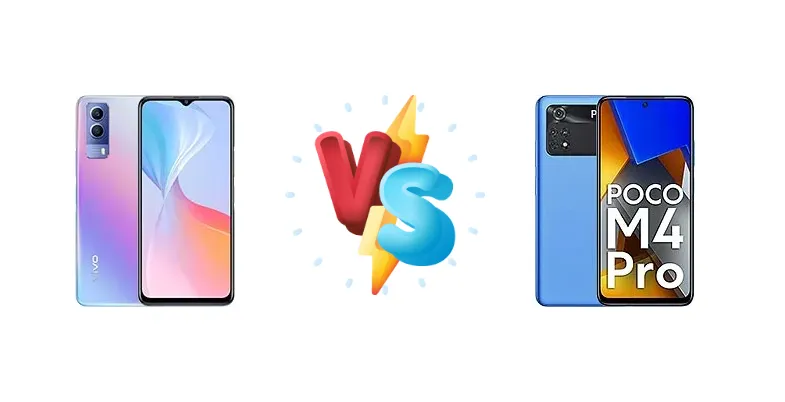
The vivo T1x and Xiaomi Poco M4 Pro represent compelling options in the crowded mid-range smartphone market. While both aim to deliver a solid experience without breaking the bank, they take different approaches. The T1x prioritizes processing power with its Dimensity 900, while the Poco M4 Pro focuses on endurance and a bright display. This comparison will dissect their key differences to help you choose the right phone for your needs.
🏆 Quick Verdict
For most users, the vivo T1x emerges as the stronger contender. Its Mediatek Dimensity 900 chipset provides a noticeable performance advantage over the Poco M4 Pro’s Helio G96, and the 44W charging is significantly faster. While the Poco M4 Pro boasts comparable battery endurance, the T1x offers a more future-proof platform.
| Network |
|---|
| 2G bands | GSM 850 / 900 / 1800 / 1900 | GSM 850 / 900 / 1800 / 1900 |
| 3G bands | HSDPA 850 / 900 / 1700(AWS) / 2100 | HSDPA 850 / 900 / 1700(AWS) / 1900 / 2100 - International |
| 4G bands | 1, 3, 4, 5, 8, 28, 34, 38, 39, 40, 41 | 1, 2, 3, 4, 5, 7, 8, 20, 28, 38, 40, 41 - International |
| 5G bands | 1, 3, 28, 41, 77, 78 SA/NSA | - |
| Speed | HSPA, LTE, 5G | HSPA, LTE |
| Technology | GSM / CDMA / HSPA / CDMA2000 / LTE / 5G | GSM / HSPA / LTE |
| | CDMA2000 1x | 1, 3, 5, 8, 40, 41 - India |
| Launch |
|---|
| Announced | 2021, October 20 | 2022, February 28 |
| Status | Available. Released 2021, November 01 | Available. Released 2022, March 16 |
| Body |
|---|
| Build | Glass front, plastic frame, plastic back | Glass front (Gorilla Glass 3), plastic frame, plastic back |
| Dimensions | 164 x 75.3 x 8.5 mm (6.46 x 2.96 x 0.33 in) | 159.9 x 73.9 x 8.1 mm (6.30 x 2.91 x 0.32 in) |
| SIM | Nano-SIM + Nano-SIM | Nano-SIM + Nano-SIM |
| Weight | 189 g (6.67 oz) | 179.5 g (6.31 oz) |
| | - | IP53, dust and splash resistant |
| Display |
|---|
| Protection | - | Corning Gorilla Glass 3 |
| Resolution | 1080 x 2408 pixels, 20:9 ratio (~401 ppi density) | 1080 x 2400 pixels, 20:9 ratio (~409 ppi density) |
| Size | 6.58 inches, 104.3 cm2 (~84.5% screen-to-body ratio) | 6.43 inches, 99.8 cm2 (~84.5% screen-to-body ratio) |
| Type | IPS LCD, 120Hz | AMOLED, 90Hz, 700 nits, 1000 nits (peak) |
| Platform |
|---|
| CPU | Octa-core (2x2.4 GHz Cortex-A78 & 6x2.0 GHz Cortex-A55) | Octa-core (2x2.05 GHz Cortex-A76 & 6x2.0 GHz Cortex-A55) |
| Chipset | Mediatek Dimensity 900 (6 nm) | Mediatek MT6781 Helio G96 (12 nm) |
| GPU | Mali-G68 MC4 | Mali-G57 MC2 |
| OS | Android 11, OriginOS | Android 11, MIUI 13 for POCO |
| Memory |
|---|
| Card slot | No | microSDXC (dedicated slot) |
| Internal | 128GB 6GB RAM, 128GB 8GB RAM, 256GB 8GB RAM | 64GB 6GB RAM, 128GB 6GB RAM, 128GB 8GB RAM, 256GB 8GB RAM |
| | - | UFS 2.2 |
| Main Camera |
|---|
| Dual | 64 MP, f/1.8, 26mm (wide), 1/1.97", 0.7µm, PDAF
2 MP (macro) | - |
| Features | LED flash, HDR, panorama | LED flash, HDR, panorama |
| Single | 8 MP, f/2.0, (wide) | 16 MP, f/2.5, (wide), 1/3.06" 1.0µm |
| Triple | - | 64 MP, f/1.8, 26mm (wide), 0.7µm, PDAF
8 MP, f/2.2, 118˚ (ultrawide), 1/4.0", 1.12µm
2 MP (macro) |
| Video | 4K@30fps, 1080p@30/60fps, gyro-EIS | 1080p@30fps |
| Selfie camera |
|---|
| Features | - | HDR |
| Single | 8 MP, f/2.0, (wide) | 16 MP, f/2.5, (wide), 1/3.06" 1.0µm |
| Video | 1080p@30fps | 1080p@30fps |
| Sound |
|---|
| 3.5mm jack | Yes | Yes |
| 35mm jack | Yes | Yes |
| Loudspeaker | Yes | Yes, with stereo speakers |
| | - | 24-bit/192kHz audio |
| Comms |
|---|
| Bluetooth | 5.2, A2DP, LE, aptX HD | 5.0, A2DP, LE |
| Infrared port | - | Yes |
| NFC | No | Yes |
| Positioning | GPS, GLONASS, GALILEO, BDS, QZSS | GPS, GLONASS, BDS, GALILEO |
| Radio | No | FM radio, recording |
| USB | USB Type-C, OTG | USB Type-C 2.0, OTG |
| WLAN | Wi-Fi 802.11 a/b/g/n/ac, dual-band, Wi-Fi Direct | Wi-Fi 802.11 a/b/g/n/ac, dual-band, Wi-Fi Direct |
| Features |
|---|
| Sensors | Fingerprint (side-mounted), accelerometer, gyro, proximity, compass | Fingerprint (side-mounted), accelerometer, gyro, compass |
| | - | Virtual proximity sensing |
| Battery |
|---|
| Charging | 44W wired, 70% in 38 min | 33W wired, PD3.0, QC3, 100% in 58 min |
| Type | 5000 mAh | Li-Po 5000 mAh |
| Misc |
|---|
| Colors | Black, Aurora, Silver | Power Black, Cool Blue, Poco Yellow |
| Models | V2123A | MZB0B5VIN, 2201117PI, 2201117PG |
| Price | About 230 EUR | € 100.18 |
| SAR | - | 0.85 W/kg (head) 0.85 W/kg (body) |
| SAR EU | - | 0.59 W/kg (head) 0.84 W/kg (body) |
| Tests |
|---|
| Battery life | - |
Endurance rating 126h
|
| Camera | - |
Photo / Video |
| Display | - |
Contrast ratio: Infinite (nominal) |
| Loudspeaker | - |
-25.2 LUFS (Very good)
|
| Performance | - |
AnTuTu: 318444 (v9)
GeekBench: 1836 (v5.1)
GFXBench: 12fps (ES 3.1 onscreen) |
vivo T1x
- Faster 44W charging significantly reduces downtime.
- More powerful Mediatek Dimensity 900 chipset for smoother performance.
- 6nm process node offers better thermal efficiency.
- Display specifications are unknown, potentially lacking brightness.
- Camera details are limited, making image quality assessment difficult.
Xiaomi Poco M4 Pro
- Bright 737 nit display for excellent outdoor visibility.
- Long battery endurance (126 hours).
- Supports PD3.0 and QC3 charging standards.
- Older Helio G96 chipset offers less processing power.
- Slower 33W charging takes nearly an hour for a full charge.
Display Comparison
The Xiaomi Poco M4 Pro boasts a brighter display, reaching a measured 737 nits, making it more legible under direct sunlight. However, the vivo T1x’s display specifications are not provided, making a direct comparison difficult. The Poco M4 Pro’s ‘Infinite’ contrast ratio is a marketing term, and real-world performance will depend on panel quality. Without knowing the T1x’s panel type or brightness, the Poco M4 Pro has a clear advantage in outdoor visibility.
Camera Comparison
Both devices feature ‘Photo / Video’ capabilities, but lack specific details regarding sensor size, aperture, or optical image stabilization (OIS). Without this information, a meaningful comparison is impossible. The presence of a 2MP macro camera on either device is unlikely to significantly impact image quality, and should be considered a secondary feature. Image processing algorithms will play a crucial role, but without sample images, it’s difficult to assess which phone delivers superior results.
Performance
The vivo T1x’s Mediatek Dimensity 900 (6nm) significantly outperforms the Xiaomi Poco M4 Pro’s Helio G96 (12nm). The Dimensity 900 utilizes more efficient Cortex-A78 cores clocked at 2.4 GHz, compared to the G96’s 2.05 GHz Cortex-A76 cores. The 6nm process node of the Dimensity 900 also translates to better thermal efficiency, reducing the likelihood of performance throttling during sustained workloads. This means the T1x will handle demanding games and applications more smoothly. The G96, while capable, is an older generation chipset and will show its age in more intensive tasks.
Battery Life
Both the vivo T1x and Xiaomi Poco M4 Pro achieve an endurance rating of 126 hours, suggesting similar real-world battery life. However, the charging speeds differ dramatically. The T1x supports 44W wired charging, reaching 70% charge in just 38 minutes. The Poco M4 Pro, with its 33W charging, takes 58 minutes to reach 100%. This faster charging speed on the T1x is a significant convenience factor, especially for users who frequently need to top up their battery quickly. The Poco M4 Pro supports PD3.0 and QC3, offering wider compatibility with chargers, but doesn’t offset the slower overall charging time.
Buying Guide
Buy the vivo T1x if you prioritize smooth multitasking, gaming, and faster charging speeds. It’s ideal for users who frequently switch between apps or enjoy mobile games. Buy the Xiaomi Poco M4 Pro if you value a bright display for outdoor visibility and long battery life, and are less concerned with peak performance. It’s a good choice for media consumption and casual use.
Frequently Asked Questions
❓ Is the Helio G96 in the Poco M4 Pro sufficient for playing demanding games like Genshin Impact?
While the Helio G96 can run Genshin Impact, you’ll likely need to lower the graphics settings to medium or low to maintain a stable frame rate. The Dimensity 900 in the vivo T1x offers a significantly smoother gaming experience with higher settings.
❓ How does the 44W charging on the vivo T1x compare to standard 33W charging in real-world use?
The 44W charging on the T1x translates to a noticeably faster top-up. You can gain a substantial amount of battery life in just 15-20 minutes, whereas the Poco M4 Pro will require a longer charging session to achieve the same level of charge.
❓ Does the Poco M4 Pro's display support a high refresh rate (90Hz or 120Hz)?
The provided specifications do not mention a high refresh rate for the Poco M4 Pro's display. It's likely limited to the standard 60Hz, which is less smooth than the higher refresh rates found on some competing devices.
❓ What type of storage does the vivo T1x use (UFS 2.2 or UFS 3.1)?
The provided specifications do not detail the storage type used in the vivo T1x. However, given its positioning, it's likely to utilize UFS 2.2 storage, which is still reasonably fast but slower than the more premium UFS 3.1.