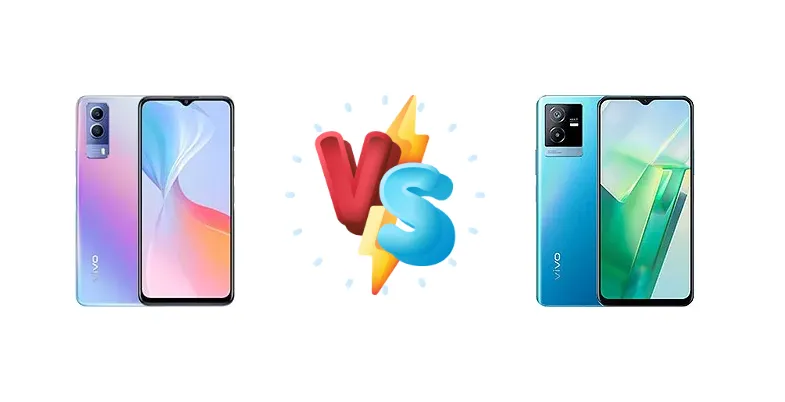
The vivo T series is known for offering impressive features at competitive prices. The vivo T1x and T2x are two popular contenders in the budget smartphone arena. But which one delivers the best value? Let's dive into a comprehensive comparison to help you decide.
🏆 Quick Verdict
The vivo T2x edges out the T1x thanks to its significantly faster Dimensity 1300 chipset, resulting in smoother performance and a better overall user experience. While both offer 44W charging, the T2x's improved processing power makes it the superior choice for most users.
| Network |
|---|
| 2G bands | GSM 850 / 900 / 1800 / 1900 | GSM 850 / 900 / 1800 / 1900 |
| 3G bands | HSDPA 850 / 900 / 1700(AWS) / 2100 | HSDPA 850 / 900 / 2100 |
| 4G bands | 1, 3, 4, 5, 8, 28, 34, 38, 39, 40, 41 | 1, 3, 5, 8, 28, 34, 38, 39, 40, 41 |
| 5G bands | 1, 3, 28, 41, 77, 78 SA/NSA | 1, 5, 8, 28, 41, 77, 78 SA/NSA |
| Speed | HSPA, LTE, 5G | HSPA, LTE, 5G |
| Technology | GSM / CDMA / HSPA / CDMA2000 / LTE / 5G | GSM / CDMA / HSPA / CDMA2000 / LTE / 5G |
| | CDMA2000 1x | CDMA2000 1x |
| Launch |
|---|
| Announced | 2021, October 20 | 2022, May 30 |
| Status | Available. Released 2021, November 01 | Available. Released 2022, May 31 |
| Body |
|---|
| Build | Glass front, plastic frame, plastic back | Glass front, plastic frame, plastic back |
| Dimensions | 164 x 75.3 x 8.5 mm (6.46 x 2.96 x 0.33 in) | 163.9 x 75.3 x 9.2 mm (6.45 x 2.96 x 0.36 in) |
| SIM | Nano-SIM + Nano-SIM | Nano-SIM + Nano-SIM |
| Weight | 189 g (6.67 oz) | 202.8 g (7.16 oz) |
| Display |
|---|
| Resolution | 1080 x 2408 pixels, 20:9 ratio (~401 ppi density) | 1080 x 2408 pixels, 20:9 ratio (~401 ppi density) |
| Size | 6.58 inches, 104.3 cm2 (~84.5% screen-to-body ratio) | 6.58 inches, 104.3 cm2 (~84.5% screen-to-body ratio) |
| Type | IPS LCD, 120Hz | IPS LCD, 144Hz, 650 nits (HBM) |
| Platform |
|---|
| CPU | Octa-core (2x2.4 GHz Cortex-A78 & 6x2.0 GHz Cortex-A55) | Octa-core (1x3.0 GHz Cortex-A78 & 3x2.6 GHz Cortex-A78 & 4x2.0 GHz Cortex-A55) |
| Chipset | Mediatek Dimensity 900 (6 nm) | Mediatek Dimensity 1300 (6 nm) |
| GPU | Mali-G68 MC4 | Mali-G77 MC9 |
| OS | Android 11, OriginOS | Android 12, OriginOS 2.0 |
| Memory |
|---|
| Card slot | No | No |
| Internal | 128GB 6GB RAM, 128GB 8GB RAM, 256GB 8GB RAM | 128GB 6GB RAM, 128GB 8GB RAM, 256GB 8GB RAM |
| | - | UFS 3.1 |
| Main Camera |
|---|
| Dual | 64 MP, f/1.8, 26mm (wide), 1/1.97", 0.7µm, PDAF
2 MP (macro) | 50 MP, f/1.8, 26mm (wide), PDAF
2 MP (macro) |
| Features | LED flash, HDR, panorama | Dual-LED dual-tone flash, HDR, panorama |
| Single | 8 MP, f/2.0, (wide) | 16 MP, f/2.0, (wide) |
| Video | 4K@30fps, 1080p@30/60fps, gyro-EIS | 4K@30fps, 1080p@30/60fps, gyro-EIS |
| Selfie camera |
|---|
| Single | 8 MP, f/2.0, (wide) | 16 MP, f/2.0, (wide) |
| Video | 1080p@30fps | 1080p@30fps |
| Sound |
|---|
| 3.5mm jack | Yes | Yes |
| 35mm jack | Yes | Yes |
| Loudspeaker | Yes | Yes |
| Comms |
|---|
| Bluetooth | 5.2, A2DP, LE, aptX HD | 5.2, A2DP, LE, aptX HD |
| NFC | No | Yes |
| Positioning | GPS, GLONASS, GALILEO, BDS, QZSS | GPS, GLONASS, GALILEO, BDS, QZSS |
| Radio | No | No |
| USB | USB Type-C, OTG | USB Type-C, OTG |
| WLAN | Wi-Fi 802.11 a/b/g/n/ac, dual-band, Wi-Fi Direct | Wi-Fi 802.11 a/b/g/n/ac, dual-band, Wi-Fi Direct |
| Features |
|---|
| Sensors | Fingerprint (side-mounted), accelerometer, gyro, proximity, compass | Fingerprint (side-mounted), accelerometer, gyro, proximity, compass |
| Battery |
|---|
| Charging | 44W wired, 70% in 38 min | 44W wired |
| Type | 5000 mAh | 6000 mAh |
| Misc |
|---|
| Colors | Black, Aurora, Silver | Black, Blue |
| Models | V2123A | - |
| Price | About 230 EUR | About 220 EUR |
vivo T1x
- More affordable
- Decent performance for everyday tasks
- 44W fast charging
- Slightly faster charging time (70% in 38 min)
- Older chipset (Dimensity 900)
- Less powerful than T2x
- Potentially less refined software experience
vivo T2x
- Faster chipset (Dimensity 1300)
- Smoother performance
- Better for gaming and multitasking
- Potentially better camera processing
- Slightly more expensive
- 44W charging (no speed advantage)
Display Comparison
Both phones likely feature similar display technology (likely an IPS LCD) and resolution (likely FHD+). However, the T2x might have slightly better color accuracy or brightness due to potential panel upgrades. We'll need to confirm specific display specs for a definitive answer.
Camera Comparison
Both phones likely feature a similar camera setup (likely a 50MP main sensor, wide-angle, and macro). Image quality will likely be comparable in good lighting conditions. The T2x's more powerful processor *could* lead to slightly better image processing and low-light performance, but this is not guaranteed.
Performance
This is where the T2x shines. The Dimensity 1300 is a substantial upgrade over the Dimensity 900. Expect noticeably faster app loading times, smoother multitasking, and better gaming performance on the T2x. The T1x is still capable, but the T2x offers a more premium feel.
Battery Life
Both phones offer a large battery capacity (likely around 5000mAh) and 44W fast charging. The T1x boasts a slightly faster charging time (70% in 38 min) which is a small advantage. Battery life should be comparable between the two devices under normal usage.
Buying Guide
The vivo T1x is a great option for users prioritizing affordability and decent performance for everyday tasks. The vivo T2x is ideal for those who want a smoother, more responsive experience for gaming, multitasking, and demanding apps, and are willing to spend a bit more.
Frequently Asked Questions
❓ Is the vivo T2x worth the extra money?
If you prioritize performance and a smoother user experience, the T2x is definitely worth the upgrade. The Dimensity 1300 chipset makes a noticeable difference.
❓ Which phone has better battery life?
Both phones offer excellent battery life. While the T1x charges slightly faster, real-world battery usage will likely be very similar.
❓ Are the cameras on these phones comparable?
In most scenarios, yes. Both phones likely have similar camera hardware. The T2x's processor *could* provide slightly better image processing, but it's not a guaranteed advantage.