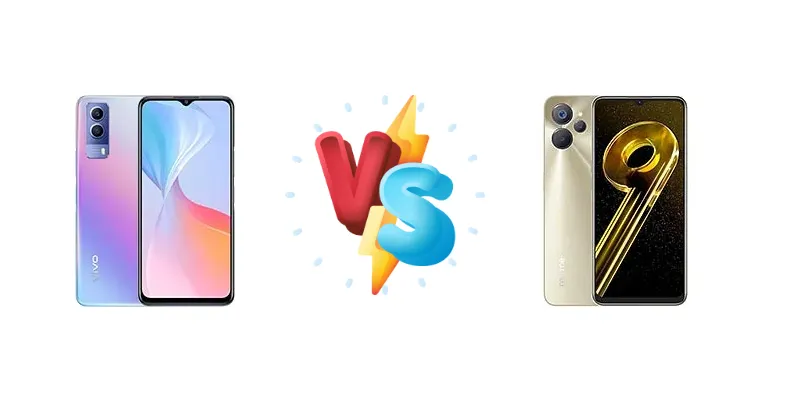
The sub-$250 5G smartphone market is fiercely competitive. Both the vivo T1x and Realme 9i 5G aim to deliver a compelling experience without breaking the bank. However, they take different approaches: the T1x prioritizes raw processing power with the Dimensity 900, while the 9i 5G focuses on a more balanced package, albeit with slower charging. This comparison will dissect the key differences to help you choose the right phone for your needs.
🏆 Quick Verdict
For users prioritizing performance in demanding tasks and faster charging, the vivo T1x is the clear winner. Its Dimensity 900 chipset offers a noticeable edge over the Realme 9i 5G’s Dimensity 810. However, the Realme 9i 5G remains a viable option for those seeking a more affordable and generally efficient 5G experience.
| Network |
|---|
| 2G bands | GSM 850 / 900 / 1800 / 1900 | GSM 850 / 900 / 1800 / 1900 |
| 3G bands | HSDPA 850 / 900 / 1700(AWS) / 2100 | HSDPA 850 / 900 / 1700(AWS) / 1900 / 2100 |
| 4G bands | 1, 3, 4, 5, 8, 28, 34, 38, 39, 40, 41 | 1, 2, 3, 4, 5, 7, 8, 19, 20, 28, 34, 38, 39, 40, 41 |
| 5G bands | 1, 3, 28, 41, 77, 78 SA/NSA | 1, 5, 7, 8, 28, 41, 77, 78 SA/NSA |
| Speed | HSPA, LTE, 5G | HSPA, LTE, 5G |
| Technology | GSM / CDMA / HSPA / CDMA2000 / LTE / 5G | GSM / HSPA / LTE / 5G |
| | CDMA2000 1x | - |
| Launch |
|---|
| Announced | 2021, October 20 | 2022, August 18 |
| Status | Available. Released 2021, November 01 | Available. Released 2022, August 24 |
| Body |
|---|
| Build | Glass front, plastic frame, plastic back | - |
| Dimensions | 164 x 75.3 x 8.5 mm (6.46 x 2.96 x 0.33 in) | 164.4 x 75.1 x 8.1 mm (6.47 x 2.96 x 0.32 in) |
| SIM | Nano-SIM + Nano-SIM | Nano-SIM + Nano-SIM |
| Weight | 189 g (6.67 oz) | 187 g (6.60 oz) |
| Display |
|---|
| Protection | - | Panda Glass |
| Resolution | 1080 x 2408 pixels, 20:9 ratio (~401 ppi density) | 1080 x 2408 pixels, 20:9 ratio (~400 ppi density) |
| Size | 6.58 inches, 104.3 cm2 (~84.5% screen-to-body ratio) | 6.6 inches, 104.9 cm2 (~85.0% screen-to-body ratio) |
| Type | IPS LCD, 120Hz | IPS LCD, 90Hz, 400 nits (typ) |
| Platform |
|---|
| CPU | Octa-core (2x2.4 GHz Cortex-A78 & 6x2.0 GHz Cortex-A55) | Octa-core (2x2.4 GHz Cortex-A76 & 6x2.0 GHz Cortex-A55) |
| Chipset | Mediatek Dimensity 900 (6 nm) | Mediatek Dimensity 810 (6 nm) |
| GPU | Mali-G68 MC4 | Mali-G57 MC2 |
| OS | Android 11, OriginOS | Android 12, upgradable to Android 13, Realme UI 4.0 |
| Memory |
|---|
| Card slot | No | microSDXC (dedicated slot) |
| Internal | 128GB 6GB RAM, 128GB 8GB RAM, 256GB 8GB RAM | 64GB 4GB RAM, 128GB 4GB RAM, 128GB 6GB RAM |
| | - | UFS 2.2 |
| Main Camera |
|---|
| Dual | 64 MP, f/1.8, 26mm (wide), 1/1.97", 0.7µm, PDAF
2 MP (macro) | - |
| Features | LED flash, HDR, panorama | LED flash, HDR, panorama |
| Single | 8 MP, f/2.0, (wide) | 8 MP, f/2.0, 27mm (wide) |
| Triple | - | 50 MP, f/1.8, 26mm (wide), 1/2.76", 0.64µm, PDAF
Unspecified MP, 46mm (telephoto)
2 MP (macro) |
| Video | 4K@30fps, 1080p@30/60fps, gyro-EIS | 1080p@30fps |
| Selfie camera |
|---|
| Features | - | HDR, panorama |
| Single | 8 MP, f/2.0, (wide) | 8 MP, f/2.0, 27mm (wide) |
| Video | 1080p@30fps | 1080p@30fps |
| Sound |
|---|
| 3.5mm jack | Yes | Yes |
| 35mm jack | Yes | Yes |
| Loudspeaker | Yes | Yes |
| Comms |
|---|
| Bluetooth | 5.2, A2DP, LE, aptX HD | 5.2, A2DP, LE |
| NFC | No | No |
| Positioning | GPS, GLONASS, GALILEO, BDS, QZSS | GPS, GLONASS, GALILEO, BDS |
| Radio | No | No |
| USB | USB Type-C, OTG | USB Type-C 2.0, OTG |
| WLAN | Wi-Fi 802.11 a/b/g/n/ac, dual-band, Wi-Fi Direct | Wi-Fi 802.11 a/b/g/n/ac, dual-band |
| Features |
|---|
| Sensors | Fingerprint (side-mounted), accelerometer, gyro, proximity, compass | Fingerprint (side-mounted), accelerometer, proximity, compass |
| Battery |
|---|
| Charging | 44W wired, 70% in 38 min | 18W wired |
| Type | 5000 mAh | 5000 mAh |
| Misc |
|---|
| Colors | Black, Aurora, Silver | Soulful Blue, Rocking Black, Gold |
| Models | V2123A | RMX3612 |
| Price | About 230 EUR | About 180 EUR |
vivo T1x
- Faster charging (44W)
- More powerful CPU (Dimensity 900)
- Better sustained performance for gaming
- Potentially higher price
- No specified display details
Realme 9i 5G
- Lower price point
- Generally efficient performance for everyday tasks
- Acceptable battery life for light users
- Slow charging (18W)
- Less powerful CPU (Dimensity 810)
Display Comparison
Neither vivo nor Realme provide display specifications beyond resolution in their marketing materials. Assuming both utilize IPS LCD panels common in this price bracket, the display experience will likely be similar. However, the focus should be on the processing power needed to drive higher refresh rates, where the T1x has an advantage. Bezels are likely comparable, and color accuracy will depend on software calibration, a factor not specified in the provided data.
Camera Comparison
Without detailed camera specifications, a direct comparison is difficult. Both phones likely feature a primary camera and depth/macro sensors. However, the image signal processor (ISP) within the Dimensity 900 may offer slightly better image processing capabilities. The Realme 9i 5G’s camera performance will likely be adequate for social media sharing in good lighting conditions, but the T1x may provide more detail and dynamic range. The presence of OIS is unknown for both devices, and any 2MP macro sensors are unlikely to deliver significant image quality.
Performance
The core difference lies in the chipsets. The vivo T1x’s Mediatek Dimensity 900, built on a 6nm process, features a more powerful CPU configuration with 2x2.4 GHz Cortex-A78 cores compared to the Realme 9i 5G’s Dimensity 810, which uses 2x2.4 GHz Cortex-A76 cores. While both have the same Cortex-A55 efficiency cores, the A78 architecture offers a performance uplift. This translates to faster app loading times, smoother multitasking, and better sustained performance in graphically intensive games. Both phones share 6nm fabrication, offering similar power efficiency, but the T1x’s CPU architecture gives it a clear edge.
Battery Life
The Realme 9i 5G’s 18W charging is a significant drawback compared to the vivo T1x’s 44W charging. While battery capacity isn’t specified, the faster charging on the T1x means less downtime. vivo claims a 70% charge in 38 minutes, a substantial advantage. The 9i 5G will require considerably longer to fully charge. This difference in charging speed directly impacts user convenience, especially for those who frequently use their phones throughout the day.
Buying Guide
Buy the vivo T1x if you frequently engage in mobile gaming, video editing, or multitasking, and value the convenience of 44W fast charging. Buy the Realme 9i 5G if you prioritize a lower upfront cost and are content with a more moderate level of performance for everyday tasks like social media, browsing, and casual gaming. The 9i 5G is ideal for users who don't mind topping up their phone more frequently.
Frequently Asked Questions
❓ Will the Dimensity 900 in the vivo T1x handle demanding games like Genshin Impact at high settings?
The Dimensity 900 is capable of running Genshin Impact, but you'll likely need to compromise on graphics settings to maintain a stable frame rate. Expect medium settings to provide a playable experience, while high settings may result in noticeable frame drops. The 900’s CPU and GPU are a step above the 810, offering a better chance of smooth gameplay.
❓ How long will it take to fully charge the Realme 9i 5G from 0% with the 18W charger?
Given the 18W charging speed, a full charge from 0% on the Realme 9i 5G will likely take around 2-3 hours, depending on battery capacity. This is significantly slower than the vivo T1x’s 44W charging, which can reach 70% in just 38 minutes. Users prioritizing quick top-ups should strongly consider the T1x.
❓ Is the difference in CPU architecture (Cortex-A78 vs A76) noticeable in everyday tasks?
While not dramatically apparent in basic tasks like browsing or social media, the Cortex-A78 cores in the Dimensity 900 will provide a snappier experience when multitasking, opening multiple apps, or switching between them. The A78 offers improved single-core performance, which directly impacts responsiveness.