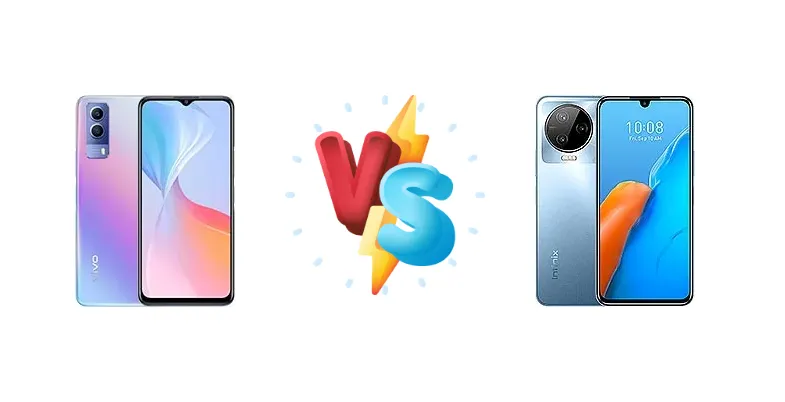
The sub-$200 smartphone market is fiercely competitive. The vivo T1x, powered by the Mediatek Dimensity 900, and the Infinix Note 12 (2023) with its Helio G99 chipset, both aim to deliver a compelling experience without breaking the bank. This comparison dives deep into their specifications to determine which device offers the best balance of performance, features, and value.
🏆 Quick Verdict
For most users, the vivo T1x emerges as the stronger contender. Its Dimensity 900 chipset provides a noticeable performance edge in CPU-intensive tasks and gaming, while the 44W charging significantly reduces downtime. The Infinix Note 12 (2023) remains a viable option for those prioritizing a slightly lower price point.
| Network |
|---|
| 2G bands | GSM 850 / 900 / 1800 / 1900 | GSM 850 / 900 / 1800 / 1900 |
| 3G bands | HSDPA 850 / 900 / 1700(AWS) / 2100 | HSDPA 850 / 900 / 1700(AWS) / 1900 / 2100 |
| 4G bands | 1, 3, 4, 5, 8, 28, 34, 38, 39, 40, 41 | 1, 2, 3, 4, 5, 7, 8, 20, 28, 38, 40, 41 |
| 5G bands | 1, 3, 28, 41, 77, 78 SA/NSA | - |
| Speed | HSPA, LTE, 5G | HSPA, LTE |
| Technology | GSM / CDMA / HSPA / CDMA2000 / LTE / 5G | GSM / HSPA / LTE |
| | CDMA2000 1x | 1, 3, 5, 8, 38, 40, 41 |
| Launch |
|---|
| Announced | 2021, October 20 | 2022, October 06 |
| Status | Available. Released 2021, November 01 | Available. Released 2022, October 06 |
| Body |
|---|
| Build | Glass front, plastic frame, plastic back | Glass front, plastic frame, plastic back |
| Dimensions | 164 x 75.3 x 8.5 mm (6.46 x 2.96 x 0.33 in) | 164.4 x 76.5 x 7.8 mm (6.47 x 3.01 x 0.31 in) |
| SIM | Nano-SIM + Nano-SIM | Nano-SIM + Nano-SIM |
| Weight | 189 g (6.67 oz) | 195 g (6.88 oz) |
| Display |
|---|
| Resolution | 1080 x 2408 pixels, 20:9 ratio (~401 ppi density) | 1080 x 2400 pixels, 20:9 ratio (~393 ppi density) |
| Size | 6.58 inches, 104.3 cm2 (~84.5% screen-to-body ratio) | 6.7 inches, 108.4 cm2 (~86.2% screen-to-body ratio) |
| Type | IPS LCD, 120Hz | AMOLED |
| Platform |
|---|
| CPU | Octa-core (2x2.4 GHz Cortex-A78 & 6x2.0 GHz Cortex-A55) | Octa-core (2x2.2 GHz Cortex-A76 & 6x2.0 GHz Cortex-A55) |
| Chipset | Mediatek Dimensity 900 (6 nm) | Mediatek Helio G99 (6 nm) |
| GPU | Mali-G68 MC4 | Mali-G57 MC2 |
| OS | Android 11, OriginOS | Android 12, XOS 10.6 |
| Memory |
|---|
| Card slot | No | microSDXC (dedicated slot) |
| Internal | 128GB 6GB RAM, 128GB 8GB RAM, 256GB 8GB RAM | 128GB 8GB RAM, 256GB 8GB RAM |
| Main Camera |
|---|
| Dual | 64 MP, f/1.8, 26mm (wide), 1/1.97", 0.7µm, PDAF
2 MP (macro) | - |
| Features | LED flash, HDR, panorama | Quad-LED flash, HDR, panorama |
| Single | 8 MP, f/2.0, (wide) | 16 MP, (wide) |
| Triple | - | 50 MP, f/1.6, (wide), PDAF
Auxiliary lenses |
| Video | 4K@30fps, 1080p@30/60fps, gyro-EIS | 1440p@30fps |
| Selfie camera |
|---|
| Single | 8 MP, f/2.0, (wide) | 16 MP, (wide) |
| Video | 1080p@30fps | 1440p@30fps |
| Sound |
|---|
| 3.5mm jack | Yes | Yes |
| 35mm jack | Yes | Yes |
| Loudspeaker | Yes | Yes, with dual speakers |
| Comms |
|---|
| Bluetooth | 5.2, A2DP, LE, aptX HD | Yes |
| NFC | No | Yes |
| Positioning | GPS, GLONASS, GALILEO, BDS, QZSS | GPS |
| Radio | No | FM radio |
| USB | USB Type-C, OTG | USB Type-C 2.0, OTG |
| WLAN | Wi-Fi 802.11 a/b/g/n/ac, dual-band, Wi-Fi Direct | Wi-Fi 802.11 a/b/g/n/ac, dual-band |
| Features |
|---|
| Sensors | Fingerprint (side-mounted), accelerometer, gyro, proximity, compass | Fingerprint (side-mounted), accelerometer, gyro, proximity, compass |
| | - | 24-bit/192kHz audio |
| Battery |
|---|
| Charging | 44W wired, 70% in 38 min | 33W wired |
| Type | 5000 mAh | 5000 mAh |
| Misc |
|---|
| Colors | Black, Aurora, Silver | Volcanic Grey, Tuscany Blue, Alpine White |
| Models | V2123A | X676C |
| Price | About 230 EUR | About 220 EUR |
vivo T1x
- Faster 44W charging for quicker top-ups.
- More powerful Dimensity 900 chipset for smoother performance.
- Potentially better thermal management due to the 6nm process.
- May be slightly more expensive than the Infinix Note 12 (2023).
- No information on display quality.
Infinix Note 12 (2023)
- Likely more affordable price point.
- Decent performance for everyday tasks.
- Efficient Helio G99 chipset.
- Slower 33W charging.
- Less powerful CPU compared to the Dimensity 900.
- Potentially more throttling under heavy load.
Display Comparison
Neither device boasts a standout display. Both likely utilize LCD panels, common in this price bracket. The focus here shifts to processing power, as display specs are not provided. Bezels are likely comparable, and color accuracy will be typical for budget phones – adequate but not color-critical. The absence of high refresh rates on either device suggests a focus on power efficiency rather than visual fluidity.
Camera Comparison
Without detailed camera specifications, a direct comparison is difficult. However, it’s safe to assume both phones feature a multi-camera setup with a primary sensor and supporting lenses. The quality will largely depend on the primary sensor’s resolution and aperture. Given the price point, image processing will likely prioritize computational photography to enhance image quality, but don't expect flagship-level results. The presence of a 2MP macro lens on either device is largely a marketing tactic, offering limited practical benefit.
Performance
The core difference lies in the chipsets. The vivo T1x’s Mediatek Dimensity 900, built on a 6nm process, features a more powerful CPU configuration with 2x2.4 GHz Cortex-A78 cores compared to the Infinix Note 12 (2023)’s Helio G99’s 2x2.2 GHz Cortex-A76 cores. While both use Cortex-A55 efficiency cores at 2.0 GHz, the A78 architecture in the Dimensity 900 offers superior single-core performance. This translates to snappier app launches and a more responsive user experience. The 6nm process node also contributes to better thermal efficiency, potentially reducing throttling during sustained workloads. The Helio G99 is still a capable chip, but the Dimensity 900 holds a clear advantage for demanding tasks.
Battery Life
The Infinix Note 12 (2023) lags behind in charging speed with 33W wired charging, while the vivo T1x supports 44W. This 11W difference translates to a significantly faster charging experience for the T1x – vivo claims 70% charge in 38 minutes. While battery capacity isn’t specified, the faster charging of the T1x mitigates any potential disadvantage from a slightly smaller battery. Users who frequently top up their phones will greatly benefit from the T1x’s faster charging capabilities.
Buying Guide
Buy the vivo T1x if you prioritize smoother multitasking, more demanding gaming, and faster charging speeds. This phone is ideal for users who frequently switch between apps or enjoy mobile games. Buy the Infinix Note 12 (2023) if you are on a very tight budget and primarily need a phone for basic communication, social media, and light web browsing. It's a good choice for users who don't heavily stress their phone's processor.
Frequently Asked Questions
❓ Will the Helio G99 in the Infinix Note 12 (2023) struggle with graphically intensive games like PUBG Mobile?
While the Helio G99 can run PUBG Mobile, you'll likely need to lower the graphics settings to achieve a consistently smooth frame rate. The Dimensity 900 in the vivo T1x offers a more comfortable gaming experience with higher settings and less frame rate fluctuation.
❓ How much faster is the 44W charging on the vivo T1x compared to the 33W charging on the Infinix Note 12 (2023) in real-world use?
Vivo claims 70% charge in 38 minutes with the 44W charger. The Infinix Note 12 (2023)'s 33W charging will take considerably longer to reach the same charge level, potentially exceeding 1 hour and 15 minutes. This difference is significant for users who need to quickly top up their battery.
❓ Is the difference in CPU performance between the Dimensity 900 and Helio G99 noticeable for everyday tasks like browsing and social media?
For basic tasks, the difference might not be immediately apparent. However, the Dimensity 900's superior CPU architecture will result in snappier app launches, smoother scrolling, and a more responsive overall experience, especially when multitasking.