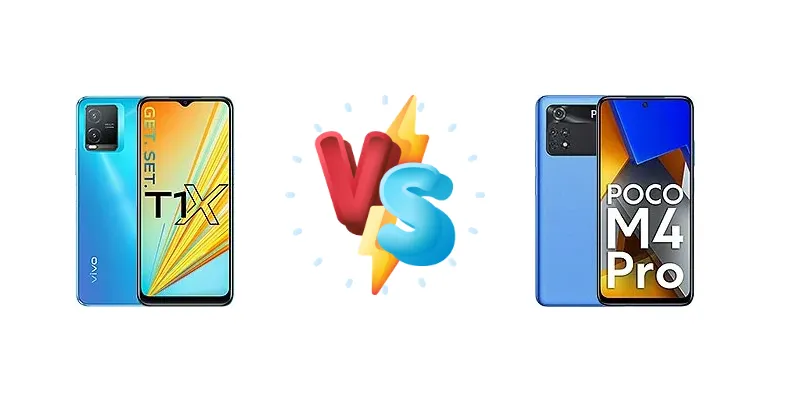
The budget smartphone market is fiercely competitive, and the vivo T1x and Xiaomi Poco M4 Pro are two strong contenders. Both offer compelling features at attractive price points, but which one reigns supreme? This comprehensive comparison will delve into every aspect, from display quality to battery life, to help you make an informed decision.
🏆 Quick Verdict
The Poco M4 Pro edges out the vivo T1x thanks to its faster charging, brighter display, and slightly more powerful chipset. While the T1x offers a competitive price, the M4 Pro's overall package provides a better user experience for most.
| Network |
|---|
| 2G bands | GSM 850 / 900 / 1800 / 1900 | GSM 850 / 900 / 1800 / 1900 |
| 3G bands | HSDPA 850 / 900 / 2100 | HSDPA 850 / 900 / 1700(AWS) / 1900 / 2100 - International |
| 4G bands | 1, 3, 5, 8, 38, 40, 41 | 1, 2, 3, 4, 5, 7, 8, 20, 28, 38, 40, 41 - International |
| Speed | HSPA, LTE | HSPA, LTE |
| Technology | GSM / HSPA / LTE | GSM / HSPA / LTE |
| | - | 1, 3, 5, 8, 40, 41 - India |
| Launch |
|---|
| Announced | 2022, July 20 | 2022, February 28 |
| Status | Available. Released 2022, July 27 | Available. Released 2022, March 16 |
| Body |
|---|
| Build | Glass front, plastic frame, plastic back | Glass front (Gorilla Glass 3), plastic frame, plastic back |
| Dimensions | 164.3 x 76.1 x 8 mm (6.47 x 3.00 x 0.31 in) | 159.9 x 73.9 x 8.1 mm (6.30 x 2.91 x 0.32 in) |
| SIM | Nano-SIM + Nano-SIM | Nano-SIM + Nano-SIM |
| Weight | 182 g (6.42 oz) | 179.5 g (6.31 oz) |
| | - | IP53, dust and splash resistant |
| Display |
|---|
| Protection | - | Corning Gorilla Glass 3 |
| Resolution | 1080 x 2408 pixels, 20:9 ratio (~401 ppi density) | 1080 x 2400 pixels, 20:9 ratio (~409 ppi density) |
| Size | 6.58 inches, 104.3 cm2 (~83.4% screen-to-body ratio) | 6.43 inches, 99.8 cm2 (~84.5% screen-to-body ratio) |
| Type | IPS LCD, 90Hz | AMOLED, 90Hz, 700 nits, 1000 nits (peak) |
| Platform |
|---|
| CPU | Octa-core (4x2.4 GHz Kryo 265 Gold & 4x1.9 GHz Kryo 265 Silver) | Octa-core (2x2.05 GHz Cortex-A76 & 6x2.0 GHz Cortex-A55) |
| Chipset | Qualcomm SM6225 Snapdragon 680 4G (6 nm) | Mediatek MT6781 Helio G96 (12 nm) |
| GPU | Adreno 610 | Mali-G57 MC2 |
| OS | Android, Funtouch 12 | Android 11, MIUI 13 for POCO |
| Memory |
|---|
| Card slot | microSDXC (dedicated slot) | microSDXC (dedicated slot) |
| Internal | 64GB 4GB RAM, 128GB 4GB RAM, 128GB 6GB RAM | 64GB 6GB RAM, 128GB 6GB RAM, 128GB 8GB RAM, 256GB 8GB RAM |
| | UFS 2.2 | UFS 2.2 |
| Main Camera |
|---|
| Dual | 50 MP, f/1.8, (wide), PDAF
Auxiliary lens | - |
| Features | LED flash, HDR | LED flash, HDR, panorama |
| Single | 8 MP, f/1.8, (wide) | 16 MP, f/2.5, (wide), 1/3.06" 1.0µm |
| Triple | - | 64 MP, f/1.8, 26mm (wide), 0.7µm, PDAF
8 MP, f/2.2, 118˚ (ultrawide), 1/4.0", 1.12µm
2 MP (macro) |
| Video | 1080p@30fps | 1080p@30fps |
| Selfie camera |
|---|
| Features | - | HDR |
| Single | 8 MP, f/1.8, (wide) | 16 MP, f/2.5, (wide), 1/3.06" 1.0µm |
| Video | 1080p@30fps | 1080p@30fps |
| Sound |
|---|
| 3.5mm jack | Yes | Yes |
| 35mm jack | Yes | Yes |
| Loudspeaker | Yes | Yes, with stereo speakers |
| | - | 24-bit/192kHz audio |
| Comms |
|---|
| Bluetooth | 5.0, A2DP, LE | 5.0, A2DP, LE |
| Infrared port | - | Yes |
| NFC | No | Yes |
| Positioning | GPS, GLONASS, GALILEO, BDS, QZSS | GPS, GLONASS, BDS, GALILEO |
| Radio | FM radio | FM radio, recording |
| USB | USB Type-C, OTG | USB Type-C 2.0, OTG |
| WLAN | Wi-Fi 802.11 a/b/g/n/ac, dual-band, Wi-Fi Direct, hotspot | Wi-Fi 802.11 a/b/g/n/ac, dual-band, Wi-Fi Direct |
| Features |
|---|
| Sensors | Fingerprint (side-mounted), accelerometer, proximity, compass | Fingerprint (side-mounted), accelerometer, gyro, compass |
| | - | Virtual proximity sensing |
| Battery |
|---|
| Charging | 18W wired | 33W wired, PD3.0, QC3, 100% in 58 min |
| Type | 5000 mAh | Li-Po 5000 mAh |
| Misc |
|---|
| Colors | Gravity Black, Space Blue | Power Black, Cool Blue, Poco Yellow |
| Models | V2143 | MZB0B5VIN, 2201117PI, 2201117PG |
| Price | About 150 EUR | € 100.18 |
| SAR | - | 0.85 W/kg (head) 0.85 W/kg (body) |
| SAR EU | - | 0.59 W/kg (head) 0.84 W/kg (body) |
| Tests |
|---|
| Battery life | - |
Endurance rating 126h
|
| Camera | - |
Photo / Video |
| Display | - |
Contrast ratio: Infinite (nominal) |
| Loudspeaker | - |
-25.2 LUFS (Very good)
|
| Performance | - |
AnTuTu: 318444 (v9)
GeekBench: 1836 (v5.1)
GFXBench: 12fps (ES 3.1 onscreen) |
vivo T1x (India)
- Very affordable
- Efficient processor (Snapdragon 680)
- Decent battery life
- Slower charging (18W)
- Likely lower display brightness
- Less powerful chipset than Poco M4 Pro
Xiaomi Poco M4 Pro
- Faster charging (33W)
- Brighter display
- More powerful chipset (Helio G96)
- Good battery life
- Slightly more expensive
- Older 12nm process (though performance is still good)
Display Comparison
The Poco M4 Pro boasts a significantly brighter display (737 nits vs. T1x's likely lower brightness, estimated around 450-500 nits based on similar vivo models). While both offer decent color reproduction, the M4 Pro's higher brightness makes it more usable outdoors. The 'Infinite' contrast ratio claim on the M4 Pro suggests excellent blacks and vibrant colors, though this is a nominal value.
Camera Comparison
Both phones offer capable camera systems for their price range. The Poco M4 Pro likely has a slight edge in image quality, particularly in well-lit conditions, due to its potentially better image processing and sensor size. Low-light performance is likely comparable. Video recording capabilities are similar on both devices.
Performance
The Poco M4 Pro's Helio G96 chipset, while on a slightly older 12nm process, generally outperforms the Snapdragon 680 in real-world usage. The G96's Cortex-A76 cores provide a boost for demanding tasks. The T1x's 6nm Snapdragon 680 is efficient, but lacks the raw power of the M4 Pro. Gaming performance will be noticeably better on the Poco M4 Pro.
Battery Life
Both phones offer excellent battery life, with an endurance rating of 126h. However, the Poco M4 Pro's 33W fast charging is a significant advantage over the T1x's 18W charging. The M4 Pro can be fully charged in approximately 58 minutes, while the T1x will take considerably longer.
Buying Guide
Who should buy the vivo T1x (India)? Users prioritizing a very budget-friendly option and are less concerned with fast charging or peak display brightness. Who should buy the Xiaomi Poco M4 Pro? Those seeking a well-rounded experience with faster charging, a brighter screen, and a slightly more capable processor, even if it means spending a bit more.
Frequently Asked Questions
❓ Which phone is better for gaming?
The Xiaomi Poco M4 Pro is the better choice for gaming due to its more powerful Helio G96 chipset.
❓ How long does it take to fully charge each phone?
The Poco M4 Pro takes approximately 58 minutes with its 33W charger, while the vivo T1x takes significantly longer with its 18W charger.
❓ Is the vivo T1x a good value for money?
Yes, the vivo T1x offers excellent value if you're on a tight budget and don't need the fastest charging or the brightest display.