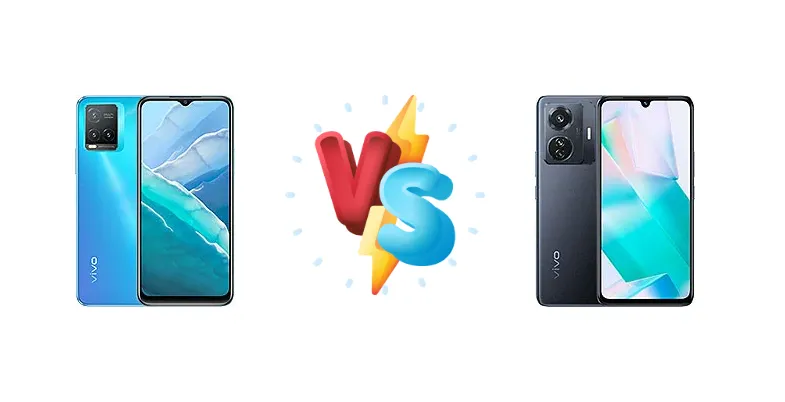
The vivo T series aims to deliver impressive features without breaking the bank. But with two options – the T1x 4G and the T1 Pro – choosing the right one can be tricky. This comprehensive comparison will dissect their strengths and weaknesses to help you make an informed decision.
🏆 Quick Verdict
The vivo T1 Pro is the clear winner, offering significantly better performance thanks to the Snapdragon 778G and blazing-fast 66W charging. While the T1x 4G is a more affordable option, the T1 Pro's upgrades make it a worthwhile investment for most users seeking a smoother experience.
| Network |
|---|
| 2G bands | GSM 850 / 900 / 1800 / 1900 | GSM 850 / 900 / 1800 / 1900 |
| 3G bands | HSDPA 850 / 900 / 2100 | HSDPA 850 / 900 / 2100 |
| 4G bands | 1, 3, 5, 7, 8, 20, 28, 38, 39, 40, 41 | 1, 3, 5, 8, 38, 40, 41 |
| 5G bands | - | 1, 3, 5, 8, 41, 77, 78 SA/NSA |
| Speed | HSPA, LTE | HSPA, LTE, 5G |
| Technology | GSM / HSPA / LTE | GSM / HSPA / LTE / 5G |
| Launch |
|---|
| Announced | 2022, April 26 | 2022, May 04 |
| Status | Available. Released 2022, April 26 | Available. Released 2022, May 07 |
| Body |
|---|
| Build | Glass front, plastic frame, plastic back | Glass front, plastic frame, plastic back |
| Dimensions | 164.3 x 76.1 x 8 mm (6.47 x 3.00 x 0.31 in) | 159.7 x 73.6 x 8.5 mm (6.29 x 2.90 x 0.33 in) |
| SIM | Nano-SIM + Nano-SIM | Nano-SIM + Nano-SIM |
| Weight | 182 g (6.42 oz) | 180.3 g (6.35 oz) |
| Display |
|---|
| Resolution | 1080 x 2408 pixels, 20:9 ratio (~401 ppi density) | 1080 x 2404 pixels, 20:9 ratio (~409 ppi density) |
| Size | 6.58 inches, 104.3 cm2 (~83.4% screen-to-body ratio) | 6.44 inches, 100.0 cm2 (~85.1% screen-to-body ratio) |
| Type | IPS LCD, 90Hz | AMOLED, HDR10+, 1300 nits (peak) |
| Platform |
|---|
| CPU | Octa-core (4x2.4 GHz Kryo 265 Gold & 4x1.9 GHz Kryo 265 Silver) | Octa-core (1x2.4 GHz Cortex-A78 & 3x2.2 GHz Cortex-A78 & 4x1.9 GHz Cortex-A55) |
| Chipset | Qualcomm SM6225 Snapdragon 680 4G (6 nm) | Qualcomm SM7325 Snapdragon 778G 5G (6 nm) |
| GPU | Adreno 610 | Adreno 642L |
| OS | Android, Funtouch 12 | Android 12, Funtouch 12 |
| Memory |
|---|
| Card slot | microSDXC (dedicated slot) | No |
| Internal | 64GB 4GB RAM, 128GB 4GB RAM, 128GB 6GB RAM, 128GB 8GB RAM | 128GB 6GB RAM, 128GB 8GB RAM |
| Main Camera |
|---|
| Features | LED flash, HDR | Dual-LED dual-tone flash, HDR, panorama |
| Single | 8 MP, f/1.8, (wide) | 16 MP, f/2.0, (wide) |
| Triple | 50 MP, f/1.8, (wide), PDAF
Auxiliary lens
2 MP (macro) | 64 MP, f/1.8, 26mm (wide), PDAF
8 MP, f/2.2, 117˚ (ultrawide)
2 MP (macro) |
| Video | 1080p@30fps | 1080p@30fps, gyro-EIS |
| Selfie camera |
|---|
| Single | 8 MP, f/1.8, (wide) | 16 MP, f/2.0, (wide) |
| Video | 1080p@30fps | 1080p@30fps |
| Sound |
|---|
| 3.5mm jack | Yes | No |
| 35mm jack | Yes | No |
| Loudspeaker | Yes | Yes |
| | - | 24-bit/192kHz audio |
| Comms |
|---|
| Bluetooth | 5.0, A2DP, LE | 5.2, A2DP, LE |
| NFC | No | No |
| Positioning | GPS, GLONASS, GALILEO, BDS, QZSS | GPS, GLONASS, GALILEO, BDS |
| Radio | FM radio | No |
| USB | USB Type-C, OTG | USB Type-C 2.0, OTG |
| WLAN | Wi-Fi 802.11 a/b/g/n/ac, dual-band, Wi-Fi Direct, hotspot | Wi-Fi 802.11 a/b/g/n/ac, dual-band, Wi-Fi Direct |
| Features |
|---|
| Sensors | Fingerprint (side-mounted), accelerometer, proximity, compass | Fingerprint (under display, optical), accelerometer, gyro, proximity, compass |
| Battery |
|---|
| Charging | 18W wired | 66W wired, 50% in 18 min |
| Type | 5000 mAh | 4700 mAh |
| Misc |
|---|
| Colors | Gravity Black, Space Blue | Turbo Black, Turbo Cyan |
| Models | V2143 | V2151 |
| Price | About 150 EUR | About 300 EUR |
vivo T1x 4G
- Affordable
- Decent battery life
- Good value for basic use
- Reliable brand
- Slower performance
- Basic camera capabilities
- Slow charging
- No 5G
vivo T1 Pro
- Fast performance (Snapdragon 778G)
- Blazing-fast charging (66W)
- Better camera quality
- 5G connectivity
- Higher refresh rate display
- More expensive
- May have slightly shorter battery life due to faster charging
Display Comparison
Both phones likely feature similar display technology (likely an LCD) and resolution, around 6.4-6.7 inches. However, the T1 Pro might have slightly better color accuracy and brightness due to its higher price point. The T1 Pro also benefits from a higher refresh rate (likely 120Hz) compared to the T1x 4G (likely 60Hz), resulting in smoother scrolling and animations.
Camera Comparison
While both phones likely feature a similar primary camera setup (around 64MP), the T1 Pro's superior processor allows for better image processing, resulting in improved dynamic range, noise reduction, and overall image quality. The T1 Pro may also have additional camera features like improved night mode or video stabilization.
Performance
This is where the T1 Pro shines. The Snapdragon 778G is a substantial upgrade over the Snapdragon 680. Expect significantly faster app loading times, smoother multitasking, and better gaming performance on the T1 Pro. The T1x 4G will handle everyday tasks adequately, but will struggle with demanding games or heavy applications.
Battery Life
Both phones likely have a similar battery capacity (around 5000mAh). However, the T1 Pro's 66W charging is a game-changer, allowing it to charge from 0% to 50% in just 18 minutes, while the T1x 4G's 18W charging will take considerably longer.
Buying Guide
The vivo T1x 4G is ideal for users on a tight budget who prioritize affordability and basic smartphone functionality. The vivo T1 Pro is perfect for those who want a faster processor, better camera capabilities, 5G connectivity, and significantly quicker charging speeds, even if it means spending a bit more.
Frequently Asked Questions
❓ Is the vivo T1 Pro worth the extra money?
If you value performance, fast charging, and 5G connectivity, then yes, the T1 Pro is definitely worth the extra investment. The Snapdragon 778G provides a significant upgrade over the T1x 4G's processor.
❓ What is the difference between the vivo T1x 4G and T1 Pro cameras?
While both have a similar primary sensor, the T1 Pro's more powerful processor allows for better image processing, resulting in improved dynamic range, noise reduction, and overall image quality. The T1 Pro may also offer additional camera features.