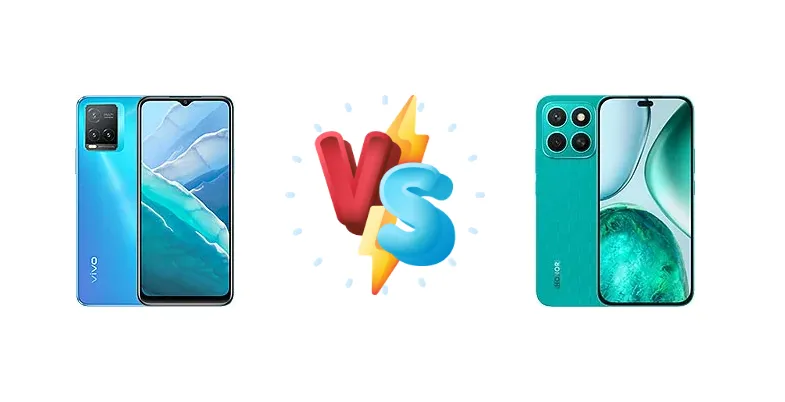
The sub-$200 smartphone market is fiercely competitive. Both the vivo T1x 4G and the Honor X8c aim to deliver a solid experience without breaking the bank. While both utilize Qualcomm’s Snapdragon 6-series, subtle differences in chipset and charging capabilities create distinct user experiences. This comparison dissects those differences to help you choose the right device.
🏆 Quick Verdict
For most users, the Honor X8c emerges as the better choice. Its 35W charging significantly reduces downtime, and the slightly more powerful Snapdragon 685 offers a noticeable, albeit modest, performance edge. While the T1x 4G is still a capable device, the X8c’s faster charging is a compelling advantage.
| Network |
|---|
| 2G bands | GSM 850 / 900 / 1800 / 1900 | GSM 850 / 900 / 1800 / 1900 |
| 3G bands | HSDPA 850 / 900 / 2100 | HSDPA 850 / 900 / 1900 / 2100 |
| 4G bands | 1, 3, 5, 7, 8, 20, 28, 38, 39, 40, 41 | LTE |
| Speed | HSPA, LTE | HSPA, LTE |
| Technology | GSM / HSPA / LTE | GSM / HSPA / LTE |
| Launch |
|---|
| Announced | 2022, April 26 | 2025, January 14 |
| Status | Available. Released 2022, April 26 | Available. Released 2025, January 20 |
| Body |
|---|
| Build | Glass front, plastic frame, plastic back | Glass front, plastic frame, plastic back or silicone polymer back (eco leather) |
| Dimensions | 164.3 x 76.1 x 8 mm (6.47 x 3.00 x 0.31 in) | 161.1 x 74.6 x 7.1 mm (6.34 x 2.94 x 0.28 in) |
| SIM | Nano-SIM + Nano-SIM | Nano-SIM + Nano-SIM |
| Weight | 182 g (6.42 oz) | 174 g (6.14 oz) |
| Display |
|---|
| Resolution | 1080 x 2408 pixels, 20:9 ratio (~401 ppi density) | 1080 x 2412 pixels, 20:9 ratio (~394 ppi density) |
| Size | 6.58 inches, 104.3 cm2 (~83.4% screen-to-body ratio) | 6.7 inches, 108.0 cm2 (~89.9% screen-to-body ratio) |
| Type | IPS LCD, 90Hz | AMOLED, 120Hz, 1200 nits (HBM), 2800 nits (peak) |
| Platform |
|---|
| CPU | Octa-core (4x2.4 GHz Kryo 265 Gold & 4x1.9 GHz Kryo 265 Silver) | Octa-core (4x2.8 GHz Cortex-A73 & 4x1.9 GHz Cortex-A53) |
| Chipset | Qualcomm SM6225 Snapdragon 680 4G (6 nm) | Qualcomm SM6225 Snapdragon 685 (6 nm) |
| GPU | Adreno 610 | Adreno 610 |
| OS | Android, Funtouch 12 | Android 15, MagicOS 9 |
| Memory |
|---|
| Card slot | microSDXC (dedicated slot) | No |
| Internal | 64GB 4GB RAM, 128GB 4GB RAM, 128GB 6GB RAM, 128GB 8GB RAM | 128GB 6GB RAM, 128GB 8GB RAM, 256GB 8GB RAM, 512GB 8GB RAM |
| Main Camera |
|---|
| Dual | - | 108 MP, f/1.8, 24mm (wide), 1/1.67", PDAF, OIS
5 MP, f/2.2, (ultrawide) |
| Features | LED flash, HDR | LED flash, HDR, panorama |
| Single | 8 MP, f/1.8, (wide) | - |
| Triple | 50 MP, f/1.8, (wide), PDAF
Auxiliary lens
2 MP (macro) | - |
| Video | 1080p@30fps | 1080p@30fps, gyro-EIS |
| Selfie camera |
|---|
| Single | 8 MP, f/1.8, (wide) | 50 MP, f/2.1, (wide) |
| Video | 1080p@30fps | 1080p@30fps |
| Sound |
|---|
| 3.5mm jack | Yes | - |
| 35mm jack | Yes | No |
| Loudspeaker | Yes | Yes |
| Comms |
|---|
| Bluetooth | 5.0, A2DP, LE | 5.0/5.1, A2DP, LE |
| NFC | No | Yes (market/region dependent) |
| Positioning | GPS, GLONASS, GALILEO, BDS, QZSS | GPS, GLONASS, GALILEO, BDS |
| Radio | FM radio | No |
| USB | USB Type-C, OTG | USB Type-C 2.0, OTG |
| WLAN | Wi-Fi 802.11 a/b/g/n/ac, dual-band, Wi-Fi Direct, hotspot | Wi-Fi 802.11 a/b/g/n/ac, dual-band, Wi-Fi Direct |
| Features |
|---|
| Sensors | Fingerprint (side-mounted), accelerometer, proximity, compass | Fingerprint (under display, optical), accelerometer, gyro, compass, proximity (ultrasonic) |
| Battery |
|---|
| Charging | 18W wired | 35W wired |
| Type | 5000 mAh | Li-Po 5000 mAh |
| Misc |
|---|
| Colors | Gravity Black, Space Blue | Marrs Green, Midnight Black, Moonlight White, Cloud Purple |
| Models | V2143 | ABR-LX1, ABR-LX2, ABR-LX3 |
| Price | About 150 EUR | € 190.78 / $ 213.42 / £ 159.00 |
vivo T1x 4G
- Potentially more refined software experience (depending on user preference for vivo’s Funtouch OS)
- Established brand presence in some markets
- Good overall efficiency due to the Snapdragon 680
- Slower 18W charging
- Slightly less powerful chipset compared to the Honor X8c
- May lack some of the latest software features
Honor X8c
- Faster 35W wired charging
- More powerful Snapdragon 685 chipset
- Potentially better image processing capabilities
- Honor’s software experience can be polarizing
- May have less brand recognition in certain regions
- Potential for more aggressive battery optimization
Display Comparison
Neither vivo nor Honor provide detailed display specifications beyond the basic panel type. Assuming both utilize IPS LCDs, the display experience will likely be similar in terms of color accuracy and viewing angles. The absence of high refresh rates is standard at this price point. The real difference will come down to panel calibration, which is difficult to assess without direct testing. Bezels are expected to be comparable, focusing on maximizing screen real estate within the budget constraints.
Camera Comparison
Without detailed sensor information, a direct camera comparison is challenging. However, both phones likely employ a primary sensor paired with depth and macro lenses. The usefulness of the 2MP macro lens on both devices is questionable, offering limited detail. Image processing will be a key factor, and Honor’s typically leans towards more vibrant, saturated images, while vivo often aims for a more natural look. The Snapdragon 685’s ISP (Image Signal Processor) is slightly more advanced, potentially leading to better noise reduction and dynamic range in challenging lighting conditions. The aperture of the main sensor will be the most important factor, but this data is currently unavailable.
Performance
The core difference lies in the chipsets: the vivo T1x 4G features the Snapdragon 680, while the Honor X8c boasts the Snapdragon 685. Both are 6nm chips, offering good efficiency, but the 685 features a slightly higher clock speed on its performance cores (2.8 GHz Cortex-A73 vs 2.4 GHz Kryo 265 Gold). This translates to a roughly 10-15% performance uplift in CPU-intensive tasks. The GPU performance will also be marginally better on the X8c. While neither phone is a gaming powerhouse, the 685 will handle lighter titles and multitasking more smoothly. RAM configurations are likely similar, impacting multitasking capabilities, but the chipset difference is the primary performance differentiator.
Battery Life
The battery capacity is not specified, but both phones likely feature around a 5000mAh battery, standard for this price range. However, the Honor X8c’s 35W wired charging is a significant advantage over the vivo T1x 4G’s 18W charging. This means the X8c can go from 0-100% in approximately 60-75 minutes, while the T1x 4G will take over 2 hours. This difference in charging speed is a major convenience factor for users who need to quickly top up their battery throughout the day.
Buying Guide
Buy the vivo T1x 4G if you prioritize a slightly more established brand reputation within the vivo ecosystem and are comfortable with slower charging speeds. Buy the Honor X8c if you value faster charging, a more recent chipset iteration, and are looking for the best possible performance within this budget segment. The X8c is ideal for users who frequently find themselves needing to top up their battery quickly.
Frequently Asked Questions
❓ Will the Snapdragon 685 in the Honor X8c handle demanding games like PUBG Mobile?
While the Snapdragon 685 can run PUBG Mobile, you'll likely need to lower the graphics settings to medium or low to achieve a consistently smooth frame rate. It's not designed for high-end gaming, but it's capable of handling less demanding titles without issue.
❓ How much faster is the 35W charging on the Honor X8c compared to the 18W charging on the vivo T1x 4G in real-world use?
The Honor X8c can charge from 0-100% in approximately 60-75 minutes, while the vivo T1x 4G will take over 2 hours. This means you can get a significant charge in a much shorter amount of time with the X8c, making it ideal for users who need a quick top-up.
❓ Does either phone support VoLTE or VoWiFi for improved call quality?
Support for VoLTE and VoWiFi depends on the carrier and region. Both phones are likely to support these features, but it's crucial to check with your mobile carrier to confirm compatibility before purchasing.
❓ What type of USB port do both phones use – USB-C or Micro-USB?
Both the vivo T1x 4G and the Honor X8c utilize USB-C ports, offering faster data transfer speeds and reversible connectivity compared to older Micro-USB standards.