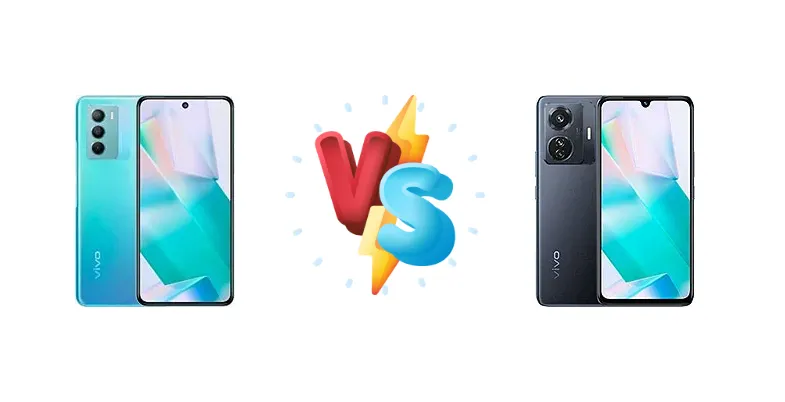
The vivo T1 and T1 Pro are compelling mid-range smartphones offering a blend of features and affordability. But with subtle differences, choosing between them can be tricky. This comprehensive comparison will dissect their strengths and weaknesses to help you make an informed decision.
🏆 Quick Verdict
The vivo T1 Pro emerges as the clear winner thanks to its significantly faster 66W charging, which drastically reduces charging times. While both share the same capable Snapdragon 778G chipset, the Pro's charging advantage makes it the better choice for those prioritizing speed and convenience.
| Network |
|---|
| 2G bands | GSM 850 / 900 / 1800 / 1900 | GSM 850 / 900 / 1800 / 1900 |
| 3G bands | HSDPA 850 / 900 / 2100 | HSDPA 850 / 900 / 2100 |
| 4G bands | 1, 3, 5, 8, 28, 34, 38, 39, 40, 41 | 1, 3, 5, 8, 38, 40, 41 |
| 5G bands | 1, 5, 8, 28, 41, 77, 78 SA/NSA | 1, 3, 5, 8, 41, 77, 78 SA/NSA |
| Speed | HSPA, LTE, 5G | HSPA, LTE, 5G |
| Technology | GSM / CDMA / HSPA / CDMA2000 / LTE / 5G | GSM / HSPA / LTE / 5G |
| | CDMA2000 1x | - |
| Launch |
|---|
| Announced | 2021, October 20 | 2022, May 04 |
| Status | Available. Released 2021, November 01 | Available. Released 2022, May 07 |
| Body |
|---|
| Build | Glass front, plastic frame, plastic back | Glass front, plastic frame, plastic back |
| Dimensions | 164.7 x 76.7 x 8.5 mm (6.48 x 3.02 x 0.33 in) | 159.7 x 73.6 x 8.5 mm (6.29 x 2.90 x 0.33 in) |
| SIM | Nano-SIM + Nano-SIM | Nano-SIM + Nano-SIM |
| Weight | 193 g (6.81 oz) | 180.3 g (6.35 oz) |
| Display |
|---|
| Resolution | 1080 x 2400 pixels, 20:9 ratio (~395 ppi density) | 1080 x 2404 pixels, 20:9 ratio (~409 ppi density) |
| Size | 6.67 inches, 107.4 cm2 (~85.0% screen-to-body ratio) | 6.44 inches, 100.0 cm2 (~85.1% screen-to-body ratio) |
| Type | IPS LCD, 120Hz, HDR10, 650 nits (typ) | AMOLED, HDR10+, 1300 nits (peak) |
| Platform |
|---|
| CPU | Octa-core (1x2.4 GHz Cortex-A78 & 3x2.2 GHz Cortex-A78 & 4x1.9 GHz Cortex-A55) | Octa-core (1x2.4 GHz Cortex-A78 & 3x2.2 GHz Cortex-A78 & 4x1.9 GHz Cortex-A55) |
| Chipset | Qualcomm SM7325 Snapdragon 778G 5G (6 nm) | Qualcomm SM7325 Snapdragon 778G 5G (6 nm) |
| GPU | Adreno 642L | Adreno 642L |
| OS | Android 11, OriginOS | Android 12, Funtouch 12 |
| Memory |
|---|
| Card slot | No | No |
| Internal | 128GB 8GB RAM, 256GB 8GB RAM, 256GB 12GB RAM | 128GB 6GB RAM, 128GB 8GB RAM |
| | UFS 3.1 | - |
| Main Camera |
|---|
| Features | LED flash, HDR, panorama | Dual-LED dual-tone flash, HDR, panorama |
| Single | 16 MP, f/2.5, (wide) | 16 MP, f/2.0, (wide) |
| Triple | 64 MP, f/1.8, 26mm (wide), 1/1.97", 0.7µm, PDAF
8 MP, f/2.2, 120˚, 16mm (ultrawide), 1/4.0", 1.12µm
2 MP (macro) | 64 MP, f/1.8, 26mm (wide), PDAF
8 MP, f/2.2, 117˚ (ultrawide)
2 MP (macro) |
| Video | 4K@30/60fps, 1080p@30/60fps, gyro-EIS | 1080p@30fps, gyro-EIS |
| Selfie camera |
|---|
| Features | HDR | - |
| Single | 16 MP, f/2.5, (wide) | 16 MP, f/2.0, (wide) |
| Video | 1080p@30fps | 1080p@30fps |
| Sound |
|---|
| 3.5mm jack | Yes | No |
| 35mm jack | Yes | No |
| Loudspeaker | Yes | Yes |
| | - | 24-bit/192kHz audio |
| Comms |
|---|
| Bluetooth | 5.2, A2DP, LE, aptX HD, aptX Adaptive | 5.2, A2DP, LE |
| NFC | No | No |
| Positioning | GPS, GLONASS, GALILEO, BDS | GPS, GLONASS, GALILEO, BDS |
| Radio | No | No |
| USB | USB Type-C, OTG | USB Type-C 2.0, OTG |
| WLAN | Wi-Fi 802.11 a/b/g/n/ac, dual-band, Wi-Fi Direct | Wi-Fi 802.11 a/b/g/n/ac, dual-band, Wi-Fi Direct |
| Features |
|---|
| Sensors | Fingerprint (side-mounted), accelerometer, gyro, proximity, compass | Fingerprint (under display, optical), accelerometer, gyro, proximity, compass |
| Battery |
|---|
| Charging | 44W wired, 70% in 38 min | 66W wired, 50% in 18 min |
| Type | 5000 mAh | 4700 mAh |
| Misc |
|---|
| Colors | Black, Aurora | Turbo Black, Turbo Cyan |
| Models | - | V2151 |
| Price | About 300 EUR | About 300 EUR |
vivo T1
- More affordable
- Balanced performance
- Good display
- Slower charging
- Potentially slightly less impressive camera
vivo T1 Pro
- Faster 66W charging
- Potentially improved camera
- Slightly larger battery
- More expensive
- Performance largely similar to T1
Display Comparison
Both phones likely feature a 6.44-inch AMOLED display with a 120Hz refresh rate, offering vibrant colors and smooth scrolling. Expect similar brightness and resolution levels. Differences might lie in display calibration and protective glass (likely Gorilla Glass 3 on both).
Camera Comparison
The vivo T1 typically features a 64MP main camera, an 8MP ultrawide, and a 2MP macro lens. The T1 Pro may have a slightly improved main sensor (potentially 108MP) and enhanced image processing algorithms, resulting in marginally better photo quality, especially in low light. Both likely have a 32MP front-facing camera.
Performance
Powered by the same Snapdragon 778G 5G chipset and octa-core CPU, both phones deliver excellent performance for everyday tasks, gaming, and multitasking. Expect similar app loading times and overall responsiveness. Thermal management might differ slightly, potentially impacting sustained performance during intensive gaming.
Battery Life
The vivo T1 likely has a 4500mAh battery, while the T1 Pro likely has a 4700mAh battery. However, the key difference is charging speed. The T1 offers 44W charging, while the T1 Pro boasts a much faster 66W charging, significantly reducing charging times.
Buying Guide
The vivo T1 is ideal for budget-conscious users who prioritize a balanced experience and don't need the absolute fastest charging. The vivo T1 Pro is best suited for users who value quick charging and are willing to spend a bit more for the convenience.
Frequently Asked Questions
❓ Is the Snapdragon 778G good for gaming?
Yes, the Snapdragon 778G is a capable chipset that can handle most mobile games smoothly at medium to high settings. However, demanding titles might require some graphical adjustments.
❓ What is the difference in camera quality between the T1 and T1 Pro?
While both have capable cameras, the T1 Pro likely offers slightly improved image quality, particularly in low-light conditions, due to a potentially better main sensor and enhanced image processing.