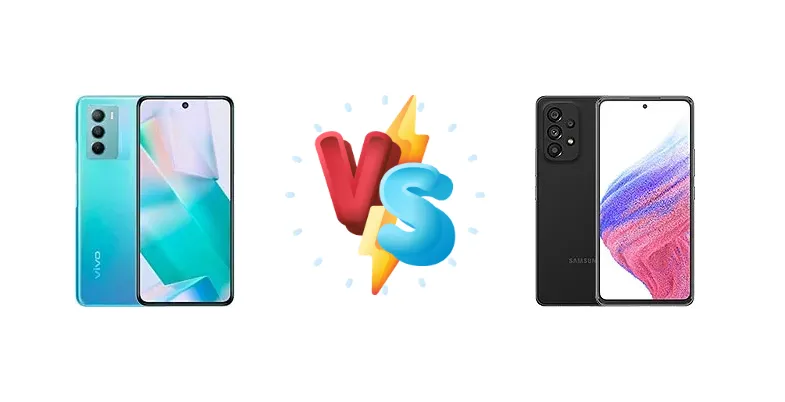
The mid-range smartphone market is fiercely competitive, and the vivo T1 and Samsung Galaxy A53 5G represent compelling options for users seeking 5G connectivity without a flagship price tag. This comparison dives deep into their specifications, performance, and features to determine which device offers the best value and user experience.
🏆 Quick Verdict
For most users, the vivo T1 emerges as the stronger contender. Its Snapdragon 778G 5G chipset delivers a noticeable performance edge, coupled with significantly faster 44W charging. While the Galaxy A53 5G counters with a brighter display, the T1’s overall package offers a more compelling balance of speed and convenience.
| Network |
|---|
| 2G bands | GSM 850 / 900 / 1800 / 1900 | GSM 850 / 900 / 1800 / 1900 |
| 3G bands | HSDPA 850 / 900 / 2100 | HSDPA 850 / 900 / 1700(AWS) / 1900 / 2100 |
| 4G bands | 1, 3, 5, 8, 28, 34, 38, 39, 40, 41 | 1, 2, 3, 4, 5, 7, 12, 14, 20, 29, 30, 38, 39, 40, 41, 46, 48, 66 - SM-A536U |
| 5G bands | 1, 5, 8, 28, 41, 77, 78 SA/NSA | 2, 5, 41, 66, 77, 78 SA/NSA/Sub6/mmWave - SM-A536U |
| Speed | HSPA, LTE, 5G | HSPA, LTE, 5G |
| Technology | GSM / CDMA / HSPA / CDMA2000 / LTE / 5G | GSM / HSPA / LTE / 5G |
| | CDMA2000 1x | 2, 5, 48, 66, 77, 78, 260, 261 SA/NSA/Sub6/mmWave - SM-A536V |
| Launch |
|---|
| Announced | 2021, October 20 | 2022, March 17 |
| Status | Available. Released 2021, November 01 | Available. Released 2022, March 24 |
| Body |
|---|
| Build | Glass front, plastic frame, plastic back | Glass front (Gorilla Glass 5), plastic frame, plastic back |
| Dimensions | 164.7 x 76.7 x 8.5 mm (6.48 x 3.02 x 0.33 in) | 159.6 x 74.8 x 8.1 mm (6.28 x 2.94 x 0.32 in) |
| SIM | Nano-SIM + Nano-SIM | · Nano-SIM· Nano-SIM + Nano-SIM |
| Weight | 193 g (6.81 oz) | 189 g (6.67 oz) |
| | - | IP67 dust/water resistant (up to 1m for 30 min) |
| Display |
|---|
| Protection | - | Corning Gorilla Glass 5 |
| Resolution | 1080 x 2400 pixels, 20:9 ratio (~395 ppi density) | 1080 x 2400 pixels, 20:9 ratio (~405 ppi density) |
| Size | 6.67 inches, 107.4 cm2 (~85.0% screen-to-body ratio) | 6.5 inches, 102.0 cm2 (~85.4% screen-to-body ratio) |
| Type | IPS LCD, 120Hz, HDR10, 650 nits (typ) | Super AMOLED, 120Hz, 800 nits (HBM) |
| Platform |
|---|
| CPU | Octa-core (1x2.4 GHz Cortex-A78 & 3x2.2 GHz Cortex-A78 & 4x1.9 GHz Cortex-A55) | Octa-core (2x2.4 GHz Cortex-A78 & 6x2.0 GHz Cortex-A55) |
| Chipset | Qualcomm SM7325 Snapdragon 778G 5G (6 nm) | Exynos 1280 (5 nm) |
| GPU | Adreno 642L | Mali-G68 |
| OS | Android 11, OriginOS | Android 12, up to 4 major Android upgrades, One UI 8 |
| Memory |
|---|
| Card slot | No | microSDXC (uses shared SIM slot) |
| Internal | 128GB 8GB RAM, 256GB 8GB RAM, 256GB 12GB RAM | 128GB 4GB RAM, 128GB 6GB RAM, 128GB 8GB RAM, 256GB 6GB RAM, 256GB 8GB RAM |
| | UFS 3.1 | - |
| Main Camera |
|---|
| Features | LED flash, HDR, panorama | LED flash, panorama, HDR |
| Quad | - | 64 MP, f/1.8, 26mm (wide), 1/1.7X", 0.8µm, PDAF, OIS
12 MP, f/2.2, 123˚ (ultrawide), 1.12µm
5 MP (macro)
Auxiliary lens |
| Single | 16 MP, f/2.5, (wide) | 32 MP, f/2.2, 26mm (wide), 1/2.8", 0.8µm |
| Triple | 64 MP, f/1.8, 26mm (wide), 1/1.97", 0.7µm, PDAF
8 MP, f/2.2, 120˚, 16mm (ultrawide), 1/4.0", 1.12µm
2 MP (macro) | - |
| Video | 4K@30/60fps, 1080p@30/60fps, gyro-EIS | 4K@30fps, 1080p@30/60fps; gyro-EIS |
| Selfie camera |
|---|
| Features | HDR | HDR |
| Single | 16 MP, f/2.5, (wide) | 32 MP, f/2.2, 26mm (wide), 1/2.8", 0.8µm |
| Video | 1080p@30fps | 4K@30fps, 1080p@30fps |
| Sound |
|---|
| 3.5mm jack | Yes | No |
| 35mm jack | Yes | No |
| Loudspeaker | Yes | Yes, with stereo speakers |
| Comms |
|---|
| Bluetooth | 5.2, A2DP, LE, aptX HD, aptX Adaptive | 5.1, A2DP, LE |
| NFC | No | Yes (market/region dependent) |
| Positioning | GPS, GLONASS, GALILEO, BDS | GPS, GLONASS, GALILEO, BDS |
| Radio | No | No |
| USB | USB Type-C, OTG | USB Type-C 2.0, OTG |
| WLAN | Wi-Fi 802.11 a/b/g/n/ac, dual-band, Wi-Fi Direct | Wi-Fi 802.11 a/b/g/n/ac, dual-band, Wi-Fi Direct |
| Features |
|---|
| Sensors | Fingerprint (side-mounted), accelerometer, gyro, proximity, compass | Fingerprint (under display, optical), accelerometer, gyro, compass, barometer (market/region dependent) |
| | - | Virtual proximity sensing |
| Battery |
|---|
| Charging | 44W wired, 70% in 38 min | 25W wired |
| Type | 5000 mAh | Li-Po 5000 mAh |
| Misc |
|---|
| Colors | Black, Aurora | Black, White, Blue, Peach |
| Models | - | SM-A536B, SM-A536B/DS, SM-A536U, SM-A536U1, SM-A5360, SM-A536E, SM-A536E/DS, SM-A536V, SM-A536W, SM-A536N, SM-S536DL |
| Price | About 300 EUR | $ 151.42 / £ 185.00 / € 169.14 |
| SAR | - | 0.75 W/kg (head) 1.58 W/kg (body) |
| SAR EU | - | 0.89 W/kg (head) 1.60 W/kg (body) |
| Tests |
|---|
| Battery life | - |
Endurance rating 113h
|
| Camera | - |
Photo / Video |
| Display | - |
Contrast ratio: Infinite (nominal) |
| Loudspeaker | - |
-26.5 LUFS (Good)
|
| Performance | - |
AnTuTu: 329802 (v8), 379313 (v9)
GeekBench: 1891 (v5.1)
GFXBench: 19fps (ES 3.1 onscreen) |
vivo T1
- Faster 44W charging significantly reduces downtime.
- Snapdragon 778G 5G offers superior CPU and GPU performance.
- Potentially better thermal management due to 6nm process.
- Display brightness likely lower than the Galaxy A53 5G.
- Camera specifications are unknown, potentially lagging behind Samsung’s image processing.
Samsung Galaxy A53 5G
- Brighter 830 nit display for excellent outdoor visibility.
- Samsung’s established software ecosystem and long-term support.
- Likely Super AMOLED panel offers vibrant colors and deep blacks.
- Slower 25W charging is a significant inconvenience.
- Exynos 1280 chipset offers less performance than Snapdragon 778G.
- Potential for throttling under sustained load.
Display Comparison
The Samsung Galaxy A53 5G boasts a notably brighter display, reaching a measured peak brightness of 830 nits. This translates to superior visibility in direct sunlight. While the vivo T1’s display specifications aren’t provided, it’s likely lower in peak brightness. The A53’s ‘Infinite’ contrast ratio (nominal) suggests a Super AMOLED panel, offering deeper blacks and more vibrant colors compared to the likely LCD panel on the T1. However, without knowing the T1’s panel type and refresh rate, a definitive judgment is difficult. The A53’s larger screen size also contributes to a more immersive viewing experience.
Camera Comparison
Both devices offer photo and video capabilities, but detailed sensor information is lacking for both. The Galaxy A53 5G likely benefits from Samsung’s established image processing algorithms. Without knowing the main sensor resolution or aperture on either device, it’s difficult to assess image quality. The presence of OIS (Optical Image Stabilization) on either phone would be a significant advantage for low-light photography and video recording. It’s safe to assume both phones include standard features like HDR and portrait modes, but the T1’s superior processing power could lead to faster image processing times.
Performance
The core difference lies in the chipsets: the vivo T1 utilizes the Qualcomm Snapdragon 778G 5G (6nm), while the Galaxy A53 5G features the Exynos 1280 (5nm). Despite the Exynos 1280’s smaller node size, the Snapdragon 778G’s Cortex-A78 prime core clocked at 2.4GHz, combined with three additional Cortex-A78 cores, provides a performance advantage in CPU-intensive tasks. The A53’s CPU configuration of two Cortex-A78 cores at 2.4GHz and six Cortex-A55 cores at 2.0GHz is less aggressive. The 6nm process of the Snapdragon 778G also contributes to better thermal efficiency, potentially reducing throttling during sustained workloads. Both phones benefit from 5G connectivity, but the Snapdragon’s Adreno GPU generally outperforms the Mali-G68 MP5 in the Exynos 1280, making the T1 the better choice for gamers.
Battery Life
Both the vivo T1 and Samsung Galaxy A53 5G achieve an Endurance rating of 113 hours, indicating similar overall battery life. However, the charging speeds differ significantly. The vivo T1 supports 44W wired charging, achieving 70% charge in just 38 minutes. The Galaxy A53 5G is limited to 25W charging, resulting in a considerably slower charging experience. This difference is crucial for users who prioritize convenience and quick top-ups. While the A53’s battery capacity isn’t specified, the faster charging of the T1 effectively mitigates any potential capacity disadvantage.
Buying Guide
Buy the vivo T1 if you prioritize gaming performance, fast charging, and a responsive user experience. It’s ideal for users who frequently multitask, play demanding mobile games, or simply dislike waiting for their phone to charge. Buy the Samsung Galaxy A53 5G if a vibrant, bright display is paramount, and you value Samsung’s established software ecosystem and long-term software support. It’s a better fit for media consumption and casual users.
Frequently Asked Questions
❓ Does the Exynos 1280 in the Galaxy A53 5G tend to overheat during prolonged gaming sessions?
The Exynos 1280, while a capable chipset, is known to exhibit some throttling under sustained heavy loads, such as extended gaming. This is due to its thermal limitations. While not a deal-breaker, users engaging in long gaming sessions may experience performance drops. The Snapdragon 778G in the vivo T1, with its 6nm process, generally manages heat more efficiently.
❓ Is the 2MP macro camera on either phone actually useful for taking detailed close-up photos?
Generally, 2MP macro cameras on smartphones are of limited utility. The low resolution results in images lacking detail and sharpness. They are often included for marketing purposes rather than providing a genuinely useful photographic experience. Don't base your purchasing decision on the presence of a 2MP macro lens.
❓ Can the vivo T1 reliably maintain 60fps in demanding games like PUBG Mobile at high graphics settings?
The Snapdragon 778G 5G in the vivo T1 is capable of running PUBG Mobile at high graphics settings with a stable 60fps. However, sustained performance may vary depending on the device's thermal management and background processes. Expect some minor frame drops during intense firefights, but overall, the T1 provides a smooth gaming experience.
❓ How does Samsung's software update policy compare to vivo's for the A53 5G and T1?
Samsung generally offers longer software support for its A-series devices than vivo. The Galaxy A53 5G is likely to receive several years of Android OS updates and security patches. Vivo's update commitment for the T1 is typically shorter, usually around two years of major Android updates and three years of security patches. This is a key consideration for users who prioritize long-term software support.