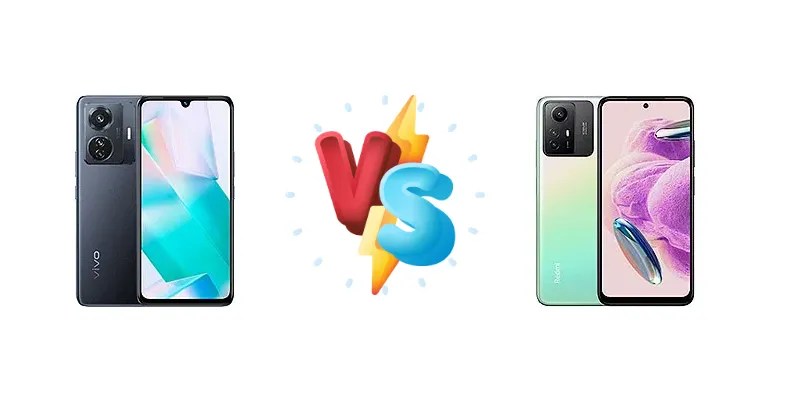
The mid-range smartphone market is fiercely competitive, offering incredible value for your money. Today, we're pitting two popular contenders against each other: the vivo T1, powered by the Snapdragon 778G, and the Xiaomi Redmi Note 12S with its Helio G96. Let's dive in to see which phone reigns supreme.
🏆 Quick Verdict
The vivo T1 takes the crown thanks to its significantly more powerful Snapdragon 778G chipset, resulting in smoother performance and better gaming. While the Redmi Note 12S offers a decent experience and potentially better camera versatility, the T1's processing power makes it the overall winner for most users.
| Network |
|---|
| 2G bands | GSM 850 / 900 / 1800 / 1900 | GSM 850 / 900 / 1800 / 1900 |
| 3G bands | HSDPA 850 / 900 / 2100 | HSDPA 850 / 900 / 2100 |
| 4G bands | 1, 3, 5, 7, 8, 20, 28, 38, 40, 41 | 1, 3, 5, 7, 8, 20, 28, 38, 40, 41 |
| 5G bands | 1, 3, 28, 40, 41, 77, 78 SA/NSA | - |
| Speed | HSPA, LTE, 5G | HSPA, LTE |
| Technology | GSM / HSPA / LTE / 5G | GSM / HSPA / LTE |
| Launch |
|---|
| Announced | 2022, April 26 | 2023, March 06 |
| Status | Available. Released 2022, April 26 | Available. Released 2023, April 26 |
| Body |
|---|
| Build | Glass front, plastic frame, plastic back | - |
| Dimensions | 159.7 x 73.6 x 8.5 mm (6.29 x 2.90 x 0.33 in) | 159.9 x 73.9 x 8.1 mm (6.30 x 2.91 x 0.32 in) |
| SIM | Nano-SIM + Nano-SIM | Nano-SIM + Nano-SIM |
| Weight | 180.3 g (6.35 oz) | 176 g (6.21 oz) |
| Display |
|---|
| Resolution | 1080 x 2404 pixels, 20:9 ratio (~409 ppi density) | 1080 x 2400 pixels, 20:9 ratio (~409 ppi density) |
| Size | 6.44 inches, 100.0 cm2 (~85.1% screen-to-body ratio) | 6.43 inches, 99.8 cm2 (~84.5% screen-to-body ratio) |
| Type | AMOLED, 90Hz, HDR10+, 1300 nits (peak) | AMOLED, 90Hz, 700 nits (HBM), 1000 nits (peak) |
| Platform |
|---|
| CPU | Octa-core (1x2.4 GHz Cortex-A78 & 3x2.2 GHz Cortex-A78 & 4x1.9 GHz Cortex-A55) | Octa-core (2x2.05 GHz Cortex-A76 & 6x2.0 GHz Cortex-A55) |
| Chipset | Qualcomm SM7325 Snapdragon 778G 5G (6 nm) | Mediatek MT6781 Helio G96 (12 nm) |
| GPU | Adreno 642L | Mali-G57 MC2 |
| OS | Android 12, Funtouch 12 | Android 13, MIUI 14 |
| Memory |
|---|
| Card slot | No | microSDXC (dedicated slot) |
| Internal | 128GB 8GB RAM | 64GB 6GB RAM, 128GB 6GB RAM, 256GB 8GB RAM |
| Main Camera |
|---|
| Features | Dual-LED dual-tone flash, HDR, panorama | LED flash, HDR, panorama |
| Single | 16 MP, f/2.0, (wide) | - |
| Triple | 64 MP, f/1.8, 26mm (wide), PDAF
8 MP, f/2.2, 117˚ (ultrawide)
2 MP (macro) | 108 MP, f/1.9, (wide), 1/1.52", 0.7µm, PDAF
8 MP, f/2.2, 118˚ (ultrawide), 1/4.0", 1.12µm
2 MP (macro) |
| Video | 1080p@30fps, gyro-EIS | 1080p@30fps |
| Selfie camera |
|---|
| Single | 16 MP, f/2.0, (wide) | 16 MP, f/2.4, (wide) |
| Video | 1080p@30fps | 1080p@30fps |
| Sound |
|---|
| 3.5mm jack | No | Yes |
| 35mm jack | No | Yes |
| Loudspeaker | Yes | Yes, with stereo speakers |
| | 24-bit/192kHz audio | - |
| Comms |
|---|
| Bluetooth | 5.2, A2DP, LE | 5.2, A2DP, LE |
| Infrared port | - | Yes |
| NFC | No | Yes (market/region dependent) |
| Positioning | GPS, GLONASS, GALILEO, BDS, QZSS | GPS (L1), GLONASS (G1), GALILEO (E1), BDS (B1) |
| Radio | No | Stereo FM radio, recording |
| USB | USB Type-C 2.0, OTG | USB Type-C 2.0 |
| WLAN | Wi-Fi 802.11 a/b/g/n/ac, dual-band, Wi-Fi Direct | Wi-Fi 802.11 a/b/g/n/ac, dual-band |
| Features |
|---|
| Sensors | Fingerprint (side-mounted), accelerometer, gyro, proximity, compass | Fingerprint (side-mounted), accelerometer, gyro, proximity, compass |
| Battery |
|---|
| Charging | 66W wired | 33W wired |
| Type | 4700 mAh | Li-Po 5000 mAh |
| Misc |
|---|
| Colors | Turbo Black, Turbo Cyan | Onyx Black, Ice Blue, Pearl Green |
| Models | - | 2303CRA44A, 23030RAC7Y, 2303ERA42L |
| Price | About 300 EUR | € 122.47 / $ 149.99 / £ 229.89 |
vivo T1 (Snapdragon 778G)
- Superior Performance (Snapdragon 778G)
- Faster Charging (66W)
- Good Display Quality (AMOLED, 120Hz)
- Generally better image processing
- Potentially less detailed photos in ideal lighting compared to Redmi Note 12S
- Slightly smaller battery capacity
Xiaomi Redmi Note 12S
- Larger Battery Capacity (5000mAh)
- Higher Resolution Main Camera (108MP)
- Generally more affordable
- Weaker Performance (Helio G96)
- Slower Charging (33W)
- Less efficient chipset
Display Comparison
Both phones feature a 6.67-inch FHD+ AMOLED display, offering vibrant colors and good viewing angles. The vivo T1 might have slightly better color accuracy due to vivo's display tuning, but the difference is minimal. Both offer a smooth 120Hz refresh rate for fluid scrolling and animations.
Camera Comparison
The Redmi Note 12S boasts a 108MP main camera, potentially offering more detail in well-lit conditions. The vivo T1 typically has a 64MP main camera. However, the Snapdragon 778G's image signal processor (ISP) often results in better overall image processing and dynamic range. Both phones offer decent ultrawide and macro lenses, but the Redmi Note 12S's higher resolution main sensor gives it a slight edge in still photography, especially in good lighting.
Performance
This is where the vivo T1 truly shines. The Snapdragon 778G is a significantly more powerful chipset than the Helio G96. Expect noticeably faster app loading times, smoother multitasking, and better gaming performance on the T1. The Redmi Note 12S will handle everyday tasks adequately, but it will struggle with demanding games and applications.
Battery Life
The vivo T1 typically has a 4500mAh battery, while the Redmi Note 12S has a 5000mAh battery. However, the Snapdragon 778G is more power-efficient than the Helio G96. The 66W fast charging on the vivo T1 is a significant advantage, allowing for much faster charging times compared to the Redmi Note 12S's 33W charging.
Buying Guide
The vivo T1 is ideal for users who prioritize performance, especially gamers and those who frequently multitask. The Xiaomi Redmi Note 12S is a good choice for budget-conscious buyers who value a decent camera and a reliable, if less powerful, experience.
Frequently Asked Questions
❓ Which phone is better for gaming?
The vivo T1 is significantly better for gaming due to its Snapdragon 778G chipset, which offers superior performance and graphics capabilities.
❓ Does the Redmi Note 12S have a better camera?
The Redmi Note 12S has a higher resolution main camera (108MP), which can capture more detail in ideal lighting conditions. However, the vivo T1's image processing is generally better.