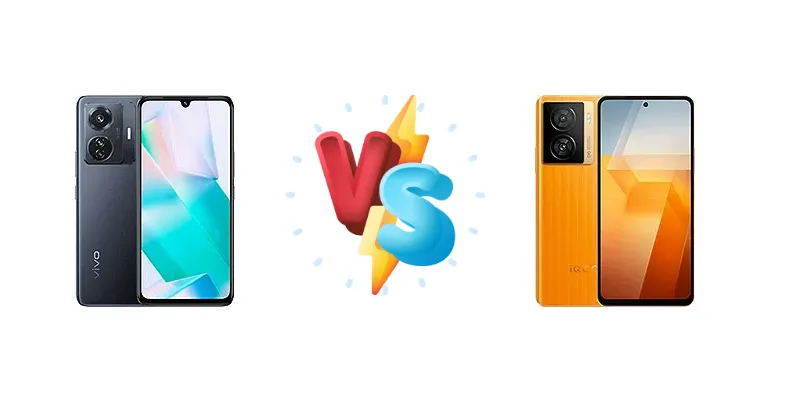
The mid-range smartphone market is fiercely competitive, and vivo's offerings are key players. We're pitting the vivo T1, powered by the Snapdragon 778G, against the iQOO Z7 (China), featuring the newer Snapdragon 782G. Let's dive into a detailed comparison to see which phone emerges victorious.
🏆 Quick Verdict
The iQOO Z7 (China) takes the win thanks to its significantly faster charging (120W vs 66W) and a slightly more powerful Snapdragon 782G chipset. However, the vivo T1 might offer better value depending on pricing and specific features like camera capabilities.
| Network |
|---|
| 2G bands | GSM 850 / 900 / 1800 / 1900 | GSM 850 / 900 / 1800 / 1900 |
| 3G bands | HSDPA 850 / 900 / 2100 | HSDPA 850 / 900 / 2100 |
| 4G bands | 1, 3, 5, 7, 8, 20, 28, 38, 40, 41 | 1, 3, 5, 8, 28, 34, 38, 39, 40, 41 |
| 5G bands | 1, 3, 28, 40, 41, 77, 78 SA/NSA | 1, 5, 8, 28, 41, 77, 78 SA/NSA |
| Speed | HSPA, LTE, 5G | HSPA, LTE, 5G |
| Technology | GSM / HSPA / LTE / 5G | GSM / CDMA / HSPA / CDMA2000 / LTE / 5G |
| | - | CDMA2000 1x |
| Launch |
|---|
| Announced | 2022, April 26 | 2023, March 20 |
| Status | Available. Released 2022, April 26 | Available. Released 2023, March 24 |
| Body |
|---|
| Build | Glass front, plastic frame, plastic back | - |
| Dimensions | 159.7 x 73.6 x 8.5 mm (6.29 x 2.90 x 0.33 in) | 164.6 x 75.8 x 8.8 mm (6.48 x 2.98 x 0.35 in) |
| SIM | Nano-SIM + Nano-SIM | Nano-SIM + Nano-SIM |
| Weight | 180.3 g (6.35 oz) | 201.5 g (7.13 oz) |
| Display |
|---|
| Resolution | 1080 x 2404 pixels, 20:9 ratio (~409 ppi density) | 1080 x 2388 pixels (~395 ppi density) |
| Size | 6.44 inches, 100.0 cm2 (~85.1% screen-to-body ratio) | 6.64 inches, 106.8 cm2 (~85.6% screen-to-body ratio) |
| Type | AMOLED, 90Hz, HDR10+, 1300 nits (peak) | IPS LCD, 120Hz, HDR10 |
| Platform |
|---|
| CPU | Octa-core (1x2.4 GHz Cortex-A78 & 3x2.2 GHz Cortex-A78 & 4x1.9 GHz Cortex-A55) | Octa-core (1x2.7 GHz Cortex-A78 & 3x2.4 GHz Cortex-A78 & 4x1.8 GHz Cortex-A55) |
| Chipset | Qualcomm SM7325 Snapdragon 778G 5G (6 nm) | Qualcomm Snapdragon 782G (6 nm) |
| GPU | Adreno 642L | Adreno 642L |
| OS | Android 12, Funtouch 12 | Android 13, OriginOS 3 |
| Memory |
|---|
| Card slot | No | No |
| Internal | 128GB 8GB RAM | 128GB 8GB RAM, 256GB 8GB RAM, 256GB 12GB RAM |
| | - | UFS 2.2 |
| Main Camera |
|---|
| Dual | - | 64 MP, f/1.8, (wide), 1/1.97", 0.7µm, PDAF, OIS
Auxiliary lens |
| Features | Dual-LED dual-tone flash, HDR, panorama | Dual-LED dual-tone flash, HDR, panorama |
| Single | 16 MP, f/2.0, (wide) | 16 MP, f/2.5, (wide) |
| Triple | 64 MP, f/1.8, 26mm (wide), PDAF
8 MP, f/2.2, 117˚ (ultrawide)
2 MP (macro) | - |
| Video | 1080p@30fps, gyro-EIS | 4K@30fps, 1080p@30fps |
| Selfie camera |
|---|
| Single | 16 MP, f/2.0, (wide) | 16 MP, f/2.5, (wide) |
| Video | 1080p@30fps | 1080p@30fps |
| Sound |
|---|
| 3.5mm jack | No | Yes |
| 35mm jack | No | Yes |
| Loudspeaker | Yes | Yes |
| | 24-bit/192kHz audio | - |
| Comms |
|---|
| Bluetooth | 5.2, A2DP, LE | 5.2, A2DP, LE, aptX HD |
| NFC | No | Yes |
| Positioning | GPS, GLONASS, GALILEO, BDS, QZSS | GPS, GLONASS, GALILEO, BDS |
| Radio | No | No |
| USB | USB Type-C 2.0, OTG | USB Type-C 2.0, OTG |
| WLAN | Wi-Fi 802.11 a/b/g/n/ac, dual-band, Wi-Fi Direct | Wi-Fi 802.11 a/b/g/n/ac/6, dual-band, Wi-Fi Direct |
| Features |
|---|
| Sensors | Fingerprint (side-mounted), accelerometer, gyro, proximity, compass | Fingerprint (side-mounted), accelerometer, gyro, proximity, compass |
| Battery |
|---|
| Charging | 66W wired | 120W wired |
| Type | 4700 mAh | 5000 mAh |
| Misc |
|---|
| Colors | Turbo Black, Turbo Cyan | Black, Blue, Orange |
| Models | - | V2270A |
| Price | About 300 EUR | About 220 EUR |
vivo T1 (Snapdragon 778G)
- Good overall performance
- Reliable camera system
- Competitive pricing
- 66W fast charging
- Slower charging compared to iQOO Z7
- Slightly less powerful chipset
vivo iQOO Z7 (China)
- Faster Snapdragon 782G chipset
- Blazing-fast 120W charging
- Potentially brighter display
- Modern design
- Potentially higher price
- Camera performance needs further evaluation
- Availability may be limited (China model)
Display Comparison
Both phones likely feature similar AMOLED displays with a 120Hz refresh rate, offering smooth scrolling and vibrant colors. The iQOO Z7 might have a slightly brighter display, but this would need confirmation with specific brightness measurements. Screen size is likely around 6.6-6.7 inches.
Camera Comparison
The vivo T1 is expected to have a versatile camera system, potentially including a 64MP main sensor. The iQOO Z7's camera capabilities are less clear without detailed specifications, but it likely offers a competitive setup. Image processing and software optimization will play a crucial role in determining the better camera.
Performance
The Snapdragon 782G in the iQOO Z7 offers a noticeable performance boost over the 778G in the vivo T1. Expect faster app loading times, smoother multitasking, and better gaming performance on the iQOO Z7. Both chipsets are capable of handling everyday tasks with ease.
Battery Life
The iQOO Z7's 120W charging is a game-changer, allowing for incredibly fast charging times. The vivo T1's 66W charging is still respectable, but significantly slower. Battery capacity is likely similar (around 4500-5000mAh) on both devices, meaning the iQOO Z7 will spend far less time plugged in.
Buying Guide
The vivo T1 is a great choice for users prioritizing a balanced experience with good performance and a reliable camera, especially if budget is a major concern. The iQOO Z7 (China) is ideal for power users who demand blazing-fast charging and a bit more processing power, willing to pay a premium for those features.
Frequently Asked Questions
❓ Is the Snapdragon 782G significantly faster than the 778G?
Yes, the Snapdragon 782G offers a noticeable performance improvement, particularly in CPU and GPU performance, leading to smoother gaming and faster app loading.
❓ Will the iQOO Z7 (China) be available globally?
Currently, the iQOO Z7 is primarily available in China. Global availability is uncertain and depends on vivo's distribution strategy.