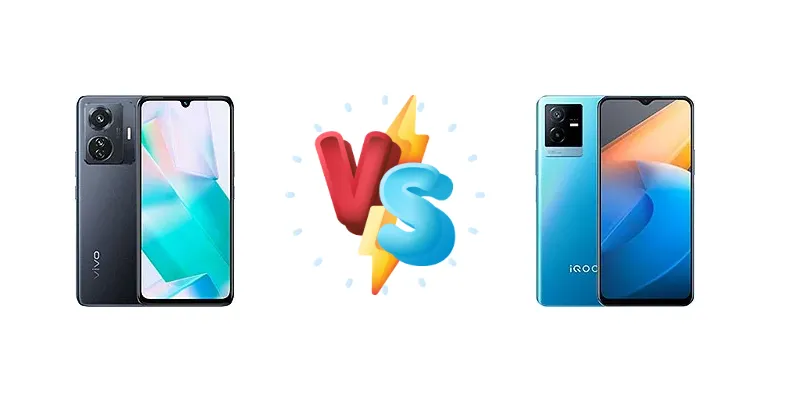
The mid-range smartphone market is fiercely competitive, and the vivo T1 and iQOO Z6x are two strong contenders vying for your attention. Both offer compelling features at accessible price points, but cater to slightly different user needs. Let's dive into a detailed comparison to help you determine which one is the perfect fit.
🏆 Quick Verdict
The vivo T1 takes the crown thanks to its significantly more powerful Snapdragon 778G chipset, offering superior performance for gaming and demanding tasks. While the iQOO Z6x boasts faster charging and a potentially more optimized software experience, the T1's raw power makes it the better overall choice for most users.
| Network |
|---|
| 2G bands | GSM 850 / 900 / 1800 / 1900 | GSM 850 / 900 / 1800 / 1900 |
| 3G bands | HSDPA 850 / 900 / 2100 | HSDPA 850 / 900 / 1700(AWS) / 2100 |
| 4G bands | 1, 3, 5, 7, 8, 20, 28, 38, 40, 41 | 1, 3, 4, 5, 8, 28, 34, 38, 39, 40, 41 |
| 5G bands | 1, 3, 28, 40, 41, 77, 78 SA/NSA | 1, 5, 8, 28, 41, 77, 78 SA/NSA |
| Speed | HSPA, LTE, 5G | HSPA, LTE, 5G |
| Technology | GSM / HSPA / LTE / 5G | GSM / CDMA / HSPA / CDMA2000 / LTE / 5G |
| | - | CDMA2000 1x |
| Launch |
|---|
| Announced | 2022, April 26 | 2022, August 25 |
| Status | Available. Released 2022, April 26 | Available. Released 2022, September 01 |
| Body |
|---|
| Build | Glass front, plastic frame, plastic back | Glass front, plastic frame, plastic back |
| Dimensions | 159.7 x 73.6 x 8.5 mm (6.29 x 2.90 x 0.33 in) | 163.9 x 75.3 x 9.3 mm (6.45 x 2.96 x 0.37 in) |
| SIM | Nano-SIM + Nano-SIM | Nano-SIM + Nano-SIM |
| Weight | 180.3 g (6.35 oz) | 204 g (7.20 oz) |
| Display |
|---|
| Resolution | 1080 x 2404 pixels, 20:9 ratio (~409 ppi density) | 1080 x 2408 pixels, 20:9 ratio (~401 ppi density) |
| Size | 6.44 inches, 100.0 cm2 (~85.1% screen-to-body ratio) | 6.58 inches, 104.3 cm2 (~84.5% screen-to-body ratio) |
| Type | AMOLED, 90Hz, HDR10+, 1300 nits (peak) | IPS LCD |
| Platform |
|---|
| CPU | Octa-core (1x2.4 GHz Cortex-A78 & 3x2.2 GHz Cortex-A78 & 4x1.9 GHz Cortex-A55) | Octa-core (2x2.4 GHz Cortex-A76 & 6x2.0 GHz Cortex-A55) |
| Chipset | Qualcomm SM7325 Snapdragon 778G 5G (6 nm) | Mediatek Dimensity 810 (6 nm) |
| GPU | Adreno 642L | Mali-G57 MC2 |
| OS | Android 12, Funtouch 12 | Android 11, OriginOS Ocean |
| Memory |
|---|
| Card slot | No | No |
| Internal | 128GB 8GB RAM | 128GB 6GB RAM, 128GB 8GB RAM, 256GB 8GB RAM |
| | - | UFS 2.2 |
| Main Camera |
|---|
| Dual | - | 50 MP, f/1.8, 26mm (wide), PDAF
2 MP (macro) |
| Features | Dual-LED dual-tone flash, HDR, panorama | Dual-LED flash, HDR, panorama |
| Single | 16 MP, f/2.0, (wide) | 8 MP, f/2.0, (wide) |
| Triple | 64 MP, f/1.8, 26mm (wide), PDAF
8 MP, f/2.2, 117˚ (ultrawide)
2 MP (macro) | - |
| Video | 1080p@30fps, gyro-EIS | 1080p@30fps |
| Selfie camera |
|---|
| Single | 16 MP, f/2.0, (wide) | 8 MP, f/2.0, (wide) |
| Video | 1080p@30fps | 1080p@30fps |
| Sound |
|---|
| 3.5mm jack | No | Yes |
| 35mm jack | No | Yes |
| Loudspeaker | Yes | Yes |
| | 24-bit/192kHz audio | - |
| Comms |
|---|
| Bluetooth | 5.2, A2DP, LE | 5.1, A2DP, LE, aptX HD |
| NFC | No | No |
| Positioning | GPS, GLONASS, GALILEO, BDS, QZSS | GPS, GLONASS, GALILEO, BDS, QZSS |
| Radio | No | - |
| USB | USB Type-C 2.0, OTG | USB Type-C 2.0, OTG |
| WLAN | Wi-Fi 802.11 a/b/g/n/ac, dual-band, Wi-Fi Direct | Wi-Fi 802.11 a/b/g/n/ac, dual-band, Wi-Fi Direct |
| Features |
|---|
| Sensors | Fingerprint (side-mounted), accelerometer, gyro, proximity, compass | Fingerprint (side-mounted), accelerometer, proximity, compass |
| Battery |
|---|
| Charging | 66W wired | 44W wired, 50% in 33 min |
| Type | 4700 mAh | 6000 mAh |
| Misc |
|---|
| Colors | Turbo Black, Turbo Cyan | Black, Blue, Orange |
| Models | - | V2164KA |
| Price | About 300 EUR | About 180 EUR |
vivo T1 (Snapdragon 778G)
- Superior Performance (Snapdragon 778G)
- Faster Charging (66W)
- Potentially Better Camera Image Processing
- Likely better software optimization
- Potentially slightly higher price
- Design might be less distinctive
vivo iQOO Z6x
- Faster Charging Speed (44W)
- Potentially more streamlined software
- Competitive Price
- Weaker Performance (Dimensity 810)
- Less powerful camera
- May lack some advanced features
Display Comparison
Both phones feature a 6.72-inch display, likely with an LCD panel and a resolution of 1080 x 2400 pixels. While the T1 might have slightly better color accuracy due to its chipset's processing capabilities, the difference will be minimal for most users. Refresh rates are likely 120Hz on both, providing a smooth scrolling experience.
Camera Comparison
The vivo T1 typically features a 64MP main camera, along with ultrawide and macro lenses. The iQOO Z6x also has a 64MP main camera, but the image processing capabilities are likely superior on the T1 due to the Snapdragon chipset. Expect better dynamic range and low-light performance from the T1. Both phones likely offer decent selfie cameras.
Performance
This is where the vivo T1 truly shines. The Snapdragon 778G is a significantly more powerful chipset than the Dimensity 810. Expect smoother multitasking, faster app loading times, and a much better gaming experience on the T1. The T1's CPU architecture is also more advanced, contributing to its overall performance advantage.
Battery Life
The iQOO Z6x has a clear advantage here with its 44W fast charging, allowing it to reach 50% in just 33 minutes. The vivo T1's 66W charging is faster overall, but the Z6x's charging speed is still impressive. Both phones likely have a battery capacity around 5000mAh, offering all-day battery life.
Buying Guide
The vivo T1 is ideal for gamers, power users, and anyone who prioritizes performance. The iQOO Z6x is a great option for budget-conscious users who value fast charging and a smooth, streamlined software experience, and are less concerned with top-tier performance.
Frequently Asked Questions
❓ Is the Snapdragon 778G better than the Dimensity 810?
Yes, the Snapdragon 778G is significantly more powerful than the Dimensity 810, offering better performance in all areas, especially gaming and demanding applications.
❓ Which phone has better battery life?
Both phones likely offer all-day battery life with their 5000mAh batteries. However, the iQOO Z6x charges faster, which can be a significant advantage.