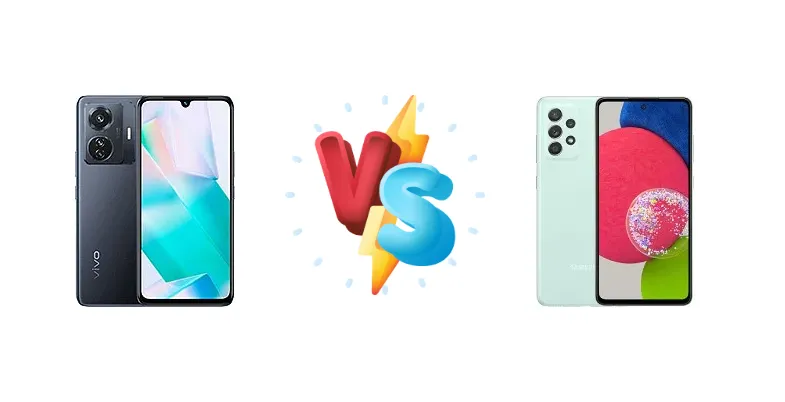
Both the vivo T1 and Samsung Galaxy A52s 5G represent compelling options in the increasingly competitive mid-range smartphone market. Both leverage the Qualcomm Snapdragon 778G 5G chipset, but diverge significantly in charging speed and overall user experience. This comparison dissects these differences to determine which device delivers the most value.
🏆 Quick Verdict
For the average user prioritizing rapid charging and a slightly more streamlined experience, the vivo T1 emerges as the winner. Its 66W charging significantly outperforms the Galaxy A52s 5G’s 25W, offsetting the identical core performance and similar battery endurance. However, Samsung’s established software and brand recognition remain strong considerations.
| Network |
|---|
| 2G bands | GSM 850 / 900 / 1800 / 1900 | GSM 850 / 900 / 1800 / 1900 |
| 3G bands | HSDPA 850 / 900 / 2100 | HSDPA 850 / 900 / 1700(AWS) / 1900 / 2100 |
| 4G bands | 1, 3, 5, 7, 8, 20, 28, 38, 40, 41 | 1, 2, 3, 4, 5, 7, 8, 12, 17, 20, 26, 28, 32, 38, 40, 41, 66 |
| 5G bands | 1, 3, 28, 40, 41, 77, 78 SA/NSA | 1, 3, 5, 7, 8, 20, 28, 38, 40, 41, 66, 78 SA/NSA/Sub6 |
| Speed | HSPA, LTE, 5G | HSPA 42.2/5.76 Mbps, LTE Cat18 1200/150 Mbps, 5G |
| Technology | GSM / HSPA / LTE / 5G | GSM / HSPA / LTE / 5G |
| Launch |
|---|
| Announced | 2022, April 26 | 2021, August 17 |
| Status | Available. Released 2022, April 26 | Available. Released 2021, September 01 |
| Body |
|---|
| Build | Glass front, plastic frame, plastic back | Glass front (Gorilla Glass 5), plastic back |
| Dimensions | 159.7 x 73.6 x 8.5 mm (6.29 x 2.90 x 0.33 in) | 159.9 x 75.1 x 8.4 mm (6.30 x 2.96 x 0.33 in) |
| SIM | Nano-SIM + Nano-SIM | · Nano-SIM· Nano-SIM + Nano-SIM |
| Weight | 180.3 g (6.35 oz) | 189 g (6.67 oz) |
| | - | IP67 dust/water resistant (up to 1m for 30 min) |
| Display |
|---|
| Protection | - | Corning Gorilla Glass 5 |
| Resolution | 1080 x 2404 pixels, 20:9 ratio (~409 ppi density) | 1080 x 2400 pixels, 20:9 ratio (~405 ppi density) |
| Size | 6.44 inches, 100.0 cm2 (~85.1% screen-to-body ratio) | 6.5 inches, 102.0 cm2 (~84.9% screen-to-body ratio) |
| Type | AMOLED, 90Hz, HDR10+, 1300 nits (peak) | Super AMOLED, 120Hz, 800 nits (HBM) |
| Platform |
|---|
| CPU | Octa-core (1x2.4 GHz Cortex-A78 & 3x2.2 GHz Cortex-A78 & 4x1.9 GHz Cortex-A55) | Octa-core (1x2.4 GHz Cortex-A78 & 3x2.2 GHz Cortex-A78 & 4x1.9 GHz Cortex-A55) |
| Chipset | Qualcomm SM7325 Snapdragon 778G 5G (6 nm) | Qualcomm SM7325 Snapdragon 778G 5G (6 nm) |
| GPU | Adreno 642L | Adreno 642L |
| OS | Android 12, Funtouch 12 | Android 11, upgradable to Android 14, One UI 6 |
| Memory |
|---|
| Card slot | No | microSDXC (uses shared SIM slot) |
| Internal | 128GB 8GB RAM | 128GB 4GB RAM, 128GB 6GB RAM, 128GB 8GB RAM, 256GB 6GB RAM, 256GB 8GB RAM |
| Main Camera |
|---|
| Features | Dual-LED dual-tone flash, HDR, panorama | LED flash, panorama, HDR |
| Quad | - | 64 MP, f/1.8, 26mm (wide), 1/1.7", 0.8µm, PDAF, OIS
12 MP, f/2.2, 123˚ (ultrawide), 1.12µm
5 MP (macro)
Auxiliary lens |
| Single | 16 MP, f/2.0, (wide) | 32 MP, f/2.2, 26mm (wide), 1/2.8", 0.8µm |
| Triple | 64 MP, f/1.8, 26mm (wide), PDAF
8 MP, f/2.2, 117˚ (ultrawide)
2 MP (macro) | - |
| Video | 1080p@30fps, gyro-EIS | 4K@30fps, 1080p@30/60fps; gyro-EIS |
| Selfie camera |
|---|
| Features | - | HDR |
| Single | 16 MP, f/2.0, (wide) | 32 MP, f/2.2, 26mm (wide), 1/2.8", 0.8µm |
| Video | 1080p@30fps | 4K@30fps, 1080p@30/60fps |
| Sound |
|---|
| 3.5mm jack | No | Yes |
| 35mm jack | No | Yes |
| Loudspeaker | Yes | Yes, with stereo speakers |
| | 24-bit/192kHz audio | - |
| Comms |
|---|
| Bluetooth | 5.2, A2DP, LE | 5.0, A2DP, LE |
| NFC | No | Yes (market/region dependent) |
| Positioning | GPS, GLONASS, GALILEO, BDS, QZSS | GPS, GLONASS, GALILEO, BDS, QZSS |
| Radio | No | No |
| USB | USB Type-C 2.0, OTG | USB Type-C 2.0, OTG |
| WLAN | Wi-Fi 802.11 a/b/g/n/ac, dual-band, Wi-Fi Direct | Wi-Fi 802.11 a/b/g/n/ac/6, dual-band, Wi-Fi Direct |
| Features |
|---|
| Sensors | Fingerprint (side-mounted), accelerometer, gyro, proximity, compass | Fingerprint (under display, optical), accelerometer, gyro, compass |
| | - | Virtual Proximity Sensing |
| Battery |
|---|
| Charging | 66W wired | 25W wired |
| Type | 4700 mAh | Li-Ion 4500 mAh |
| Misc |
|---|
| Colors | Turbo Black, Turbo Cyan | Awesome Black, Awesome White, Awesome Purple, Awesome Mint |
| Models | - | SM-A528B, SM-A528B/DS, SM-A528N |
| Price | About 300 EUR | £ 112.98 / € 249.47 |
| SAR | - | 0.72 W/kg (head) |
| SAR EU | - | 0.88 W/kg (head) 0.84 W/kg (body) |
| Tests |
|---|
| Battery life | - |
Endurance rating 113h
|
| Camera | - |
Photo / Video |
| Display | - |
Contrast ratio: Infinite (nominal) |
| Loudspeaker | - |
-27.5 LUFS (Good)
|
| Performance | - |
AnTuTu: 429675 (v8), 506432(v9)
GeekBench: 11060 (v4.4), 2801 (v5.1)
GFXBench: 28fps (ES 3.1 onscreen) |
vivo T1 (Snapdragon 778G)
- Significantly faster 66W charging
- Potentially more streamlined software experience
- Competitive Snapdragon 778G performance
- Display specifications are unknown
- Camera details are limited
Samsung Galaxy A52s 5G
- 800 nits peak brightness for better outdoor visibility
- Established brand reputation and software support
- Strong 113-hour endurance rating
- Slower 25W charging
- Potential for software bloat
- 2MP macro camera offers limited utility
Display Comparison
Both devices utilize AMOLED panels, but the Samsung Galaxy A52s 5G boasts a measured peak brightness of 800 nits, suggesting a more visible display in direct sunlight. While the vivo T1’s display specifications aren’t provided, Samsung’s ‘Infinite’ contrast ratio indicates a strong visual experience. The absence of high refresh rate information for the vivo T1 means the A52s likely offers a smoother scrolling experience if it supports a higher refresh rate (a common feature in this segment).
Camera Comparison
Both phones are advertised as having capable photo and video capabilities, but detailed sensor information is lacking. Without specifics on sensor size, aperture, or optical image stabilization (OIS), a direct comparison is difficult. The presence of a 2MP macro camera on the A52s is a common inclusion but often delivers limited real-world benefit. Image processing philosophies will likely differ, with Samsung typically favoring vibrant, saturated colors and vivo potentially leaning towards a more natural look.
Performance
At the heart of both the vivo T1 and Galaxy A52s 5G lies the Qualcomm SM7325 Snapdragon 778G 5G (6 nm) chipset, featuring an octa-core CPU configuration: 1x2.4 GHz Cortex-A78, 3x2.2 GHz Cortex-A78, and 4x1.9 GHz Cortex-A55. This identical CPU configuration ensures comparable performance in everyday tasks and gaming. However, thermal management could differentiate the two; the 6nm process node is efficient, but Samsung’s experience with optimizing software for Snapdragon chips might yield slightly better sustained performance. RAM configurations are not specified, but LPDDR5 is expected on both, contributing to fast app loading and multitasking.
Battery Life
The Samsung Galaxy A52s 5G achieves an impressive endurance rating of 113 hours, indicating solid battery life. The vivo T1’s battery capacity isn’t specified, but its 66W wired charging is a significant advantage over the A52s’ 25W. This translates to a substantially faster 0-100% charge time for the vivo T1, potentially reducing downtime from hours to under 40 minutes. While the A52s’ endurance suggests comparable overall battery life, the T1’s charging speed offers a more convenient user experience.
Buying Guide
Buy the vivo T1 (Snapdragon 778G) if you need blazing-fast charging, minimizing downtime and maximizing usability throughout the day. Buy the Samsung Galaxy A52s 5G if you prefer a more established brand with a proven track record for software updates and a potentially wider ecosystem of accessories, and aren't as concerned about charging speed.
Frequently Asked Questions
❓ How much faster is the vivo T1's 66W charging compared to the Galaxy A52s 5G's 25W charging in real-world use?
The vivo T1's 66W charging can potentially reduce charging times by over 50% compared to the Galaxy A52s 5G's 25W. While the A52s might take over an hour to fully charge, the T1 could achieve a full charge in under 40 minutes, offering significant convenience for users who frequently need to top up their battery.
❓ Does the Snapdragon 778G in either phone struggle with demanding games like PUBG or Genshin Impact?
The Snapdragon 778G is a capable chipset, and both the vivo T1 and Galaxy A52s 5G should handle PUBG and Genshin Impact at medium to high settings. However, sustained performance may be limited by thermal throttling. Samsung’s software optimization could potentially mitigate throttling slightly, but both phones are unlikely to maintain peak performance for extended gaming sessions.
❓ Is the camera on the Samsung Galaxy A52s 5G noticeably better than the vivo T1, considering its brand reputation for camera quality?
Without detailed camera specifications, it's difficult to definitively say. Samsung generally excels in image processing, often producing vibrant and shareable photos. However, the vivo T1 could offer a different, potentially more natural, image style. The quality will depend heavily on the sensor size, aperture, and image processing algorithms employed by each device.