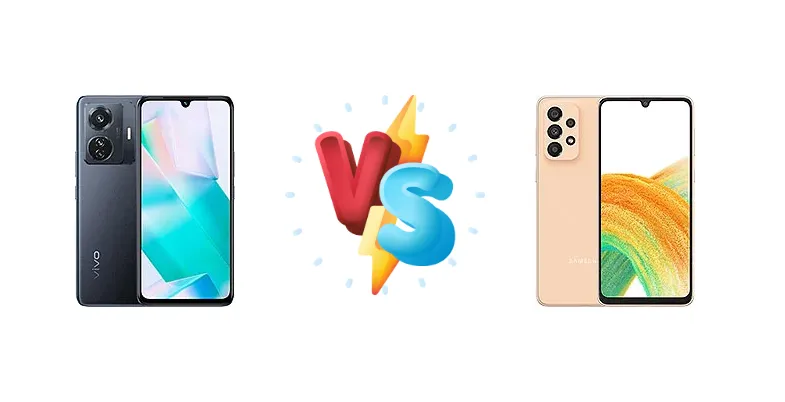
The mid-range smartphone market is fiercely competitive, offering incredible value for your money. Today, we're pitting two popular contenders against each other: the vivo T1, powered by the Snapdragon 778G, and the Samsung Galaxy A33 5G, boasting a vibrant display and Samsung's reliable software. Let's dive in to see which phone reigns supreme.
🏆 Quick Verdict
The vivo T1 offers significantly faster performance thanks to the Snapdragon 778G and its 66W charging. However, the Galaxy A33 5G provides a more polished software experience, a potentially better camera system, and longer software support. Ultimately, the choice depends on your priorities: speed and charging vs. ecosystem and longevity.
| Network |
|---|
| 2G bands | GSM 850 / 900 / 1800 / 1900 | GSM 850 / 900 / 1800 / 1900 |
| 3G bands | HSDPA 850 / 900 / 2100 | HSDPA 850 / 900 / 1700(AWS) / 1900 / 2100 |
| 4G bands | 1, 3, 5, 7, 8, 20, 28, 38, 40, 41 | 1, 2, 3, 4, 5, 7, 8, 12, 17, 20, 26, 28, 32, 38, 40, 41, 66 |
| 5G bands | 1, 3, 28, 40, 41, 77, 78 SA/NSA | 1, 3, 5, 7, 8, 20, 28, 38, 40, 41, 66, 78 SA/NSA/Sub6 |
| Speed | HSPA, LTE, 5G | HSPA, LTE, 5G |
| Technology | GSM / HSPA / LTE / 5G | GSM / HSPA / LTE / 5G |
| Launch |
|---|
| Announced | 2022, April 26 | 2022, March 17 |
| Status | Available. Released 2022, April 26 | Available. Released 2022, April 20 |
| Body |
|---|
| Build | Glass front, plastic frame, plastic back | Glass front (Gorilla Glass 5), plastic frame, plastic back |
| Dimensions | 159.7 x 73.6 x 8.5 mm (6.29 x 2.90 x 0.33 in) | 159.7 x 74 x 8.1 mm (6.29 x 2.91 x 0.32 in) |
| SIM | Nano-SIM + Nano-SIM | · Nano-SIM· Nano-SIM + Nano-SIM |
| Weight | 180.3 g (6.35 oz) | 186 g (6.56 oz) |
| | - | IP67 dust/water resistant (up to 1m for 30 min) |
| Display |
|---|
| Protection | - | Corning Gorilla Glass 5 |
| Resolution | 1080 x 2404 pixels, 20:9 ratio (~409 ppi density) | 1080 x 2400 pixels, 20:9 ratio (~411 ppi density) |
| Size | 6.44 inches, 100.0 cm2 (~85.1% screen-to-body ratio) | 6.4 inches, 98.9 cm2 (~83.7% screen-to-body ratio) |
| Type | AMOLED, 90Hz, HDR10+, 1300 nits (peak) | Super AMOLED, 90Hz |
| Platform |
|---|
| CPU | Octa-core (1x2.4 GHz Cortex-A78 & 3x2.2 GHz Cortex-A78 & 4x1.9 GHz Cortex-A55) | Octa-core (2x2.4 GHz Cortex-A78 & 6x2.0 GHz Cortex-A55) |
| Chipset | Qualcomm SM7325 Snapdragon 778G 5G (6 nm) | Exynos 1280 (5 nm) |
| GPU | Adreno 642L | Mali-G68 |
| OS | Android 12, Funtouch 12 | Android 12, up to 4 major Android upgrades, One UI 8 |
| Memory |
|---|
| Card slot | No | microSDXC (uses shared SIM slot) |
| Internal | 128GB 8GB RAM | 128GB 4GB RAM, 128GB 6GB RAM, 128GB 8GB RAM, 256GB 8GB RAM |
| Main Camera |
|---|
| Features | Dual-LED dual-tone flash, HDR, panorama | LED flash, panorama, HDR |
| Quad | - | 48 MP, f/1.8, 26mm (wide), 1/2.0", 0.8µm, PDAF, OIS
8 MP, f/2.2, 123˚, (ultrawide), 1/4.0", 1.12µm
5 MP (macro)
Auxiliary lens |
| Single | 16 MP, f/2.0, (wide) | 13 MP, f/2.2, (wide), 1/3.1", 1.12µm |
| Triple | 64 MP, f/1.8, 26mm (wide), PDAF
8 MP, f/2.2, 117˚ (ultrawide)
2 MP (macro) | - |
| Video | 1080p@30fps, gyro-EIS | 4K@30fps, 1080p@30/60fps |
| Selfie camera |
|---|
| Single | 16 MP, f/2.0, (wide) | 13 MP, f/2.2, (wide), 1/3.1", 1.12µm |
| Video | 1080p@30fps | 4K@30fps, 1080p@30fps |
| Sound |
|---|
| 3.5mm jack | No | No |
| 35mm jack | No | No |
| Loudspeaker | Yes | Yes, with stereo speakers |
| | 24-bit/192kHz audio | - |
| Comms |
|---|
| Bluetooth | 5.2, A2DP, LE | 5.1, A2DP, LE |
| NFC | No | Yes (market/region dependent) |
| Positioning | GPS, GLONASS, GALILEO, BDS, QZSS | GPS, GLONASS, GALILEO, BDS |
| Radio | No | No |
| USB | USB Type-C 2.0, OTG | USB Type-C 2.0, OTG |
| WLAN | Wi-Fi 802.11 a/b/g/n/ac, dual-band, Wi-Fi Direct | Wi-Fi 802.11 a/b/g/n/ac, dual-band, Wi-Fi Direct |
| Features |
|---|
| Sensors | Fingerprint (side-mounted), accelerometer, gyro, proximity, compass | Fingerprint (under display, optical), accelerometer, gyro, compass |
| | - | Virtual proximity sensing |
| Battery |
|---|
| Charging | 66W wired | 25W wired |
| Type | 4700 mAh | Li-Po 5000 mAh |
| Misc |
|---|
| Colors | Turbo Black, Turbo Cyan | Black, White, Blue, Peach |
| Models | - | SM-A336E, SM-A336B, SM-A336B/DS, SM-A336B/DSN, SM-A336E/DS, SM-A336M, SM-A3360 |
| Price | About 300 EUR | £ 174.99 / € 187.50 / ₹ 21,999 |
| SAR | - | 0.35 W/kg (head) |
| SAR EU | - | 0.57 W/kg (head) 1.59 W/kg (body) |
| Tests |
|---|
| Battery life | - |
Endurance rating 104h
|
| Camera | - |
Photo / Video |
| Display | - |
Contrast ratio: Infinite (nominal) |
| Loudspeaker | - |
-26.5 LUFS (Good)
|
| Performance | - |
AnTuTu: 354420 (v8), 394918 (v9)
GeekBench: 1900 (v5.1)
GFXBench: 20fps (ES 3.1 onscreen) |
vivo T1 (Snapdragon 778G)
- Faster Performance (Snapdragon 778G)
- 66W Fast Charging
- Potentially Lower Price
- Good Value for Money
- Likely Less Polished Software
- Potentially Weaker Camera
- Shorter Software Support
Samsung Galaxy A33 5G
- Brighter Display
- Samsung Ecosystem Integration
- Potentially Better Camera
- Longer Software Support
- Good Battery Life
- Slower Performance (Exynos 1280)
- 25W Slow Charging
- Potentially Higher Price
Display Comparison
The Galaxy A33 5G boasts a brighter display (728 nits vs. vivo T1's likely lower brightness) and an 'infinite' contrast ratio, suggesting excellent image quality. While the vivo T1's display is likely good, the A33 5G has a clear edge in visual fidelity. Both offer FHD+ resolution, ensuring sharp visuals.
Camera Comparison
The Galaxy A33 5G likely has a more versatile camera system, potentially with better image processing and low-light performance. While the vivo T1's camera is decent, the A33 5G's reputation for camera quality is stronger. Specific camera specs would be needed for a more precise comparison.
Performance
Here, the vivo T1 takes a commanding lead. The Snapdragon 778G is a significantly more powerful chipset than the Exynos 1280. Expect smoother multitasking, faster app loading times, and better gaming performance on the vivo T1. The A33 5G is still capable, but it won't match the T1's raw power.
Battery Life
Both phones offer excellent battery life, with the Galaxy A33 5G claiming an endurance rating of 104 hours. The vivo T1's 66W charging is a major advantage, allowing for significantly faster top-ups compared to the A33 5G's 25W charging.
Buying Guide
The vivo T1 is ideal for gamers and users who prioritize performance and fast charging. The Samsung Galaxy A33 5G is a better choice for those invested in the Samsung ecosystem, value longer software updates, and prefer a more refined camera experience.
Frequently Asked Questions
❓ Which phone is better for gaming?
The vivo T1 is significantly better for gaming due to its more powerful Snapdragon 778G chipset.
❓ How long will Samsung support the Galaxy A33 5G with software updates?
Samsung typically provides 4 years of OS updates and 5 years of security updates for its A-series phones, offering longer software support than vivo.