
vivo T1 (Snapdragon 778G) vs OnePlus Nord 2 5G: A Deep Dive into Mid-Range Power
| Phones Images | |||||
|---|---|---|---|---|---|
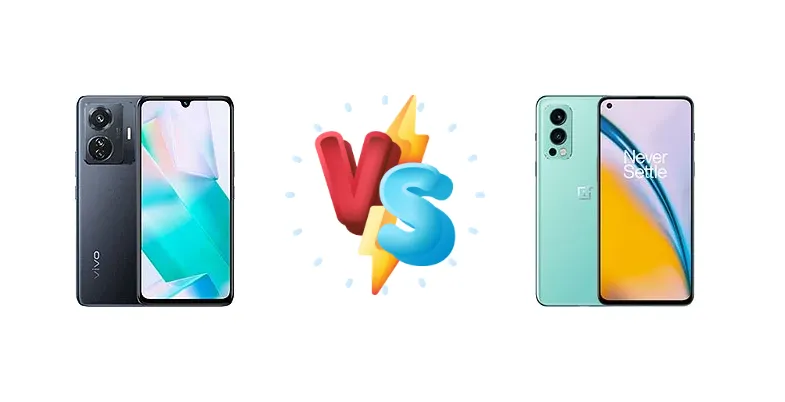
|
🏆 Quick Verdict
For most users, the OnePlus Nord 2 5G emerges as the slightly stronger choice. Its Dimensity 1200 chipset provides a noticeable performance edge in demanding tasks, and the 65W charging with PD support offers a convenient and rapid top-up. However, the vivo T1 remains a strong contender, particularly for those prioritizing a potentially cooler thermal profile.
| PHONES | ||
|---|---|---|
| Phone Names | vivo T1 (Snapdragon 778G) | OnePlus Nord 2 5G |
| Network | ||
|---|---|---|
| 2G bands | GSM 850 / 900 / 1800 / 1900 | GSM 850 / 900 / 1800 / 1900 |
| 3G bands | HSDPA 850 / 900 / 2100 | HSDPA 800 / 850 / 900 / 1700(AWS) / 1800 / 1900 / 2100 |
| 4G bands | 1, 3, 5, 7, 8, 20, 28, 38, 40, 41 | 1, 2, 3, 4, 5, 7, 8, 12, 17, 18, 19, 20, 26, 28, 32, 34, 38, 39, 40, 41, 66 - EU |
| 5G bands | 1, 3, 28, 40, 41, 77, 78 SA/NSA | 1, 3, 7, 8, 20, 28, 38, 41, 66, 78 SA/NSA - EU |
| Speed | HSPA, LTE, 5G | HSPA 42.2/5.76 Mbps, LTE Cat18 1200/150 Mbps, 5G |
| Technology | GSM / HSPA / LTE / 5G | GSM / HSPA / LTE / 5G |
| Launch | ||
|---|---|---|
| Announced | 2022, April 26 | 2021, July 22 |
| Status | Available. Released 2022, April 26 | Available. Released 2021, July 28 |
| Body | ||
|---|---|---|
| Build | Glass front, plastic frame, plastic back | Glass front (Gorilla Glass 5), glass back (Gorilla Glass 5), plastic frame |
| Dimensions | 159.7 x 73.6 x 8.5 mm (6.29 x 2.90 x 0.33 in) | 159.1 x 73.3 x 8.3 mm (6.26 x 2.89 x 0.33 in) |
| SIM | Nano-SIM + Nano-SIM | Nano-SIM + Nano-SIM |
| Weight | 180.3 g (6.35 oz) | 189 g (6.67 oz) |
| Display | ||
|---|---|---|
| Protection | - | Corning Gorilla Glass 5 |
| Resolution | 1080 x 2404 pixels, 20:9 ratio (~409 ppi density) | 1080 x 2400 pixels, 20:9 ratio (~409 ppi density) |
| Size | 6.44 inches, 100.0 cm2 (~85.1% screen-to-body ratio) | 6.43 inches, 99.8 cm2 (~85.6% screen-to-body ratio) |
| Type | AMOLED, 90Hz, HDR10+, 1300 nits (peak) | Fluid AMOLED, 90Hz, HDR10+ |
| Platform | ||
|---|---|---|
| CPU | Octa-core (1x2.4 GHz Cortex-A78 & 3x2.2 GHz Cortex-A78 & 4x1.9 GHz Cortex-A55) | Octa-core (1x3.0 GHz Cortex-A78 & 3x2.6 GHz Cortex-A78 & 4x2.0 GHz Cortex-A55) |
| Chipset | Qualcomm SM7325 Snapdragon 778G 5G (6 nm) | Mediatek Dimensity 1200 (6 nm) |
| GPU | Adreno 642L | Mali-G77 MC9 |
| OS | Android 12, Funtouch 12 | Android 11, upgradable to Android 13, OxygenOS 13 |
| Memory | ||
|---|---|---|
| Card slot | No | No |
| Internal | 128GB 8GB RAM | 128GB 6GB RAM, 128GB 8GB RAM, 256GB 8GB RAM, 256GB 12GB RAM |
| Main Camera | ||
|---|---|---|
| Features | Dual-LED dual-tone flash, HDR, panorama | Dual-LED flash, HDR, panorama |
| Single | 16 MP, f/2.0, (wide) | - |
| Triple | 64 MP, f/1.8, 26mm (wide), PDAF 8 MP, f/2.2, 117˚ (ultrawide) 2 MP (macro) | 50 MP, f/1.9, 24mm (wide), 1/1.56", 1.0µm, PDAF, OIS 8 MP, f/2.3, 120˚ (ultrawide) Auxiliary lens |
| Video | 1080p@30fps, gyro-EIS | 4K@30fps, 1080p@30/60/120fps, gyro-EIS |
| Selfie camera | ||
|---|---|---|
| Features | - | Auto HDR |
| Single | 16 MP, f/2.0, (wide) | 32 MP, f/2.5, (wide), 1/2.8", 0.8µm |
| Video | 1080p@30fps | 1080p@30fps, gyro-EIS |
| Sound | ||
|---|---|---|
| 3.5mm jack | No | No |
| 35mm jack | No | No |
| Loudspeaker | Yes | Yes, with stereo speakers |
| 24-bit/192kHz audio | - | |
| Comms | ||
|---|---|---|
| Bluetooth | 5.2, A2DP, LE | 5.2, A2DP, LE, aptX HD |
| NFC | No | Yes |
| Positioning | GPS, GLONASS, GALILEO, BDS, QZSS | GPS, GLONASS, GALILEO, BDS, SBAS, NavIC |
| Radio | No | No |
| USB | USB Type-C 2.0, OTG | USB Type-C 2.0, OTG |
| WLAN | Wi-Fi 802.11 a/b/g/n/ac, dual-band, Wi-Fi Direct | Wi-Fi 802.11 a/b/g/n/ac/6, dual-band, Wi-Fi Direct |
| Features | ||
|---|---|---|
| Sensors | Fingerprint (side-mounted), accelerometer, gyro, proximity, compass | Fingerprint (under display, optical), accelerometer, gyro, proximity, compass |
| Battery | ||
|---|---|---|
| Charging | 66W wired | 65W wired, PD, 100% in 30 min |
| Type | 4700 mAh | Li-Po 4500 mAh |
| Misc | ||
|---|---|---|
| Colors | Turbo Black, Turbo Cyan | Gray Sierra, Blue Haze, Green Wood, Pac-Man Edition |
| Models | - | DN2101, DN2103 |
| Price | About 300 EUR | € 189.00 / $ 219.99 / £ 148.00 |
| Tests | ||
|---|---|---|
| Battery life | - | Endurance rating 102h |
| Camera | - | Photo / Video |
| Display | - | Contrast ratio: Infinite (nominal) |
| Loudspeaker | - | -24.3 LUFS (Very good) |
| Performance | - | AnTuTu: 512164 (v8) | 598022 (v9) GeekBench: 2792 (v5.1) GFXBench: 38fps (ES 3.1 onscreen) |
vivo T1 (Snapdragon 778G)
- Potentially better thermal management due to Snapdragon 778G's efficiency.
- 66W fast charging provides quick top-ups.
- Competitive price point within the mid-range segment.
- Snapdragon 778G is outperformed by the Dimensity 1200 in raw processing power.
- Limited display information hinders a full comparison.
OnePlus Nord 2 5G
- Dimensity 1200 offers superior performance for gaming and demanding apps.
- 65W charging with PD support for versatile charging options.
- Brighter display (633 nits) for better outdoor visibility.
- Dimensity 1200 may run hotter under sustained load.
- Lack of detailed camera sensor information.
Display Comparison
The OnePlus Nord 2 5G boasts a measured peak brightness of 633 nits, suggesting a more visible display in direct sunlight compared to the vivo T1, for which display brightness data is unavailable. While both utilize 6nm chipsets, the display’s impact on overall power consumption isn’t specified. The Nord 2 5G’s ‘Infinite’ contrast ratio (nominal) indicates a typical AMOLED panel, offering deep blacks and vibrant colors. Without specific panel technology details for the T1, it’s difficult to assess its color accuracy or viewing angles relative to the Nord 2 5G.
Camera Comparison
Both phones are advertised as having capable photo and video capabilities, but specific sensor details are lacking. Without knowing the megapixel count or sensor size of the main cameras, a direct comparison is difficult. The absence of information regarding Optical Image Stabilization (OIS) on either device is a significant omission. The image processing style will likely differ, with OnePlus historically favoring more saturated colors and vivo leaning towards a more natural look. The usefulness of any 2MP macro cameras on either device is questionable, as image quality is typically limited.
Performance
The core difference lies in the chipsets. The OnePlus Nord 2 5G’s MediaTek Dimensity 1200, with its 1x3.0 GHz Cortex-A78 prime core and 3x2.6 GHz Cortex-A78 performance cores, demonstrably outperforms the vivo T1’s Snapdragon 778G (1x2.4 GHz Cortex-A78 & 3x2.2 GHz Cortex-A78). This translates to faster app loading times, smoother multitasking, and higher frame rates in graphically intensive games. While both use 6nm fabrication, the Dimensity 1200’s architecture provides a performance advantage. The T1’s CPU configuration, with a mix of A78 and A55 cores, is optimized for efficiency, potentially leading to better battery life during less demanding tasks. However, the Nord 2 5G’s superior GPU will be more noticeable in gaming.
Battery Life
Both the vivo T1 and OnePlus Nord 2 5G achieve an Endurance rating of 102 hours, indicating similar overall battery life. However, the charging speeds differ slightly. The Nord 2 5G’s 65W charging with Power Delivery (PD) support promises a full charge in 30 minutes, while the T1’s 66W charging is similarly fast. The inclusion of PD on the Nord 2 5G offers broader compatibility with chargers and accessories. The similar endurance ratings suggest that despite the more powerful chipset in the Nord 2 5G, software optimization and battery capacity are well-matched.
Buying Guide
Buy the vivo T1 (Snapdragon 778G) if you prioritize sustained performance under load and potentially better thermal management during extended gaming sessions. Buy the OnePlus Nord 2 5G if you prefer a more powerful processor for everyday tasks and demanding applications, coupled with faster charging and a proven track record of software optimization.