
vivo T1 (Snapdragon 778G) vs Motorola Edge 20 Fusion: A Detailed Comparison
| Phones Images | |||||
|---|---|---|---|---|---|
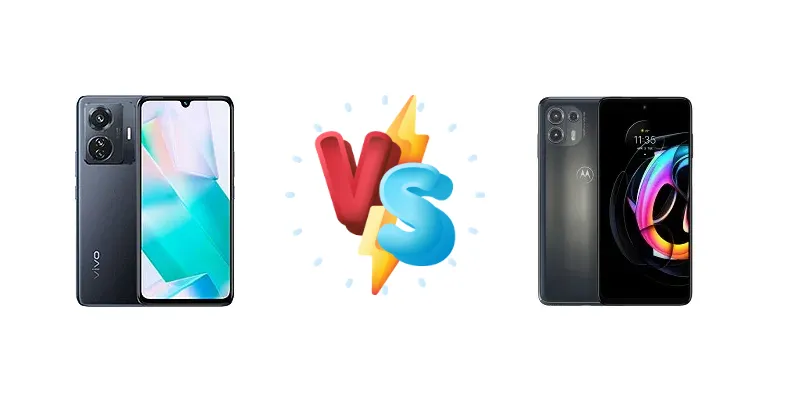
|
🏆 Quick Verdict
For most users, the vivo T1 emerges as the stronger contender. Its Snapdragon 778G chipset, built on a more efficient 6nm process, provides a noticeable performance edge, particularly in sustained workloads. The significantly faster 66W charging also offers a substantial convenience advantage, making it the better choice for power users and gamers.
| PHONES | ||
|---|---|---|
| Phone Names | vivo T1 (Snapdragon 778G) | Motorola Edge 20 Fusion |
| Network | ||
|---|---|---|
| 2G bands | GSM 850 / 900 / 1800 / 1900 | GSM 850 / 900 / 1800 / 1900 |
| 3G bands | HSDPA 850 / 900 / 2100 | HSDPA 850 / 900 / 1700(AWS) / 1900 / 2100 |
| 4G bands | 1, 3, 5, 7, 8, 20, 28, 38, 40, 41 | 1, 2, 3, 4, 5, 7, 8, 12, 13, 17, 18, 19, 20, 26, 28, 32, 34, 38, 39, 40, 41, 42, 43, 66 |
| 5G bands | 1, 3, 28, 40, 41, 77, 78 SA/NSA | 1, 3, 5, 7, 8, 20, 28, 38, 40, 41, 77, 78, 66 SA/NSA/Sub6 |
| Speed | HSPA, LTE, 5G | HSPA 42.2/5.76 Mbps, LTE Cat18 1200/150 Mbps, 5G |
| Technology | GSM / HSPA / LTE / 5G | GSM / HSPA / LTE / 5G |
| Launch | ||
|---|---|---|
| Announced | 2022, April 26 | 2021, August 17 |
| Status | Available. Released 2022, April 26 | Available. Released 2021, August 27 |
| Body | ||
|---|---|---|
| Build | Glass front, plastic frame, plastic back | Glass front |
| Dimensions | 159.7 x 73.6 x 8.5 mm (6.29 x 2.90 x 0.33 in) | 166 x 76 x 8.3 mm (6.54 x 2.99 x 0.33 in) |
| SIM | Nano-SIM + Nano-SIM | Nano-SIM + Nano-SIM |
| Weight | 180.3 g (6.35 oz) | 185 g (6.53 oz) |
| - | Water-repellent design | |
| Display | ||
|---|---|---|
| Resolution | 1080 x 2404 pixels, 20:9 ratio (~409 ppi density) | 1080 x 2400 pixels, 20:9 ratio (~393 ppi density) |
| Size | 6.44 inches, 100.0 cm2 (~85.1% screen-to-body ratio) | 6.7 inches, 108.4 cm2 (~85.9% screen-to-body ratio) |
| Type | AMOLED, 90Hz, HDR10+, 1300 nits (peak) | OLED, 1B colors, 90Hz, HDR10+ |
| Platform | ||
|---|---|---|
| CPU | Octa-core (1x2.4 GHz Cortex-A78 & 3x2.2 GHz Cortex-A78 & 4x1.9 GHz Cortex-A55) | Octa-core (2x2.4 GHz Cortex-A76 & 6x2.0 GHz Cortex-A55) |
| Chipset | Qualcomm SM7325 Snapdragon 778G 5G (6 nm) | Mediatek Dimensity 800U (7 nm) |
| GPU | Adreno 642L | Mali-G57 MC3 |
| OS | Android 12, Funtouch 12 | Android 11 |
| Memory | ||
|---|---|---|
| Card slot | No | microSDXC |
| Internal | 128GB 8GB RAM | 128GB 6GB RAM, 128GB 8GB RAM |
| Main Camera | ||
|---|---|---|
| Features | Dual-LED dual-tone flash, HDR, panorama | LED flash, HDR, panorama |
| Single | 16 MP, f/2.0, (wide) | - |
| Triple | 64 MP, f/1.8, 26mm (wide), PDAF 8 MP, f/2.2, 117˚ (ultrawide) 2 MP (macro) | 108 MP, f/1.9, (wide), 1/1.52", 0.7µm, PDAF 8 MP, f/2.2, 118˚ (ultrawide) Auxiliary lens |
| Video | 1080p@30fps, gyro-EIS | 4K@30fps, 1080p@30/60/120fps, gyro-EIS |
| Selfie camera | ||
|---|---|---|
| Features | - | HDR |
| Single | 16 MP, f/2.0, (wide) | 32 MP, f/2.3, (wide), 0.7µm |
| Video | 1080p@30fps | 1080p@30fps |
| Sound | ||
|---|---|---|
| 3.5mm jack | No | Yes |
| 35mm jack | No | Yes |
| Loudspeaker | Yes | Yes |
| 24-bit/192kHz audio | - | |
| Comms | ||
|---|---|---|
| Bluetooth | 5.2, A2DP, LE | 5.0, A2DP, LE |
| NFC | No | Yes |
| Positioning | GPS, GLONASS, GALILEO, BDS, QZSS | GPS, GLONASS, GALILEO |
| Radio | No | FM radio |
| USB | USB Type-C 2.0, OTG | USB Type-C 2.0 |
| WLAN | Wi-Fi 802.11 a/b/g/n/ac, dual-band, Wi-Fi Direct | Wi-Fi 802.11 a/b/g/n/ac, dual-band, Wi-Fi Direct |
| Features | ||
|---|---|---|
| Sensors | Fingerprint (side-mounted), accelerometer, gyro, proximity, compass | Fingerprint (side-mounted), accelerometer, gyro, proximity, compass |
| Battery | ||
|---|---|---|
| Charging | 66W wired | 30W wired |
| Type | 4700 mAh | Li-Po 5000 mAh |
| Misc | ||
|---|---|---|
| Colors | Turbo Black, Turbo Cyan | Electric Graphite, Cyber Teal |
| Price | About 300 EUR | About 250 EUR |
vivo T1 (Snapdragon 778G)
- Superior chipset performance (Snapdragon 778G)
- Faster 66W charging
- More efficient 6nm process for better thermal management
- Software experience may vary (vivo’s Funtouch OS)
- Camera details are currently unknown
Motorola Edge 20 Fusion
- Potentially cleaner software experience (Motorola’s near-stock Android)
- Competitive price point
- Decent performance for everyday tasks
- Less powerful chipset (Dimensity 800U)
- Slower 30W charging
- 7nm process may lead to more thermal throttling
Display Comparison
Neither device boasts a standout display. While specific panel details (like peak brightness or color gamut coverage) are absent, the focus here is on the underlying processing power impacting UI smoothness. Both likely utilize FHD+ resolution panels, common in this price bracket. The chipset’s GPU will be the primary determinant of frame rates in games and video playback, rather than display specs alone.
Camera Comparison
Without detailed camera sensor information, a direct comparison is limited. However, the chipset’s ISP (Image Signal Processor) plays a crucial role. Qualcomm’s Snapdragon ISPs generally offer more advanced features and processing capabilities than MediaTek’s equivalents. This suggests the vivo T1 may deliver slightly better image quality, particularly in challenging lighting conditions. The absence of information regarding OIS (Optical Image Stabilization) on either device makes it difficult to assess low-light video performance.
Performance
The Snapdragon 778G (6nm) in the vivo T1 holds a clear advantage over the Dimensity 800U (7nm). The 778G’s CPU configuration – a 1x2.4 GHz Cortex-A78 prime core, 3x2.2 GHz Cortex-A78 cores, and 4x1.9 GHz Cortex-A55 efficiency cores – is architecturally superior to the Edge 20 Fusion’s 2x2.4 GHz Cortex-A76 and 6x2.0 GHz Cortex-A55 setup. The newer Cortex-A78 cores offer improved IPC (Instructions Per Clock) and efficiency. Furthermore, the 6nm fabrication process of the 778G translates to better thermal management, reducing the likelihood of performance throttling during extended gaming sessions. This benefits users who engage in graphically intensive tasks or prolonged gaming.
Battery Life
The vivo T1’s 66W wired charging is a significant differentiator. This allows for a much faster 0-100% charge time compared to the Motorola Edge 20 Fusion’s 30W charging. While battery capacity isn’t specified, the faster charging speed mitigates any potential disadvantage if the T1 has a slightly smaller battery. Users who frequently find themselves needing to top up their phone quickly will greatly appreciate the T1’s charging capabilities.
Buying Guide
Buy the vivo T1 (Snapdragon 778G) if you prioritize gaming performance, faster charging speeds, and a more future-proof chipset. It’s ideal for users who frequently multitask, play demanding games, or simply want a phone that can keep up with a fast-paced lifestyle. Buy the Motorola Edge 20 Fusion if you prefer a potentially cleaner software experience (depending on Motorola’s current skin) and are less concerned with pushing the phone to its absolute performance limits. It’s a solid option for everyday tasks and casual use.