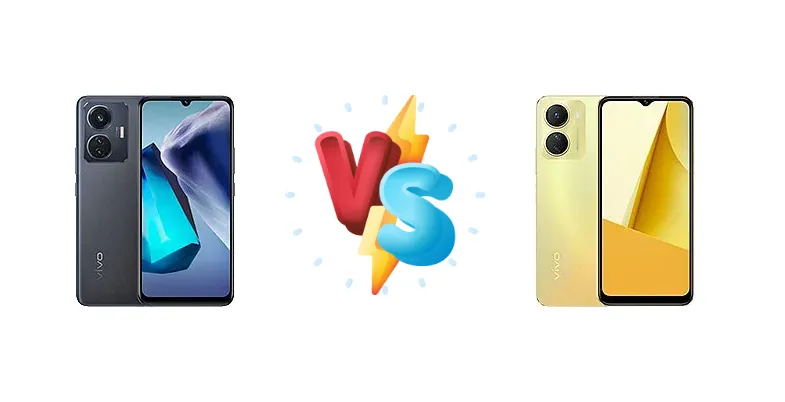
The budget smartphone market is fiercely competitive, and vivo consistently delivers compelling options. Today, we're pitting two popular contenders against each other: the vivo T1, powered by a Snapdragon 680, and the vivo Y16. Which phone offers the best bang for your buck?
🏆 Quick Verdict
The vivo T1 is the clear winner. Its Snapdragon 680 chipset provides significantly better performance, faster charging, and a generally smoother user experience compared to the Y16's Helio P35. While the Y16 is a more affordable option, the T1's upgrades justify the price difference.
| Network |
|---|
| 2G bands | GSM 850 / 900 / 1800 / 1900 | GSM 850 / 900 / 1800 / 1900 |
| 3G bands | HSDPA 850 / 900 / 2100 | HSDPA 850 / 900 / 2100 |
| 4G bands | 1, 3, 5, 8, 38, 40, 41 | 1, 3, 5, 8, 40 |
| Speed | HSPA, LTE | HSPA, LTE |
| Technology | GSM / HSPA / LTE | GSM / HSPA / LTE |
| Launch |
|---|
| Announced | 2022, May 04 | 2022, September 01 |
| Status | Available. Released 2022, May 20 | Available. Released 2022, September 01 |
| Body |
|---|
| Build | Glass front, plastic frame, plastic back | Glass front, plastic frame, plastic back |
| Dimensions | 160.8 x 73.8 x 8.4 mm (6.33 x 2.91 x 0.33 in) | 164 x 75.6 x 8.2 mm (6.46 x 2.98 x 0.32 in) |
| SIM | Nano-SIM + Nano-SIM | Nano-SIM + Nano-SIM |
| Weight | 182 g (6.42 oz) | 184 g (6.49 oz) |
| | - | Splashproof |
| Display |
|---|
| Resolution | 1080 x 2400 pixels, 20:9 ratio (~409 ppi density) | 720 x 1600 pixels, 20:9 ratio (~270 ppi density) |
| Size | 6.44 inches, 100.1 cm2 (~84.4% screen-to-body ratio) | 6.51 inches, 102.3 cm2 (~82.5% screen-to-body ratio) |
| Type | AMOLED | IPS LCD |
| Platform |
|---|
| CPU | Octa-core (4x2.4 GHz Kryo 265 Gold & 4x1.9 GHz Kryo 265 Silver) | Octa-core (4x2.3 GHz Cortex-A53 & 4x1.8 GHz Cortex-A53) |
| Chipset | Qualcomm SM6225 Snapdragon 680 4G (6 nm) | Mediatek MT6765 Helio P35 (12 nm) |
| GPU | Adreno 610 | PowerVR GE8320 |
| OS | Android 12, Funtouch 12 | Android 12, Funtouch 12 |
| Memory |
|---|
| Card slot | microSDXC (dedicated slot) | microSDXC (dedicated slot) |
| Internal | 128GB 4GB RAM, 128GB 6GB RAM, 128GB 8GB RAM | 32GB 2GB RAM, 32GB 3GB RAM, 64GB 3GB RAM, 64GB 4GB RAM, 128GB 4GB RAM |
| Main Camera |
|---|
| Dual | - | 13 MP, f/2.2, (wide), PDAF
2 MP (macro) |
| Features | LED flash, HDR, panorama | LED flash |
| Single | 16 MP, f/2.0, (wide) | 5 MP, f/2.2, (wide) |
| Triple | 50 MP, f/1.8, (wide), 1/2.76", 0.64µm, PDAF
2 MP (macro)
Auxiliary lens | - |
| Video | 1080p@30fps, gyro-EIS | 1080p@30fps |
| Selfie camera |
|---|
| Single | 16 MP, f/2.0, (wide) | 5 MP, f/2.2, (wide) |
| Video | 1080p@30fps | Yes |
| Sound |
|---|
| 3.5mm jack | Yes | Yes |
| 35mm jack | Yes | Yes |
| Loudspeaker | Yes | Yes |
| | 24-bit/192kHz audio | - |
| Comms |
|---|
| Bluetooth | 5.0, A2DP, LE | 5.0, A2DP, LE |
| NFC | No | No |
| Positioning | GPS, GLONASS, GALILEO, BDS, QZSS | GPS, GLONASS, GALILEO, BDS |
| Radio | FM radio | FM radio |
| USB | USB Type-C 2.0, OTG | USB Type-C, OTG |
| WLAN | Wi-Fi 802.11 a/b/g/n/ac, dual-band, Wi-Fi Direct | Wi-Fi 802.11 a/b/g/n/ac, dual-band |
| Features |
|---|
| Sensors | Fingerprint (under display, optical), accelerometer, gyro, proximity, compass | Fingerprint (side-mounted), accelerometer, proximity, compass |
| Battery |
|---|
| Charging | 44W wired, 50% in 28 min | 10W wired |
| Type | 5000 mAh | 5000 mAh |
| Misc |
|---|
| Colors | Midnight Galaxy, Starry Sky, Ice Dawn | Drizzling Gold, Stellar Black |
| Models | V2153 | V2204, V2214 |
| Price | About 190 EUR | About 120 EUR |
vivo T1 (Snapdragon 680)
- Significantly faster performance (Snapdragon 680)
- 44W Fast Charging
- Better image processing
- More responsive user experience
- Likely slightly better display quality
- Potentially slightly more expensive than the Y16
- Design might be less unique than the Y16
vivo Y16
- More affordable
- Decent battery life
- Simple and straightforward user experience
- Slow performance (Helio P35)
- Slow 10W charging
- Subpar image processing
- Laggy multitasking
- Less responsive
Display Comparison
Both phones feature similar display technology (likely IPS LCD) and resolution (likely FHD+). However, the T1 might have slightly better color accuracy and brightness due to its higher-tier chipset. Expect a comfortable viewing experience on both, but the T1 could offer a marginally more vibrant display.
Camera Comparison
While both phones likely feature a multi-lens camera setup (likely a primary sensor, macro, and depth sensor), the T1's more powerful processor should enable better image processing and potentially improved low-light performance. Expect slightly more detailed and vibrant photos from the T1.
Performance
This is where the T1 truly shines. The Snapdragon 680 is a significantly more powerful chipset than the Helio P35. Expect noticeably faster app loading times, smoother multitasking, and better overall responsiveness on the T1. The Y16 will feel sluggish by comparison, especially when handling demanding apps or games.
Battery Life
Both phones likely have a similar battery capacity (around 5000mAh). However, the T1's 44W fast charging is a game-changer, allowing it to charge much faster than the Y16's 10W charging. This means less time tethered to a wall and more time using your phone.
Buying Guide
The vivo T1 is ideal for users who prioritize performance, smooth multitasking, and faster charging. It's a great choice for light gaming and everyday tasks. The vivo Y16 is best suited for users on a very tight budget who primarily need a phone for basic calling, texting, and occasional social media browsing.
Frequently Asked Questions
❓ Is the vivo T1 worth the extra money compared to the vivo Y16?
Yes, the vivo T1's superior performance and faster charging make it a worthwhile investment if your budget allows. The Y16 is a basic phone, while the T1 offers a much smoother and more enjoyable user experience.
❓ Can the vivo Y16 handle basic social media apps?
Yes, the vivo Y16 can handle basic social media apps like Facebook and WhatsApp, but expect some lag and occasional slowdowns, especially when multitasking.