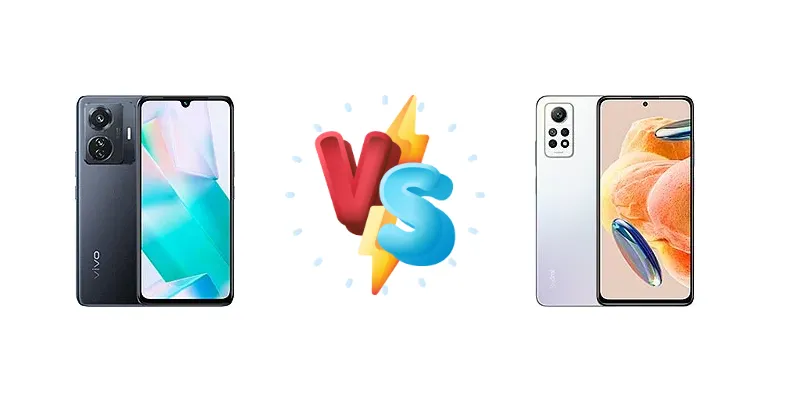
The mid-range smartphone market is fiercely competitive, and the vivo T1 Pro and Xiaomi Redmi Note 12 Pro 4G are two strong contenders. Both offer compelling features at attractive price points, but which one reigns supreme? Let's dive into a detailed comparison to help you decide.
🏆 Quick Verdict
The vivo T1 Pro edges out the Redmi Note 12 Pro 4G thanks to its superior chipset (Snapdragon 778G vs 732G), faster charging, and generally smoother performance. While the Redmi Note 12 Pro 4G offers a solid experience, the T1 Pro provides a more premium feel.
| Network |
|---|
| 2G bands | GSM 850 / 900 / 1800 / 1900 | GSM 850 / 900 / 1800 / 1900 |
| 3G bands | HSDPA 850 / 900 / 2100 | HSDPA 850 / 900 / 1700(AWS) / 1900 / 2100 |
| 4G bands | 1, 3, 5, 8, 38, 40, 41 | 1, 2, 3, 4, 5, 7, 8, 20, 28, 38, 40, 41, 66 |
| 5G bands | 1, 3, 5, 8, 41, 77, 78 SA/NSA | - |
| Speed | HSPA, LTE, 5G | HSPA, LTE |
| Technology | GSM / HSPA / LTE / 5G | GSM / HSPA / LTE |
| Launch |
|---|
| Announced | 2022, May 04 | 2023, March 03 |
| Status | Available. Released 2022, May 07 | Available. Released 2023, April 11 |
| Body |
|---|
| Build | Glass front, plastic frame, plastic back | - |
| Dimensions | 159.7 x 73.6 x 8.5 mm (6.29 x 2.90 x 0.33 in) | 164.2 x 76.1 x 8.1 mm (6.46 x 3.00 x 0.32 in) |
| SIM | Nano-SIM + Nano-SIM | Nano-SIM + Nano-SIM |
| Weight | 180.3 g (6.35 oz) | 201.8 g (7.13 oz) |
| Display |
|---|
| Resolution | 1080 x 2404 pixels, 20:9 ratio (~409 ppi density) | 1080 x 2400 pixels, 20:9 ratio (~395 ppi density) |
| Size | 6.44 inches, 100.0 cm2 (~85.1% screen-to-body ratio) | 6.67 inches, 107.4 cm2 (~86.0% screen-to-body ratio) |
| Type | AMOLED, HDR10+, 1300 nits (peak) | AMOLED, 120Hz, Dolby Vision, 700 nits (HBM), 1100 nits (peak) |
| Platform |
|---|
| CPU | Octa-core (1x2.4 GHz Cortex-A78 & 3x2.2 GHz Cortex-A78 & 4x1.9 GHz Cortex-A55) | Octa-core (2x2.2 GHz Kryo 470 Gold & 6x1.8 GHz Kryo 470 Silver) |
| Chipset | Qualcomm SM7325 Snapdragon 778G 5G (6 nm) | Qualcomm SM7150 Snapdragon 732G (8 nm) |
| GPU | Adreno 642L | Adreno 618 |
| OS | Android 12, Funtouch 12 | Android 11, MIUI 13 |
| Memory |
|---|
| Card slot | No | microSDXC (uses shared SIM slot) |
| Internal | 128GB 6GB RAM, 128GB 8GB RAM | 128GB 6GB RAM, 128GB 8GB RAM, 256GB 8GB RAM |
| | - | UFS 2.2 |
| Main Camera |
|---|
| Features | Dual-LED dual-tone flash, HDR, panorama | LED flash, HDR, panorama |
| Quad | - | 108 MP, f/1.9, (wide), 1/1.52", 0.7µm, PDAF
8 MP, 120˚, (ultrawide)
2 MP (macro)
Auxiliary lens |
| Single | 16 MP, f/2.0, (wide) | - |
| Triple | 64 MP, f/1.8, 26mm (wide), PDAF
8 MP, f/2.2, 117˚ (ultrawide)
2 MP (macro) | - |
| Video | 1080p@30fps, gyro-EIS | 4K@30fps, 1080p@30/60fps |
| Selfie camera |
|---|
| Single | 16 MP, f/2.0, (wide) | 16 MP, f/2.4, (wide) |
| Video | 1080p@30fps | 1080p@30fps |
| Sound |
|---|
| 3.5mm jack | No | Yes |
| 35mm jack | No | Yes |
| Loudspeaker | Yes | Yes, with stereo speakers |
| | 24-bit/192kHz audio | - |
| Comms |
|---|
| Bluetooth | 5.2, A2DP, LE | 5.0, A2DP, LE |
| Infrared port | - | Yes |
| NFC | No | Yes (market/region dependent) |
| Positioning | GPS, GLONASS, GALILEO, BDS | GPS, GLONASS, GALILEO, BDS |
| Radio | No | Unspecified |
| USB | USB Type-C 2.0, OTG | USB Type-C 2.0, OTG |
| WLAN | Wi-Fi 802.11 a/b/g/n/ac, dual-band, Wi-Fi Direct | Wi-Fi 802.11 a/b/g/n/ac, dual-band |
| Features |
|---|
| Sensors | Fingerprint (under display, optical), accelerometer, gyro, proximity, compass | Fingerprint (side-mounted), accelerometer, gyro, compass |
| Battery |
|---|
| Charging | 66W wired, 50% in 18 min | 67W wired |
| Type | 4700 mAh | Li-Po 5000 mAh |
| Misc |
|---|
| Colors | Turbo Black, Turbo Cyan | Star Blue, Graphite Gray, Polar White, Ice blue |
| Models | V2151 | 2209116AG, 2209116AG |
| Price | About 300 EUR | About 150 EUR |
vivo T1 Pro
- Superior Chipset (Snapdragon 778G)
- Faster Charging (66W)
- Generally Smoother Performance
- Good Value
- Camera consistency can vary
- Design might not appeal to everyone
Xiaomi Redmi Note 12 Pro 4G
- Versatile Camera System
- Good Battery Life
- Reliable Performance
- Attractive Price
- Slower Chipset (Snapdragon 732G)
- Slightly slower charging
- 4G only
Display Comparison
Both phones feature AMOLED displays, offering vibrant colors and deep blacks. The Redmi Note 12 Pro 4G typically has a slightly higher refresh rate (120Hz vs 120Hz on the T1 Pro, though this can vary by region), potentially resulting in smoother scrolling. Screen size is similar, around 6.6 inches, making them both comfortable to hold and use.
Camera Comparison
The Redmi Note 12 Pro 4G generally has a more versatile camera system, often including a higher resolution main sensor (typically 50MP vs 64MP on the T1 Pro) and potentially a dedicated macro lens. Image quality is generally comparable in good lighting conditions, but the Redmi Note 12 Pro 4G might offer slightly better detail in certain scenarios. Low-light performance is decent on both, but the T1 Pro's image processing can sometimes be inconsistent.
Performance
The vivo T1 Pro boasts a significant advantage here. Its Snapdragon 778G chipset is noticeably faster and more efficient than the Redmi Note 12 Pro 4G's Snapdragon 732G. This translates to quicker app loading times, smoother multitasking, and better gaming performance. The T1 Pro's 6nm process also contributes to better power efficiency.
Battery Life
Both phones offer respectable battery life, easily lasting a full day with moderate usage. The vivo T1 Pro's 66W charging is faster than the Redmi Note 12 Pro 4G's 67W, allowing for quicker top-ups. However, the difference in charging speed is minimal in practice.
Buying Guide
The vivo T1 Pro is ideal for users prioritizing performance and fast charging. If you're a gamer or frequently multitask, the T1 Pro's chipset will be a noticeable upgrade. The Xiaomi Redmi Note 12 Pro 4G is a great choice for those seeking a reliable, well-rounded phone with a good camera and battery life, especially if 5G isn't a necessity.
Frequently Asked Questions
❓ Is the vivo T1 Pro worth the extra money?
If performance is a priority, then yes. The Snapdragon 778G offers a noticeable upgrade over the 732G. However, if you're on a tight budget and primarily need a reliable phone for everyday tasks, the Redmi Note 12 Pro 4G is a great value.
❓ Does the Redmi Note 12 Pro 4G support 5G?
No, the Redmi Note 12 Pro 4G is a 4G-only device. If 5G connectivity is important to you, consider the 5G variant of the Redmi Note 12 Pro or explore other options.