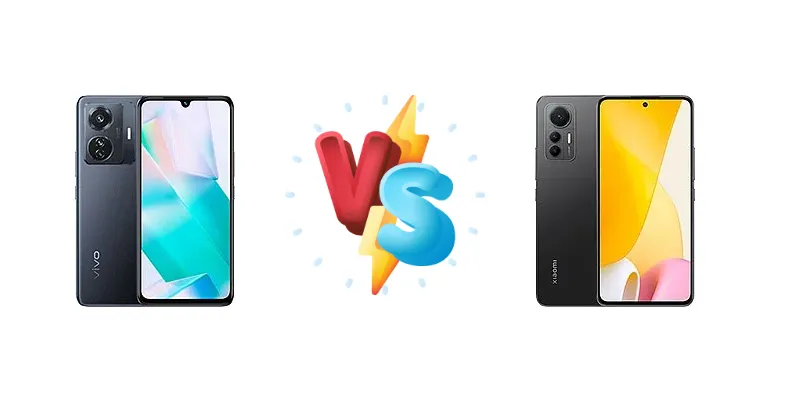
The mid-range smartphone market is fiercely competitive, and the vivo T1 Pro and Xiaomi 12 Lite are two strong contenders. Both offer compelling features at attractive price points, but cater to slightly different user needs. Let's dive into a detailed comparison to help you determine which one is the perfect fit for you.
🏆 Quick Verdict
The Xiaomi 12 Lite edges out the vivo T1 Pro thanks to its slightly faster charging, potentially better display brightness, and generally sleeker design. However, the vivo T1 Pro might offer a more competitive price, making it a strong value proposition for budget-conscious buyers.
| Network |
|---|
| 2G bands | GSM 850 / 900 / 1800 / 1900 | GSM 850 / 900 / 1800 / 1900 |
| 3G bands | HSDPA 850 / 900 / 2100 | HSDPA 850 / 900 / 1700(AWS) / 1900 / 2100 |
| 4G bands | 1, 3, 5, 8, 38, 40, 41 | 1, 2, 3, 4, 5, 7, 8, 12, 13, 17, 18, 19, 20, 26, 28, 32, 38, 40, 41, 42, 48, 66 |
| 5G bands | 1, 3, 5, 8, 41, 77, 78 SA/NSA | 1, 3, 5, 7, 8, 20, 28, 38, 40, 41, 66, 77, 78 SA/NSA |
| Speed | HSPA, LTE, 5G | HSPA, LTE, 5G |
| Technology | GSM / HSPA / LTE / 5G | GSM / HSPA / LTE / 5G |
| Launch |
|---|
| Announced | 2022, May 04 | 2022, July 09 |
| Status | Available. Released 2022, May 07 | Available. Released 2022, July 11 |
| Body |
|---|
| Build | Glass front, plastic frame, plastic back | Glass front (Gorilla Glass 5), glass back, plastic frame |
| Dimensions | 159.7 x 73.6 x 8.5 mm (6.29 x 2.90 x 0.33 in) | 159.3 x 73.7 x 7.3 mm (6.27 x 2.90 x 0.29 in) |
| SIM | Nano-SIM + Nano-SIM | Nano-SIM + Nano-SIM |
| Weight | 180.3 g (6.35 oz) | 173 g (6.10 oz) |
| Display |
|---|
| Protection | - | Corning Gorilla Glass 5 |
| Resolution | 1080 x 2404 pixels, 20:9 ratio (~409 ppi density) | 1080 x 2400 pixels, 20:9 ratio (~402 ppi density) |
| Size | 6.44 inches, 100.0 cm2 (~85.1% screen-to-body ratio) | 6.55 inches, 103.6 cm2 (~88.2% screen-to-body ratio) |
| Type | AMOLED, HDR10+, 1300 nits (peak) | AMOLED, 68B colors, 120Hz, Dolby Vision, HDR10+, 950 nits (peak) |
| Platform |
|---|
| CPU | Octa-core (1x2.4 GHz Cortex-A78 & 3x2.2 GHz Cortex-A78 & 4x1.9 GHz Cortex-A55) | Octa-core (1x2.4 GHz Cortex-A78 & 3x2.2 GHz Cortex-A78 & 4x1.9 GHz Cortex-A55) |
| Chipset | Qualcomm SM7325 Snapdragon 778G 5G (6 nm) | Qualcomm SM7325 Snapdragon 778G 5G (6 nm) |
| GPU | Adreno 642L | Adreno 642L |
| OS | Android 12, Funtouch 12 | Android 12, upgradable to Android 14, HyperOS |
| Memory |
|---|
| Card slot | No | No |
| Internal | 128GB 6GB RAM, 128GB 8GB RAM | 128GB 6GB RAM, 128GB 8GB RAM, 256GB 8GB RAM |
| | - | UFS 2.2 |
| Main Camera |
|---|
| Features | Dual-LED dual-tone flash, HDR, panorama | Dual-LED dual-tone flash, HDR, panorama |
| Single | 16 MP, f/2.0, (wide) | 32 MP, f/2.5, (wide), 1/2.8", 0.8µm, AF |
| Triple | 64 MP, f/1.8, 26mm (wide), PDAF
8 MP, f/2.2, 117˚ (ultrawide)
2 MP (macro) | 108 MP, f/1.9, 26mm (wide), 1/1.52", 0.7µm, PDAF
8 MP, f/2.2, 120˚ (ultrawide), 1/4.0", 1.12µm
2 MP (macro) |
| Video | 1080p@30fps, gyro-EIS | 4K@30fps, 1080p@30/60/120fps; gyro-EIS |
| Selfie camera |
|---|
| Features | - | HDR, panorama |
| Single | 16 MP, f/2.0, (wide) | 32 MP, f/2.5, (wide), 1/2.8", 0.8µm, AF |
| Video | 1080p@30fps | 1080p@30/60fps, 720p@120fps |
| Sound |
|---|
| 3.5mm jack | No | No |
| 35mm jack | No | No |
| Loudspeaker | Yes | Yes, with dual speakers |
| | 24-bit/192kHz audio | 24-bit/192kHz audio |
| Comms |
|---|
| Bluetooth | 5.2, A2DP, LE | 5.2, A2DP, LE, aptX HD, aptX Adaptive |
| Infrared port | - | Yes |
| NFC | No | Yes (market/region dependent) |
| Positioning | GPS, GLONASS, GALILEO, BDS | GPS (L1), GLONASS (G1), BDS (B1I+B1c), GALILEO (E1), QZSS (L1) |
| Radio | No | No |
| USB | USB Type-C 2.0, OTG | USB Type-C 2.0, OTG |
| WLAN | Wi-Fi 802.11 a/b/g/n/ac, dual-band, Wi-Fi Direct | Wi-Fi 802.11 a/b/g/n/ac/6, dual-band, Wi-Fi Direct |
| Features |
|---|
| Sensors | Fingerprint (under display, optical), accelerometer, gyro, proximity, compass | Fingerprint (under display, optical), accelerometer, gyro, compass |
| | - | Virtual proximity sensing |
| Battery |
|---|
| Charging | 66W wired, 50% in 18 min | 67W wired, PD3.0, QC4, 50% in 13 min |
| Type | 4700 mAh | Li-Po 4300 mAh |
| Misc |
|---|
| Colors | Turbo Black, Turbo Cyan | Black, Lite Green, Lite Pink |
| Models | V2151 | 2203129G |
| Price | About 300 EUR | € 119.80 / $ 269.00 / £ 121.15 |
| SAR | - | 1.09 W/kg (head) 0.73 W/kg (body) |
| SAR EU | - | 0.60 W/kg (head) 1.00 W/kg (body) |
| Tests |
|---|
| Battery life | - |
Endurance rating 100h
|
| Camera | - |
Photo / Video |
| Display | - |
Contrast ratio: Infinite (nominal) |
| Loudspeaker | - |
-25.2 LUFS (Very good)
|
| Performance | - |
AnTuTu: 528905 (v9)
GeekBench: 2943 (v5.1)
GFXBench: 29fps (ES 3.1 onscreen) |
vivo T1 Pro
- Excellent value for money
- Reliable performance with Snapdragon 778G
- Fast 66W charging
- Potentially less bright display
- Camera may not be as good as Xiaomi 12 Lite
- Design might be less premium
Xiaomi 12 Lite
- Stylish and sleek design
- Faster 67W charging
- Potentially brighter display
- Good selfie camera
- May be slightly more expensive
- Infinite contrast ratio claim is nominal
- Performance is similar to T1 Pro
Display Comparison
Both phones feature AMOLED displays, offering vibrant colors and deep blacks. The Xiaomi 12 Lite boasts a measured peak brightness of 824 nits, suggesting better visibility in direct sunlight compared to the T1 Pro. The T1 Pro's display is likely good, but lacks specific brightness data. Xiaomi also touts an 'infinite' contrast ratio, though this is a nominal value.
Camera Comparison
Camera performance is a key differentiator. While both are described as 'Photo / Video', the Xiaomi 12 Lite is generally known for its improved selfie camera and overall image processing. The vivo T1 Pro's camera is competent, but may not match the Xiaomi's quality, especially in low light. Specific camera specs (megapixels, aperture) would be needed for a more precise comparison.
Performance
Both devices share the same Snapdragon 778G 5G chipset and CPU configuration, meaning performance should be very similar in everyday tasks and gaming. Expect smooth multitasking and responsive app loading on both.
Battery Life
The Xiaomi 12 Lite claims an endurance rating of 100 hours, suggesting excellent battery life. The vivo T1 Pro's battery capacity is likely comparable, but the Xiaomi's charging speed (67W vs 66W) gives it an advantage in topping up quickly. The Xiaomi 12 Lite charges to 50% in 13 minutes, while the T1 Pro takes 18 minutes.
Buying Guide
Who should buy the vivo T1 Pro? Users prioritizing value and a reliable all-around performer. Who should buy the Xiaomi 12 Lite? Those seeking a stylish design, slightly faster charging, and potentially a brighter display for outdoor use.
Frequently Asked Questions
❓ Which phone has better battery life?
The Xiaomi 12 Lite claims a higher endurance rating (100h) and faster charging (67W), suggesting better overall battery performance.
❓ Are the performance differences significant?
No, both phones use the same Snapdragon 778G chipset, so performance will be very similar for most users.