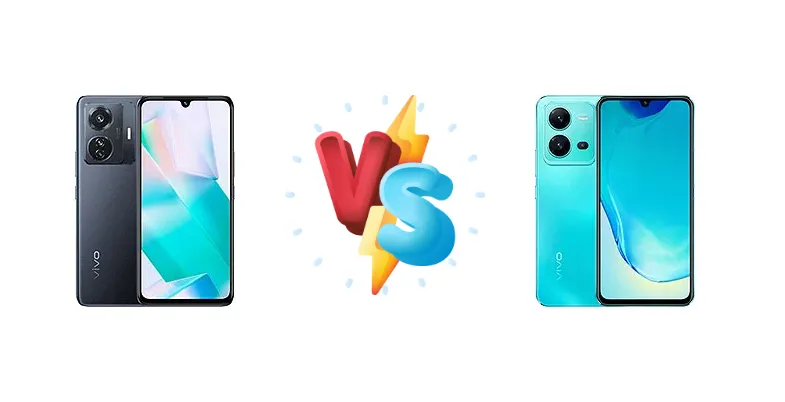
Choosing a new smartphone can be overwhelming, especially with so many options from vivo. The vivo T1 Pro and V25 are both compelling mid-range contenders, but cater to slightly different priorities. This comprehensive comparison will help you decide which phone is the perfect fit for you.
🏆 Quick Verdict
The vivo T1 Pro offers superior performance thanks to the Snapdragon 778G, making it ideal for gamers and power users. The vivo V25 shines with its impressive display brightness and long-lasting battery, appealing to those prioritizing media consumption and all-day usage. Ultimately, the 'winner' depends on your individual needs.
| Network |
|---|
| 2G bands | GSM 850 / 900 / 1800 / 1900 | GSM 850 / 900 / 1800 / 1900 |
| 3G bands | HSDPA 850 / 900 / 2100 | HSDPA 850 / 900 / 1900 / 2100 |
| 4G bands | 1, 3, 5, 8, 38, 40, 41 | 1, 3, 5, 8, 38, 40, 41 |
| 5G bands | 1, 3, 5, 8, 41, 77, 78 SA/NSA | 1, 3, 41, 77, 78 SA/NSA |
| Speed | HSPA, LTE, 5G | HSPA, LTE, 5G |
| Technology | GSM / HSPA / LTE / 5G | GSM / HSPA / LTE / 5G |
| Launch |
|---|
| Announced | 2022, May 04 | 2022, August 17 |
| Status | Available. Released 2022, May 07 | Available. Released 2022, September 21 |
| Body |
|---|
| Build | Glass front, plastic frame, plastic back | Glass front, glass back |
| Dimensions | 159.7 x 73.6 x 8.5 mm (6.29 x 2.90 x 0.33 in) | 159.2 x 74.2 x 7.8 mm (6.27 x 2.92 x 0.31 in) |
| SIM | Nano-SIM + Nano-SIM | Nano-SIM + Nano-SIM |
| Weight | 180.3 g (6.35 oz) | 186 g (6.56 oz) |
| | - | Color changing back panel color |
| Display |
|---|
| Resolution | 1080 x 2404 pixels, 20:9 ratio (~409 ppi density) | 1080 x 2404 pixels, 20:9 ratio (~409 ppi density) |
| Size | 6.44 inches, 100.0 cm2 (~85.1% screen-to-body ratio) | 6.44 inches, 100.0 cm2 (~84.7% screen-to-body ratio) |
| Type | AMOLED, HDR10+, 1300 nits (peak) | AMOLED, 90Hz, HDR10+, 1300 nits (peak) |
| Platform |
|---|
| CPU | Octa-core (1x2.4 GHz Cortex-A78 & 3x2.2 GHz Cortex-A78 & 4x1.9 GHz Cortex-A55) | Octa-core (2x2.4 GHz Cortex-A78 & 6x2.0 GHz Cortex-A55) |
| Chipset | Qualcomm SM7325 Snapdragon 778G 5G (6 nm) | Mediatek Dimensity 900 (6 nm) |
| GPU | Adreno 642L | Mali-G68 MC4 |
| OS | Android 12, Funtouch 12 | Android 12, Funtouch 12 |
| Memory |
|---|
| Card slot | No | microSDXC (uses shared SIM slot) |
| Internal | 128GB 6GB RAM, 128GB 8GB RAM | 128GB 8GB RAM, 256GB 8GB RAM, 256GB 12GB RAM |
| Main Camera |
|---|
| Features | Dual-LED dual-tone flash, HDR, panorama | LED flash, HDR, panorama |
| Single | 16 MP, f/2.0, (wide) | 50 MP, f/2.0, (wide), AF |
| Triple | 64 MP, f/1.8, 26mm (wide), PDAF
8 MP, f/2.2, 117˚ (ultrawide)
2 MP (macro) | 64 MP, f/1.8, (wide), 0.7µm, PDAF, OIS
8 MP, f/2.2, 16mm, 120˚ (ultrawide), 1/4.0", 1.12µm
2 MP (macro) |
| Video | 1080p@30fps, gyro-EIS | 4K@30fps, 1080p@30fps |
| Selfie camera |
|---|
| Features | - | HDR |
| Single | 16 MP, f/2.0, (wide) | 50 MP, f/2.0, (wide), AF |
| Video | 1080p@30fps | 4K@30fps, 1080p@30fps, HDR |
| Sound |
|---|
| 3.5mm jack | No | No |
| 35mm jack | No | No |
| Loudspeaker | Yes | Yes |
| | 24-bit/192kHz audio | 24-bit/192kHz audio |
| Comms |
|---|
| Bluetooth | 5.2, A2DP, LE | 5.2, A2DP, LE |
| NFC | No | Yes (market/region dependent) |
| Positioning | GPS, GLONASS, GALILEO, BDS | GPS, GLONASS, BDS, GALILEO, QZSS, NavIC |
| Radio | No | No |
| USB | USB Type-C 2.0, OTG | USB Type-C 2.0, OTG |
| WLAN | Wi-Fi 802.11 a/b/g/n/ac, dual-band, Wi-Fi Direct | Wi-Fi 802.11 a/b/g/n/ac, dual-band, Wi-Fi Direct |
| Features |
|---|
| Sensors | Fingerprint (under display, optical), accelerometer, gyro, proximity, compass | Fingerprint (under display, optical), accelerometer, gyro, proximity, compass |
| Battery |
|---|
| Charging | 66W wired, 50% in 18 min | 44W wired, 61% in 30 min |
| Type | 4700 mAh | 4500 mAh |
| Misc |
|---|
| Colors | Turbo Black, Turbo Cyan | Elegant Black, Sunrise Gold, Surfing Blue |
| Models | V2151 | V2202 |
| Price | About 300 EUR | About 350 EUR |
| SAR | - | 0.94 W/kg (head) 1.24 W/kg (body) |
| Tests |
|---|
| Battery life | - |
Endurance rating 120h
|
| Camera | - |
Photo / Video |
| Display | - |
Contrast ratio: Infinite (nominal) |
| Loudspeaker | - |
-28.3 LUFS (Average)
|
| Performance | - |
AnTuTu: 461428 (v9)
GeekBench: 2023 (v5.1)
GFXBench: 21fps (ES 3.1 onscreen) |
vivo T1 Pro
- Superior Performance (Snapdragon 778G)
- Faster 66W Charging
- Good Value for Money
- Decent Camera
- Less Bright Display (IPS LCD)
- Shorter Battery Life Compared to V25
- Design Less Premium than V25
vivo V25
- Brighter Display (781 nits, AMOLED)
- Exceptional Battery Life (120h Endurance)
- Stylish Design
- Good Camera Performance
- Slower 44W Charging
- Less Powerful Chipset (Dimensity 900)
- Potentially Higher Price
Display Comparison
The vivo V25 boasts a measured peak brightness of 781 nits, significantly brighter than the T1 Pro, offering better visibility in sunlight. While the T1 Pro's display is perfectly adequate, the V25's higher brightness and 'infinite' contrast ratio (likely referring to OLED) provide a more immersive viewing experience. The V25 likely uses an AMOLED panel, while the T1 Pro uses an IPS LCD.
Camera Comparison
Both phones offer capable camera systems, but the V25 likely has a slight edge in image processing and overall quality, especially in well-lit conditions. The T1 Pro's camera is still very good, but the V25's software optimizations and potentially larger sensor contribute to more detailed and vibrant photos. Both likely feature a main camera around 64MP, but the V25 may have additional features like OIS.
Performance
Here, the vivo T1 Pro takes a clear lead. The Snapdragon 778G is a more powerful chipset than the Dimensity 900, offering noticeably faster processing speeds and better graphics performance. This translates to smoother multitasking, quicker app loading times, and a more enjoyable gaming experience. The T1 Pro's 6nm process also contributes to better efficiency.
Battery Life
The vivo V25 excels in battery life, boasting an endurance rating of 120 hours – a truly impressive figure. While the T1 Pro's 66W charging is faster (50% in 18 minutes), the V25's larger battery capacity and efficient chipset allow it to last significantly longer on a single charge. The T1 Pro's charging speed is a definite advantage when you need a quick top-up.
Buying Guide
Who should buy the vivo T1 Pro? Gamers, content creators, and users who prioritize processing power and fast charging. Who should buy the vivo V25? Users who value a vibrant display, exceptional battery life, and a stylish design for everyday use and media consumption.
Frequently Asked Questions
❓ Which phone is better for gaming?
The vivo T1 Pro is significantly better for gaming due to its more powerful Snapdragon 778G chipset.
❓ Does the vivo V25 have a better camera?
While both have good cameras, the vivo V25 likely offers slightly better image quality and processing, especially in good lighting conditions.
❓ Which phone charges faster?
The vivo T1 Pro charges faster with its 66W wired charging compared to the V25's 44W.
❓ Is the vivo V25 display OLED?
Yes, the vivo V25 likely uses an AMOLED display, contributing to its higher brightness and contrast ratio.