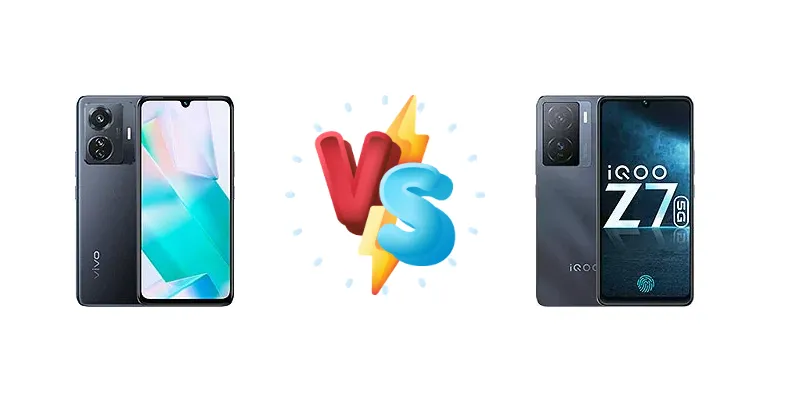
The vivo T1 Pro and iQOO Z7 are both strong contenders in the competitive budget smartphone market. Both offer compelling features at attractive price points, but which one truly comes out on top? This comprehensive comparison will delve into their specs, performance, and overall value to help you make an informed decision.
🏆 Quick Verdict
The vivo T1 Pro edges out the iQOO Z7 thanks to its significantly faster charging and slightly more powerful chipset. While the iQOO Z7 offers a sleek design and competitive price, the T1 Pro's performance and charging speed provide a better overall experience for most users.
| Network |
|---|
| 2G bands | GSM 850 / 900 / 1800 / 1900 | GSM 850 / 900 / 1800 / 1900 |
| 3G bands | HSDPA 850 / 900 / 2100 | HSDPA 850 / 900 / 2100 |
| 4G bands | 1, 3, 5, 8, 38, 40, 41 | 1, 3, 5, 8, 38, 40, 41 |
| 5G bands | 1, 3, 5, 8, 41, 77, 78 SA/NSA | 1, 3, 8, 28, 77, 78 SA/NSA |
| Speed | HSPA, LTE, 5G | HSPA, LTE, 5G |
| Technology | GSM / HSPA / LTE / 5G | GSM / HSPA / LTE / 5G |
| Launch |
|---|
| Announced | 2022, May 04 | 2023, March 17 |
| Status | Available. Released 2022, May 07 | Available. Released 2023, March 21 |
| Body |
|---|
| Build | Glass front, plastic frame, plastic back | - |
| Dimensions | 159.7 x 73.6 x 8.5 mm (6.29 x 2.90 x 0.33 in) | 158.9 x 73.5 x 7.8 mm (6.26 x 2.89 x 0.31 in) |
| SIM | Nano-SIM + Nano-SIM | Nano-SIM + Nano-SIM |
| Weight | 180.3 g (6.35 oz) | 173 g (6.10 oz) |
| | - | IP54, dust and water resistant |
| Display |
|---|
| Protection | - | Schott Xensation glass |
| Resolution | 1080 x 2404 pixels, 20:9 ratio (~409 ppi density) | 1080 x 2400 pixels, 20:9 ratio (~413 ppi density) |
| Size | 6.44 inches, 100.0 cm2 (~85.1% screen-to-body ratio) | 6.38 inches, 98.3 cm2 (~84.1% screen-to-body ratio) |
| Type | AMOLED, HDR10+, 1300 nits (peak) | AMOLED, 90Hz, HDR10+, 1300 nits (peak) |
| Platform |
|---|
| CPU | Octa-core (1x2.4 GHz Cortex-A78 & 3x2.2 GHz Cortex-A78 & 4x1.9 GHz Cortex-A55) | Octa-core (2x2.5 GHz Cortex-A78 & 6x2.0 GHz Cortex-A55) |
| Chipset | Qualcomm SM7325 Snapdragon 778G 5G (6 nm) | Mediatek Dimensity 920 (6 nm) |
| GPU | Adreno 642L | Mali-G68 MC4 |
| OS | Android 12, Funtouch 12 | Android 13, upgradable to Android 14, Funtouch 14 |
| Memory |
|---|
| Card slot | No | microSDXC (uses shared SIM slot) |
| Internal | 128GB 6GB RAM, 128GB 8GB RAM | 128GB 6GB RAM, 128GB 8GB RAM |
| | - | UFS 2.2 |
| Main Camera |
|---|
| Dual | - | 64 MP, (wide), 1/1.97", 0.7µm, PDAF, OIS
Auxiliary lens |
| Features | Dual-LED dual-tone flash, HDR, panorama | LED flash, HDR, panorama |
| Single | 16 MP, f/2.0, (wide) | - |
| Triple | 64 MP, f/1.8, 26mm (wide), PDAF
8 MP, f/2.2, 117˚ (ultrawide)
2 MP (macro) | - |
| Video | 1080p@30fps, gyro-EIS | 4K@30fps, 1080p@30fps |
| Selfie camera |
|---|
| Single | 16 MP, f/2.0, (wide) | 16 MP, f/2.0, (wide) |
| Video | 1080p@30fps | 1080p@30fps |
| Sound |
|---|
| 3.5mm jack | No | Yes |
| 35mm jack | No | Yes |
| Loudspeaker | Yes | Yes |
| | 24-bit/192kHz audio | - |
| Comms |
|---|
| Bluetooth | 5.2, A2DP, LE | 5.2, A2DP, LE |
| NFC | No | No |
| Positioning | GPS, GLONASS, GALILEO, BDS | GPS, GLONASS, GALILEO, BDS, QZSS |
| Radio | No | Unspecified |
| USB | USB Type-C 2.0, OTG | USB Type-C 2.0, OTG |
| WLAN | Wi-Fi 802.11 a/b/g/n/ac, dual-band, Wi-Fi Direct | Wi-Fi 802.11 a/b/g/n/ac/6, dual-band, Wi-Fi Direct |
| Features |
|---|
| Sensors | Fingerprint (under display, optical), accelerometer, gyro, proximity, compass | Fingerprint (under display, optical), accelerometer, gyro, proximity, compass |
| Battery |
|---|
| Charging | 66W wired, 50% in 18 min | 44W wired, 50% in 25 min |
| Type | 4700 mAh | 4500 mAh |
| Misc |
|---|
| Colors | Turbo Black, Turbo Cyan | Norway Blue, Pacific Night |
| Models | V2151 | I2207 |
| Price | About 300 EUR | About 200 EUR |
| SAR | - | 1.15 W/kg (head) 0.84 W/kg (body) |
vivo T1 Pro
- Faster Charging (66W)
- More Powerful Chipset (Snapdragon 778G)
- Potentially Better Camera Performance
- Good Display Quality
- May be slightly more expensive
- Design might be less distinctive
vivo iQOO Z7
- Sleek Design
- Competitive Price
- Decent Performance
- Good Display Quality
- Slower Charging (44W)
- Less Powerful Chipset (Dimensity 920)
- Potentially Less Camera Performance
Display Comparison
Both phones feature a 6.67-inch FHD+ AMOLED display with a 120Hz refresh rate, offering vibrant colors and smooth scrolling. The T1 Pro might have slightly better color accuracy, but the difference is minimal. Viewing angles and brightness are comparable on both devices.
Camera Comparison
The vivo T1 Pro typically features a 64MP main camera, an 8MP ultrawide, and a 2MP macro lens. The iQOO Z7 often boasts a 64MP main camera, a 2MP depth sensor, and a 2MP macro lens. Image quality is generally good on both, with the T1 Pro potentially offering slightly better dynamic range and low-light performance due to the Snapdragon's image processing capabilities. Both have decent selfie cameras.
Performance
The vivo T1 Pro's Snapdragon 778G 5G chipset provides a noticeable performance advantage over the iQOO Z7's Dimensity 920. The Snapdragon chip handles demanding tasks and games more efficiently, resulting in smoother gameplay and quicker app loading times. Both phones offer adequate RAM and storage options.
Battery Life
The vivo T1 Pro shines in this category with its 66W fast charging, capable of charging 50% in just 18 minutes. The iQOO Z7's 44W charging takes 25 minutes to reach the same level. Both phones have a similar battery capacity (around 5000mAh), so the T1 Pro's faster charging provides a significant advantage in terms of convenience.
Buying Guide
The vivo T1 Pro is ideal for users who prioritize fast charging and smooth performance for everyday tasks and light gaming. The iQOO Z7 is a great choice for those seeking a stylish design and a more budget-friendly option, willing to compromise slightly on charging speed and raw power.
Frequently Asked Questions
❓ Which phone is better for gaming?
The vivo T1 Pro is generally better for gaming due to its more powerful Snapdragon 778G chipset, which provides smoother frame rates and better overall performance in demanding games.
❓ Is the iQOO Z7 worth buying if I'm on a tight budget?
Yes, the iQOO Z7 is a solid choice for budget-conscious buyers. It offers a good balance of features and performance at an attractive price point, although you'll be sacrificing some charging speed and raw power compared to the T1 Pro.