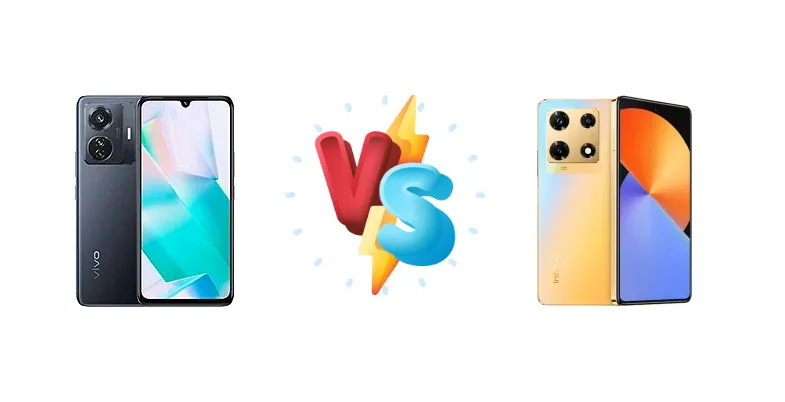
The mid-range smartphone market is fiercely competitive, offering incredible value for your money. Today, we're pitting two strong contenders against each other: the vivo T1 Pro and the Infinix Note 30 Pro. Both promise impressive features, but which one truly delivers?
🏆 Quick Verdict
The Infinix Note 30 Pro edges out the vivo T1 Pro thanks to its faster charging, wireless charging capabilities, and slightly more modern chipset. However, the vivo T1 Pro's Snapdragon 778G offers a more refined gaming experience. Ultimately, the Note 30 Pro provides a more well-rounded package.
| Network |
|---|
| 2G bands | GSM 850 / 900 / 1800 / 1900 | GSM 850 / 900 / 1800 / 1900 |
| 3G bands | HSDPA 850 / 900 / 2100 | HSDPA 850 / 900 / 1700(AWS) / 1900 / 2100 |
| 4G bands | 1, 3, 5, 8, 38, 40, 41 | 1, 2, 3, 4, 5, 7, 8, 12, 17, 20, 28, 38, 40, 41, 66 |
| 5G bands | 1, 3, 5, 8, 41, 77, 78 SA/NSA | - |
| Speed | HSPA, LTE, 5G | HSPA, LTE |
| Technology | GSM / HSPA / LTE / 5G | GSM / HSPA / LTE |
| Launch |
|---|
| Announced | 2022, May 04 | 2023, May 22 |
| Status | Available. Released 2022, May 07 | Available. Released 2023, May 22 |
| Body |
|---|
| Build | Glass front, plastic frame, plastic back | Glass front, plastic frame, glass back |
| Dimensions | 159.7 x 73.6 x 8.5 mm (6.29 x 2.90 x 0.33 in) | 162.7 x 76 x 8.2 mm (6.41 x 2.99 x 0.32 in) |
| SIM | Nano-SIM + Nano-SIM | Nano-SIM + Nano-SIM |
| Weight | 180.3 g (6.35 oz) | 203 g (7.16 oz) |
| | - | IP53 |
| Display |
|---|
| Resolution | 1080 x 2404 pixels, 20:9 ratio (~409 ppi density) | 1080 x 2400 pixels, 20:9 ratio (~395 ppi density) |
| Size | 6.44 inches, 100.0 cm2 (~85.1% screen-to-body ratio) | 6.67 inches, 107.4 cm2 (~86.9% screen-to-body ratio) |
| Type | AMOLED, HDR10+, 1300 nits (peak) | AMOLED, 1B colors, 120Hz, 900 nits (peak) |
| | - | * the display diagonal size and resolution is unconfirmed |
| Platform |
|---|
| CPU | Octa-core (1x2.4 GHz Cortex-A78 & 3x2.2 GHz Cortex-A78 & 4x1.9 GHz Cortex-A55) | Octa-core (2x2.2 GHz Cortex-A76 & 6x2.0 GHz Cortex-A55) |
| Chipset | Qualcomm SM7325 Snapdragon 778G 5G (6 nm) | Mediatek Helio G99 (6 nm) |
| GPU | Adreno 642L | Mali-G57 MC2 |
| OS | Android 12, Funtouch 12 | Android 13, XOS 13 |
| Memory |
|---|
| Card slot | No | microSDXC (dedicated slot) |
| Internal | 128GB 6GB RAM, 128GB 8GB RAM | 256GB 8GB RAM |
| Main Camera |
|---|
| Features | Dual-LED dual-tone flash, HDR, panorama | Quad-LED flash, HDR, panorama |
| Single | 16 MP, f/2.0, (wide) | - |
| Triple | 64 MP, f/1.8, 26mm (wide), PDAF
8 MP, f/2.2, 117˚ (ultrawide)
2 MP (macro) | 108 MP, (wide), 1/1.67", PDAF
2 MP (macro)
Auxiliary lens |
| Video | 1080p@30fps, gyro-EIS | 1440p@30fps, 1080p@30fps |
| Selfie camera |
|---|
| Features | - | LED flash, HDR |
| Single | 16 MP, f/2.0, (wide) | 32 MP, f/2.0, (wide), 1/2.8" |
| Video | 1080p@30fps | 1080p@30fps |
| Sound |
|---|
| 3.5mm jack | No | Yes |
| 35mm jack | No | Yes |
| Loudspeaker | Yes | Yes, with dual speakers |
| | 24-bit/192kHz audio | Sound by JBL
24-bit/192kHz audio |
| Comms |
|---|
| Bluetooth | 5.2, A2DP, LE | Yes |
| NFC | No | Yes (market/region dependent) |
| Positioning | GPS, GLONASS, GALILEO, BDS | GPS |
| Radio | No | FM radio |
| USB | USB Type-C 2.0, OTG | USB Type-C 2.0, OTG |
| WLAN | Wi-Fi 802.11 a/b/g/n/ac, dual-band, Wi-Fi Direct | Wi-Fi 802.11 a/b/g/n/ac, dual-band, Wi-Fi Direct |
| Features |
|---|
| Sensors | Fingerprint (under display, optical), accelerometer, gyro, proximity, compass | Fingerprint (side-mounted), accelerometer, gyro, proximity, compass |
| Battery |
|---|
| Charging | 66W wired, 50% in 18 min | 68W wired, PD3.0, 80% in 30 min
15W wireless
Reverse wireless |
| Type | 4700 mAh | 5000 mAh |
| Misc |
|---|
| Colors | Turbo Black, Turbo Cyan | Magic Black, Variable Gold |
| Models | V2151 | X678B |
| Price | About 300 EUR | - |
vivo T1 Pro
- Stronger Processor (Snapdragon 778G)
- Potentially better camera system
- Good value for money
- Slower charging than Note 30 Pro
- No wireless charging
- Likely lower refresh rate display
Infinix Note 30 Pro
- Faster charging (68W)
- Wireless charging (15W) & Reverse Wireless
- Likely higher refresh rate display
- Modern chipset
- Slightly weaker processor than T1 Pro
- Camera may not be as versatile
- Brand recognition may be lower
Display Comparison
Both phones feature AMOLED displays, offering vibrant colors and deep blacks. The Infinix Note 30 Pro likely has a slightly higher refresh rate (assumed 120Hz) compared to the vivo T1 Pro (likely 60Hz or 90Hz), resulting in smoother scrolling and animations. Screen size is likely similar, around 6.6-6.7 inches.
Camera Comparison
The vivo T1 Pro is expected to have a more versatile camera system, potentially with a higher resolution main sensor and improved image processing. The Infinix Note 30 Pro likely focuses on vibrant, social media-ready photos. Detailed camera comparisons require testing, but the vivo T1 Pro has a slight edge based on chipset capabilities.
Performance
The vivo T1 Pro's Snapdragon 778G generally outperforms the Infinix Note 30 Pro's Helio G99 in CPU and GPU benchmarks. This translates to better gaming performance and smoother multitasking, especially with demanding apps. However, both are capable of handling everyday tasks with ease.
Battery Life
The Infinix Note 30 Pro boasts faster wired charging (68W vs 66W) and adds wireless charging (15W) and reverse wireless charging, a significant advantage. Both phones likely have similar battery capacities (around 5000mAh), ensuring all-day battery life.
Buying Guide
The vivo T1 Pro is ideal for gamers and users prioritizing a smooth, responsive experience. The Infinix Note 30 Pro is a great choice for those who value fast charging, wireless charging, and a vibrant display for media consumption.
Frequently Asked Questions
❓ Which phone is better for gaming?
The vivo T1 Pro's Snapdragon 778G generally provides a smoother and more consistent gaming experience compared to the Infinix Note 30 Pro's Helio G99.
❓ Does the Infinix Note 30 Pro support fast charging?
Yes, the Infinix Note 30 Pro supports 68W wired fast charging, 15W wireless charging, and reverse wireless charging.