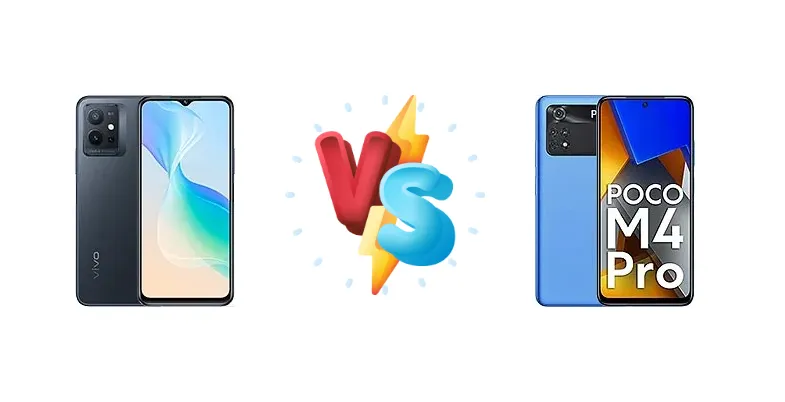
The mid-range smartphone market is fiercely competitive, offering incredible value for your money. Today, we're pitting two popular contenders against each other: the vivo T1 5G and the Xiaomi Poco M4 Pro. Both promise a compelling blend of features and affordability, but which one truly comes out on top?
🏆 Quick Verdict
The Poco M4 Pro edges out the vivo T1 5G thanks to its faster charging, brighter display, and generally more robust feature set. While the T1 5G offers a decent Snapdragon chipset, the Poco's overall package provides a better user experience for the price.
| Network |
|---|
| 2G bands | GSM 850 / 900 / 1800 / 1900 | GSM 850 / 900 / 1800 / 1900 |
| 3G bands | HSDPA 850 / 900 / 2100 | HSDPA 850 / 900 / 1700(AWS) / 1900 / 2100 - International |
| 4G bands | 1, 3, 5, 8, 38, 40, 41 - India | 1, 2, 3, 4, 5, 7, 8, 20, 28, 38, 40, 41 - International |
| 5G bands | 77, 78 SA/NSA - India | - |
| Speed | HSPA, LTE, 5G | HSPA, LTE |
| Technology | GSM / HSPA / LTE / 5G | GSM / HSPA / LTE |
| | 1, 3, 40 SA/NSA - Indonesia | 1, 3, 5, 8, 40, 41 - India |
| Launch |
|---|
| Announced | 2022, February 09 | 2022, February 28 |
| Status | Available. Released 2022, February 14 | Available. Released 2022, March 16 |
| Body |
|---|
| Build | Glass front, plastic frame, plastic back | Glass front (Gorilla Glass 3), plastic frame, plastic back |
| Dimensions | 164 x 75.8 x 8.3 mm (6.46 x 2.98 x 0.33 in) | 159.9 x 73.9 x 8.1 mm (6.30 x 2.91 x 0.32 in) |
| SIM | Nano-SIM + Nano-SIM | Nano-SIM + Nano-SIM |
| Weight | 187 g (6.60 oz) | 179.5 g (6.31 oz) |
| | - | IP53, dust and splash resistant |
| Display |
|---|
| Protection | - | Corning Gorilla Glass 3 |
| Resolution | 1080 x 2408 pixels, 20:9 ratio (~401 ppi density) | 1080 x 2400 pixels, 20:9 ratio (~409 ppi density) |
| Size | 6.58 inches, 104.3 cm2 (~83.9% screen-to-body ratio) | 6.43 inches, 99.8 cm2 (~84.5% screen-to-body ratio) |
| Type | IPS LCD, 120Hz | AMOLED, 90Hz, 700 nits, 1000 nits (peak) |
| Platform |
|---|
| CPU | Octa-core (2x2.2 GHz Kryo 660 Gold & 6x1.7 GHz Kryo 660 Silver)Octa-core (2x2.4 GHz Cortex-A76 & 6x2.0 GHz Cortex-A55) - Indonesia | Octa-core (2x2.05 GHz Cortex-A76 & 6x2.0 GHz Cortex-A55) |
| Chipset | Qualcomm SM6375 Snapdragon 695 5G (6 nm)Mediatek Dimensity 810 (6 nm) - Indonesia | Mediatek MT6781 Helio G96 (12 nm) |
| GPU | Adreno 619Mali-G57 MC2 - Indonesia | Mali-G57 MC2 |
| OS | Android 11, Funtouch 12 | Android 11, MIUI 13 for POCO |
| Memory |
|---|
| Card slot | microSDXC (uses shared SIM slot) | microSDXC (dedicated slot) |
| Internal | 128GB 4GB RAM, 128GB 6GB RAM, 128GB 8GB RAM, 256GB 8GB RAM | 64GB 6GB RAM, 128GB 6GB RAM, 128GB 8GB RAM, 256GB 8GB RAM |
| | UFS 2.2 - India | UFS 2.2 |
| Main Camera |
|---|
| Features | Dual-LED flash, HDR, panorama | LED flash, HDR, panorama |
| Single | 16 MP, f/2.0, (wide) | 16 MP, f/2.5, (wide), 1/3.06" 1.0µm |
| Triple | 50 MP, f/1.8, 26mm (wide), PDAF
2 MP (macro)
Auxiliary lens | 64 MP, f/1.8, 26mm (wide), 0.7µm, PDAF
8 MP, f/2.2, 118˚ (ultrawide), 1/4.0", 1.12µm
2 MP (macro) |
| Video | 1080p@30fps | 1080p@30fps |
| Selfie camera |
|---|
| Features | - | HDR |
| Single | 16 MP, f/2.0, (wide) | 16 MP, f/2.5, (wide), 1/3.06" 1.0µm |
| Video | 1080p@30fps | 1080p@30fps |
| Sound |
|---|
| 3.5mm jack | Yes | Yes |
| 35mm jack | Yes | Yes |
| Loudspeaker | Yes | Yes, with stereo speakers |
| | - | 24-bit/192kHz audio |
| Comms |
|---|
| Bluetooth | 5.1, A2DP, LE | 5.0, A2DP, LE |
| Infrared port | - | Yes |
| NFC | Yes (market/region dependent) | Yes |
| Positioning | GPS, GLONASS, GALILEO, BDS, QZSS | GPS, GLONASS, BDS, GALILEO |
| Radio | FM radio | FM radio, recording |
| USB | USB Type-C 2.0, OTG | USB Type-C 2.0, OTG |
| WLAN | Wi-Fi 802.11 a/b/g/n/ac, dual-band, Wi-Fi Direct | Wi-Fi 802.11 a/b/g/n/ac, dual-band, Wi-Fi Direct |
| Features |
|---|
| Sensors | Fingerprint (side-mounted), accelerometer, proximity, compass | Fingerprint (side-mounted), accelerometer, gyro, compass |
| | - | Virtual proximity sensing |
| Battery |
|---|
| Charging | 18W wired | 33W wired, PD3.0, QC3, 100% in 58 min |
| Type | 5000 mAh | Li-Po 5000 mAh |
| Misc |
|---|
| Colors | Starlight Black, Rainbow Fantasy | Power Black, Cool Blue, Poco Yellow |
| Models | V2141, V2157 | MZB0B5VIN, 2201117PI, 2201117PG |
| Price | About 180 EUR | € 100.18 |
| SAR | - | 0.85 W/kg (head) 0.85 W/kg (body) |
| SAR EU | - | 0.59 W/kg (head) 0.84 W/kg (body) |
| Tests |
|---|
| Battery life | - |
Endurance rating 126h
|
| Camera | - |
Photo / Video |
| Display | - |
Contrast ratio: Infinite (nominal) |
| Loudspeaker | - |
-25.2 LUFS (Very good)
|
| Performance | - |
AnTuTu: 318444 (v9)
GeekBench: 1836 (v5.1)
GFXBench: 12fps (ES 3.1 onscreen) |
vivo T1 5G
- 5G Connectivity
- Potentially better performance (Snapdragon 695)
- Streamlined Funtouch OS (subjective)
- Slower charging (18W)
- Likely dimmer display
- Camera specs less clear
- Battery life not as impressive as Poco M4 Pro
Xiaomi Poco M4 Pro
- Faster charging (33W)
- Brighter display
- Excellent battery life (126h endurance)
- Versatile camera system (likely)
- Helio G96 chipset (slightly less powerful)
- MIUI software (can be bloated)
- 12nm process (less efficient than 6nm)
Display Comparison
The Poco M4 Pro boasts a significantly brighter display (737 nits vs. likely around 500 nits for the T1 5G), making it easier to view content outdoors. Both feature FHD+ resolution, but the Poco's higher brightness gives it a noticeable advantage. The 'Infinite' contrast ratio claim on the Poco is nominal and difficult to verify, but generally, LCD panels offer good contrast.
Camera Comparison
The Poco M4 Pro likely has a more versatile camera system, potentially including a higher resolution main sensor and more advanced features. While both offer decent image quality in good lighting, the Poco's camera is expected to perform better in low-light conditions. Specific camera specs are missing for the T1 5G, making a direct comparison difficult.
Performance
The vivo T1 5G's Snapdragon 695 5G generally offers slightly better performance than the Poco M4 Pro's Helio G96, particularly in graphics-intensive tasks. However, both are capable of handling everyday tasks and moderate gaming. The Snapdragon's efficiency also contributes to potentially better thermal management.
Battery Life
The Poco M4 Pro shines with its exceptional battery life, boasting an endurance rating of 126 hours. The vivo T1 5G's battery life is respectable, but not as impressive. The Poco's 33W charging is also significantly faster than the T1 5G's 18W wired charging.
Buying Guide
The vivo T1 5G is a good choice for users prioritizing 5G connectivity and a slightly more streamlined software experience. The Xiaomi Poco M4 Pro is ideal for those seeking a vibrant display, fast charging, and a versatile camera system, especially if battery life is a key concern.
Frequently Asked Questions
❓ Which phone is better for gaming?
The vivo T1 5G's Snapdragon 695 5G generally offers slightly better gaming performance, but both phones can handle most games at moderate settings.
❓ Is the MIUI software on the Poco M4 Pro easy to use?
MIUI can be feature-rich but also comes with bloatware. User experience varies, but it's generally considered functional if you're willing to customize it.