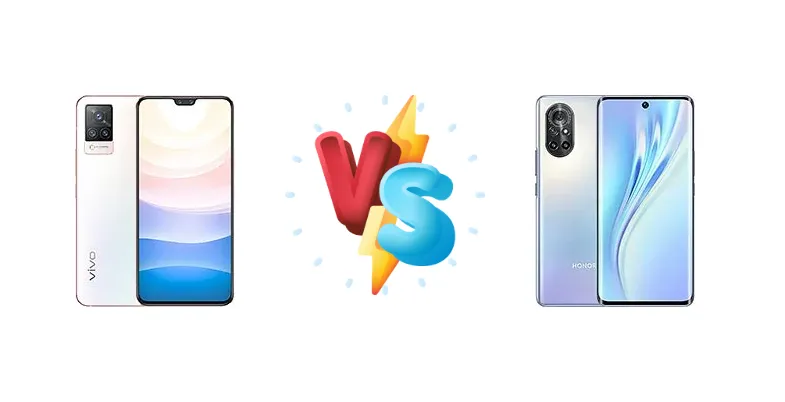
The vivo S9 and Honor V40 Lite represent compelling options in the increasingly competitive mid-range smartphone market. Both leverage Mediatek's Dimensity series, but with distinct chipsets and charging approaches. This comparison dissects the core differences to determine which device delivers the best value for performance-conscious users and those prioritizing rapid replenishment.
🏆 Quick Verdict
For users prioritizing raw processing power and sustained performance, the vivo S9 emerges as the stronger choice thanks to its Dimensity 1100. However, the Honor V40 Lite’s significantly faster 66W charging offers a compelling advantage for those who frequently need to top up their battery quickly.
| Network |
|---|
| 2G bands | GSM 850 / 900 / 1800 / 1900 | GSM 850 / 900 / 1800 / 1900 |
| 3G bands | HSDPA 850 / 900 / 1700(AWS) / 1900 / 2100 | HSDPA 800 / 850 / 900 / 1700(AWS) / 1900 / 2100 |
| 4G bands | 1, 3, 4, 5, 8, 28, 34, 38, 39, 40, 41 | 1, 2, 3, 4, 5, 8, 18, 19, 26, 34, 38, 39, 40, 41 |
| 5G bands | 1, 3, 28, 41, 77, 78 SA/NSA | 1, 28, 41, 77, 78 SA/NSA |
| Speed | HSPA, LTE, 5G | HSPA, LTE, 5G |
| Technology | GSM / CDMA / HSPA / CDMA2000 / LTE / 5G | GSM / CDMA / HSPA / LTE / 5G |
| | CDMA2000 1x | CDMA 800 |
| Launch |
|---|
| Announced | 2021, March 03 | 2021, March 23 |
| Status | Available. Released 2021, March 12 | Available. Released 2021, March 28 |
| Body |
|---|
| Dimensions | 158.4 x 73.9 x 7.4 mm (6.24 x 2.91 x 0.29 in) | 160.1 x 74.1 x 7.6 mm (6.30 x 2.92 x 0.30 in) |
| SIM | Nano-SIM + Nano-SIM | Nano-SIM + Nano-SIM |
| Weight | 173 g (6.10 oz) | 169 g (5.96 oz) |
| Display |
|---|
| Resolution | 1080 x 2400 pixels, 20:9 ratio (~409 ppi density) | 1080 x 2340 pixels, 19.5:9 ratio (~392 ppi density) |
| Size | 6.44 inches, 100.1 cm2 (~85.5% screen-to-body ratio) | 6.57 inches, 106.0 cm2 (~89.3% screen-to-body ratio) |
| Type | AMOLED, 90Hz, HDR10+ | OLED, 1B colors, HDR10, 90Hz |
| Platform |
|---|
| CPU | Octa-core (4x2.6 GHz Cortex-A78 & 4x2.0 GHz Cortex-A55) | Octa-core (2x2.4 GHz Cortex-A76 & 6x2.0 GHz Cortex-A55) |
| Chipset | Mediatek Dimensity 1100 (6 nm) | Mediatek Dimensity 800U (7 nm) |
| GPU | Mali-G77 MC9 | Mali-G57 MC3 |
| OS | Android 11, OriginOS 1.0 | Android 10, Magic UI 4.0, no Google Play Services |
| Memory |
|---|
| Card slot | No | No |
| Internal | 128GB 8GB RAM, 256GB 8GB RAM, 256GB 12GB RAM | 128GB 8GB RAM, 256GB 8GB RAM |
| | UFS 3.1 | UFS |
| Main Camera |
|---|
| Dual | 44 MP, f/2.0, (wide), AF
8 MP, f/2.3, 105˚ (ultrawide) | - |
| Features | Dual-LED dual-tone flash, HDR, panorama | LED flash, panorama, HDR |
| Quad | - | 64 MP, f/1.9, 26mm (wide), PDAF
8 MP, f/2.4, 120˚, 17mm (ultrawide)
2 MP (macro)
Auxiliary lens |
| Single | - | 32 MP, f/2.0, 26mm (wide) |
| Triple | 64 MP, f/1.8, 26mm (wide), 1/1.72", 0.8µm, PDAF, OIS
8 MP, f/2.2, 120˚, 16mm (ultrawide), 1/4.0", 1.12µm
Auxiliary lens | - |
| Video | 4K@30fps, 1080p@30fps, gyro-EIS | 4K, 1080p, 720p@960fps, gyro-EIS |
| Selfie camera |
|---|
| Dual | 44 MP, f/2.0, (wide), AF
8 MP, f/2.3, 105˚ (ultrawide) | - |
| Features | HDR | HDR |
| Single | - | 32 MP, f/2.0, 26mm (wide) |
| Video | 4K@30fps, 1080p@30fps | 4K |
| Sound |
|---|
| 3.5mm jack | No | No |
| 35mm jack | No | No |
| Loudspeaker | Yes | Yes |
| | 24-bit/192kHz audio | - |
| Comms |
|---|
| Bluetooth | 5.2, A2DP, LE, aptX HD | 5.1, A2DP, LE |
| NFC | Yes | Yes |
| Positioning | GPS, GLONASS, GALILEO, BDS | GPS, GLONASS, BDS, GALILEO |
| Radio | No | No |
| USB | USB Type-C, OTG | USB Type-C 2.0, OTG |
| WLAN | Wi-Fi 802.11 a/b/g/n/ac, dual-band, Wi-Fi Direct | Wi-Fi 802.11 a/b/g/n/ac, dual-band, Wi-Fi Direct |
| Features |
|---|
| Sensors | Fingerprint (under display, optical), accelerometer, gyro, proximity, compass | Fingerprint (under display, optical), accelerometer, gyro, proximity, compass |
| Battery |
|---|
| Charging | 33W wired, 66% in 30 min | 66W wired, 60% in 15 min, 100% in 35 min
5W reverse wired |
| Type | 4000 mAh | Li-Po 3800 mAh |
| Misc |
|---|
| Colors | Black, White, Gradient Blue | Black, Blue, Green |
| Models | V2072A | ALA-AN70 |
| Price | About 390 EUR | About 390 EUR |
vivo S9
- Superior chipset (Dimensity 1100) for better performance
- More efficient 6nm process for potentially less throttling
- Likely better sustained performance in demanding tasks
- Slower charging speed (33W)
- May be slightly more expensive
Honor V40 Lite
- Ultra-fast 66W charging for minimal downtime
- 5W reverse wired charging for accessories
- Potentially more affordable
- Less powerful chipset (Dimensity 800U)
- 7nm process may result in more heat under load
Display Comparison
Context data lacks display specifics, but given the market positioning, both likely feature AMOLED panels. The vivo S9, being positioned slightly higher, may benefit from a higher peak brightness and potentially a more refined color calibration. However, without concrete data, it's difficult to definitively state a display advantage. Expect both to target a 6.4-6.6 inch size range, common for this segment.
Camera Comparison
Without detailed sensor information, a direct camera comparison is limited. However, the market segment suggests both will feature multi-camera setups. The focus should be on image processing capabilities. Vivo typically emphasizes vibrant, social-media-ready images, while Honor often leans towards more natural color reproduction. The absence of OIS information suggests neither phone prioritizes advanced stabilization, potentially impacting low-light video quality. Ignoring the likely inclusion of 2MP macro/depth sensors, the primary sensor quality and software processing will be the key differentiators.
Performance
The vivo S9’s Mediatek Dimensity 1100 (6nm) represents a significant step up from the Honor V40 Lite’s Dimensity 800U (7nm). The Dimensity 1100’s Cortex-A78 cores clocked at 2.6GHz offer a substantial performance boost over the V40 Lite’s 2.4GHz Cortex-A76 cores. This translates to faster app loading times, smoother multitasking, and improved gaming performance. The 6nm process node also contributes to better thermal efficiency, potentially reducing throttling during extended use. While both utilize octa-core configurations, the architectural improvements in the Dimensity 1100 provide a clear advantage for demanding users.
Battery Life
The Honor V40 Lite’s 66W charging is the standout feature here. Achieving 60% charge in 15 minutes and 100% in 35 minutes is significantly faster than the vivo S9’s 33W charging, which reaches 66% in 30 minutes. While battery capacity isn’t specified, the faster charging speed of the V40 Lite effectively mitigates any potential capacity disadvantage. Users who prioritize quick top-ups will heavily favor the Honor V40 Lite, even if the S9 offers slightly better power efficiency due to its more advanced chipset.
Buying Guide
Buy the vivo S9 if you need a phone capable of handling demanding applications, multitasking, and moderate gaming with greater ease. Its superior chipset provides a noticeable performance edge. Buy the Honor V40 Lite if you prioritize minimizing downtime and value the convenience of incredibly fast charging, even if it means a slight compromise in peak processing power. This is the phone for users who hate waiting for their battery to fill.
Frequently Asked Questions
❓ Will the Dimensity 800U in the Honor V40 Lite struggle with graphically intensive games like PUBG or Genshin Impact?
The Dimensity 800U is capable of running these games, but you may need to lower graphics settings to maintain a consistently smooth frame rate. The vivo S9’s Dimensity 1100 will provide a noticeably better gaming experience with higher settings and more stable performance.
❓ How much faster is the 66W charging on the Honor V40 Lite compared to using a standard 25W charger?
The difference is substantial. A 25W charger would take significantly longer to fully charge the Honor V40 Lite, likely exceeding 90 minutes. The 66W charger cuts that time down to around 35 minutes, offering a massive convenience boost for users on the go.
❓ Does the vivo S9 support 5G connectivity, and if so, on which bands?
The Mediatek Dimensity 1100 inherently supports 5G connectivity. Specific band support will vary by region and carrier, so it's crucial to check compatibility with your local network provider before purchasing.
❓ Is the reverse wired charging on the Honor V40 Lite useful for charging accessories like earbuds or smartwatches?
At 5W, the reverse charging is primarily intended for small accessories like earbuds or smartwatches. It won't rapidly charge a smartphone, but it's a convenient feature for topping up smaller devices when a power outlet isn't available.