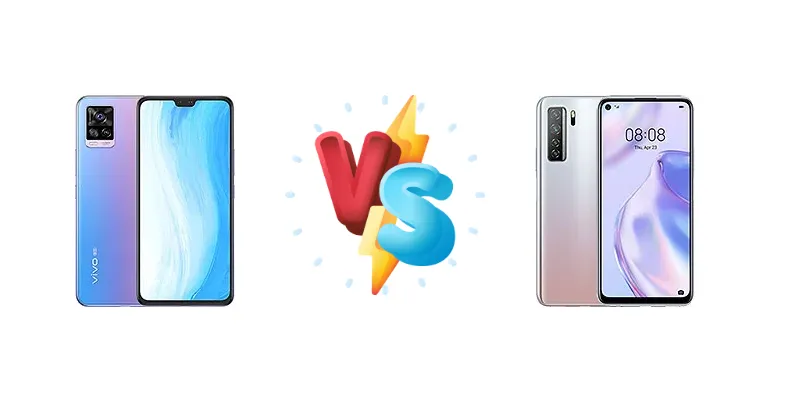
The mid-range 5G smartphone market is fiercely competitive, and the vivo S7 and Huawei nova 7 SE 5G Youth represent compelling options for users seeking a balance of performance and affordability. Both devices aim to deliver 5G connectivity without breaking the bank, but they achieve this through different approaches – Qualcomm’s Snapdragon 765G versus MediaTek’s Dimensity 800U. This comparison dissects their key differences to determine which phone best suits your needs.
🏆 Quick Verdict
For the average user prioritizing consistent performance and a well-rounded experience, the vivo S7 emerges as the slightly stronger choice. While the Huawei nova 7 SE 5G Youth boasts faster 40W charging, the Snapdragon 765G’s more mature architecture and optimized software integration provide a smoother, more reliable user experience.
| Network |
|---|
| 2G bands | GSM 850 / 900 / 1800 / 1900 | GSM 850 / 900 / 1800 / 1900 |
| 3G bands | HSDPA 850 / 900 / 1700(AWS) / 1900 / 2100 | HSDPA 800 / 850 / 900 / 1700(AWS) / 1900 / 2100 |
| 4G bands | 1, 3, 4, 5, 8, 34, 38, 39, 40, 41 | 1, 2, 3, 4, 5, 8, 18, 19, 26, 34, 38, 39, 40, 41 |
| 5G bands | 1, 3, 41, 77, 78, 79 SA/NSA | 1, 41, 77, 78 SA/NSA |
| EDGE | Class 10 | - |
| GPRS | Class 10 | - |
| Speed | HSPA, LTE, 5G | HSPA, LTE, 5G |
| Technology | GSM / CDMA / HSPA / LTE / 5G | GSM / CDMA / HSPA / LTE / 5G |
| | CDMA 800 & TD-SCDMA | CDMA 800 & TD-SCDMA |
| Launch |
|---|
| Announced | 2020, August 03. Released 2020, August 08 | 2020, October 16. Released 2020, October 16 |
| Status | Discontinued | Discontinued |
| Body |
|---|
| Build | Glass front, glass back (Gorilla Glass 5) | - |
| Dimensions | 158.8 x 74.2 x 7.4 mm (6.25 x 2.92 x 0.29 in) | 162.3 x 75 x 8.6 mm (6.39 x 2.95 x 0.34 in) |
| SIM | Nano-SIM + Nano-SIM | Nano-SIM + Nano-SIM |
| Weight | 170 g (6.00 oz) | 189 g (6.67 oz) |
| Display |
|---|
| Resolution | 1080 x 2400 pixels, 20:9 ratio (~409 ppi density) | 1080 x 2400 pixels, 20:9 ratio (~405 ppi density) |
| Size | 6.44 inches, 100.1 cm2 (~85.0% screen-to-body ratio) | 6.5 inches, 102.0 cm2 (~83.8% screen-to-body ratio) |
| Type | AMOLED | IPS LCD, HDR10 |
| Platform |
|---|
| CPU | Octa-core (1x2.4 GHz Kryo 475 Prime & 1x2.2 GHz Kryo 475 Gold & 6x1.8 GHz Kryo 475 Silver) | Octa-core (2x2.4 GHz Cortex-A76 & 6x2.0 GHz Cortex-A55) |
| Chipset | Qualcomm SM7250 Snapdragon 765G 5G (7 nm) | Mediatek Dimensity 800U (7 nm) |
| GPU | Adreno 620 | Mali-G57 MC3 |
| OS | Android 10, Funtouch 10.5 | Android 10, EMUI 10.1, no Google Play Services |
| Memory |
|---|
| Call records | 30 dialed, 30 received, 30 missed calls | - |
| Card slot | No | No |
| Internal | 128GB 8GB RAM, 256GB 8GB RAM | 128GB 8GB RAM |
| Phonebook | 1000 entries, Photocall | - |
| | UFS 2.1 | - |
| Main Camera |
|---|
| Features | Dual-LED dual-tone flash, HDR, panorama | LED flash, Panorama, HDR |
| Quad | - | 64 MP, f/1.8, 26mm (wide), PDAF
8 MP, f/2.4, 17mm (ultrawide)
2 MP (macro)
Auxiliary lens |
| Single | 1.3 MP | - |
| Triple | 64 MP, f/1.9, 26mm (wide), 1/1.72", 0.8µm, PDAF
8 MP, f/2.2, 120˚, 16mm (ultrawide), 1/4.0", 1.12µm
Auxiliary lens | - |
| Video | 4K@30fps, 1080p@30fps, gyro-EIS | 4K@30fps, 1080p@30fps |
| Selfie camera |
|---|
| Dual | 44 MP, f/2.0, (wide)
8 MP, f/2.3, 105˚ (ultrawide) | - |
| Features | HDR | HDR |
| Single | - | 16 MP, f/2.0, (wide) |
| Video | 4K@30/60fps, 1080p@30/240fps | 1080p@30fps |
| Sound |
|---|
| 3.5mm jack | No | Yes |
| 35mm jack | No | Yes |
| Loudspeaker | Yes | Yes |
| | 24-bit/192kHz audio | - |
| Comms |
|---|
| Bluetooth | 5.1, A2DP, LE, aptX HD | 5.1, A2DP, LE |
| NFC | Yes | No |
| Positioning | GPS, GLONASS, GALILEO, BDS | GPS, GLONASS, GALILEO, BDS, QZSS |
| Radio | No | No |
| USB | USB Type-C, OTG | USB Type-C 2.0, OTG |
| WLAN | Wi-Fi 802.11 a/b/g/n/ac, dual-band, Wi-Fi Direct | Wi-Fi 802.11 a/b/g/n/ac, dual-band, Wi-Fi Direct |
| Features |
|---|
| Browser | WAP 2.0/xHTML | - |
| Games | Yes | - |
| Java | Yes, MIDP 2.0 | - |
| Messaging | SMS, MMS | - |
| Sensors | Fingerprint (under display, optical), accelerometer, proximity, compass | Fingerprint (side-mounted), accelerometer, proximity, compass |
| Battery |
|---|
| Charging | 33W wired | 40W wired, 70% in 30 min
5W reverse wired |
| Type | 4000 mAh | Li-Po 4000 mAh |
| Misc |
|---|
| Colors | Black, White, Gradient Blue | Crush Green, Space Silver, Midnight Black, Purple |
| Models | V2020A | CND-AN00 |
| Price | About 340 EUR | About 290 EUR |
| SAR EU | 0.59 W/kg (head) | - |
vivo S7
- More efficient and consistently performing Snapdragon 765G chipset
- Qualcomm’s optimized software integration for smoother experience
- Potentially better image processing from Qualcomm ISP
- Slower 33W charging compared to the Huawei
- Lacks reverse wireless charging
Huawei nova 7 SE 5G Youth
- Significantly faster 40W charging with 70% in 30 minutes
- Includes 5W reverse wired charging
- Potentially lower price point
- Dimensity 800U may exhibit more thermal throttling under sustained load
- MediaTek chipset may have less optimized software support
Display Comparison
Neither device boasts a standout display, focusing instead on value. While specific panel details (like peak brightness in nits or color gamut coverage) are unavailable, both likely utilize IPS LCD panels common in this price bracket. The focus here isn't on cutting-edge display tech, but on providing a functional viewing experience for everyday tasks. Bezels are likely comparable, and color accuracy will be adequate for most users, though not professional-grade.
Camera Comparison
Detailed camera specs beyond the main sensors are lacking, but the focus should be on the primary shooters. Both phones likely feature multi-camera setups, but the quality will heavily depend on sensor size and image processing. Without specific sensor size data, it’s difficult to declare a clear winner. However, Qualcomm’s image signal processor (ISP) in the Snapdragon 765G is known for its excellent image processing capabilities, potentially giving the vivo S7 an edge in dynamic range and low-light performance. The inclusion of Optical Image Stabilization (OIS) on either device would be a significant advantage, but this information is unavailable.
Performance
The core difference lies in the chipsets. The vivo S7’s Qualcomm Snapdragon 765G (7nm) features a Kryo 475 CPU with a prime core clocked at 2.4GHz, alongside a Gold core at 2.2GHz and six Silver cores at 1.8GHz. This architecture prioritizes sustained performance and efficiency. Conversely, the Huawei nova 7 SE 5G Youth utilizes the MediaTek Dimensity 800U (7nm) with a dual-cluster configuration: two Cortex-A76 cores at 2.4GHz and six Cortex-A55 cores at 2.0GHz. While the peak clock speeds are similar, the Snapdragon 765G’s Kryo cores generally offer superior single-core performance and more efficient multi-core handling. This translates to smoother multitasking and potentially better gaming performance on the vivo S7, especially in graphically demanding titles. The Snapdragon also benefits from Qualcomm’s Adreno 620 GPU, which is generally considered more powerful than the Mali-G52 MC3 found in the Dimensity 800U.
Battery Life
The Huawei nova 7 SE 5G Youth takes a clear lead in charging speed with its 40W wired charging, capable of reaching 70% charge in just 30 minutes. The vivo S7 offers 33W wired charging, which is still respectable but noticeably slower. However, battery life isn’t solely determined by charging speed. The Snapdragon 765G’s efficiency could offset the potential difference in battery capacity (which is unspecified for both devices), resulting in comparable real-world battery endurance. The nova 7 SE 5G Youth also includes 5W reverse wired charging, a feature absent on the vivo S7, allowing it to charge other devices – a niche but useful capability.
Buying Guide
Buy the vivo S7 if you need a phone with a consistently responsive user interface, reliable gaming performance, and a chipset known for its efficient power management. Buy the Huawei nova 7 SE 5G Youth if you prioritize extremely fast charging speeds and frequently find yourself needing to top up your battery quickly, and are comfortable with potential software limitations due to the ongoing geopolitical situation.
Frequently Asked Questions
❓ Does the Dimensity 800U in the Huawei nova 7 SE 5G Youth struggle with demanding games like PUBG or Call of Duty?
While the Dimensity 800U is capable, it may exhibit more thermal throttling and frame rate drops during extended gaming sessions compared to the Snapdragon 765G in the vivo S7. You may need to lower graphics settings to maintain a smooth experience, especially in graphically intensive titles.
❓ How much faster is the 40W charging on the Huawei nova 7 SE 5G Youth compared to the 33W charging on the vivo S7 in real-world use?
The Huawei nova 7 SE 5G Youth can gain approximately 35% battery charge in the time it takes the vivo S7 to reach 70% (30 minutes). This makes a significant difference for users who frequently need a quick power boost.
❓ Is the lack of reverse wireless charging on the vivo S7 a significant drawback?
For most users, no. Reverse wireless charging is a convenience feature, not a necessity. The Huawei nova 7 SE 5G Youth’s 5W reverse *wired* charging is also relatively slow, so the difference in practical use is minimal.