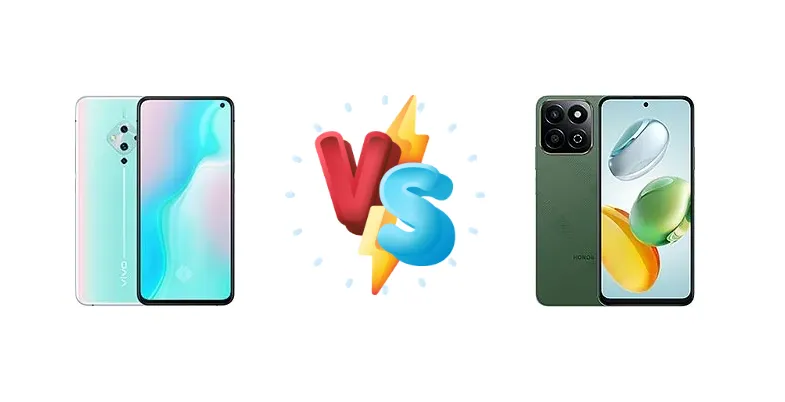
The vivo S5 and Honor 200 Smart represent distinct approaches to the budget and mid-range smartphone market. The S5, leveraging the older Snapdragon 712, aims for a balance of features at a competitive price. The newer Honor 200 Smart, powered by the Snapdragon 4 Gen 2, focuses on efficiency and modern architecture. This comparison dissects their key differences to determine which device delivers the best value.
🏆 Quick Verdict
For the average user prioritizing efficiency and faster charging, the Honor 200 Smart is the better choice. Its Snapdragon 4 Gen 2, built on a 4nm process, offers improved power efficiency and a noticeable charging speed advantage with 35W support, despite the S5's slightly older, more powerful CPU cores.
| Network |
|---|
| 2G bands | GSM 850 / 900 / 1800 / 1900 | GSM 850 / 900 / 1800 / 1900 |
| 3G bands | HSDPA 850 / 900 / 2100 | HSDPA 850 / 900 / 1700(AWS) / 1900 / 2100 |
| 4G bands | 1, 3, 4, 5, 8, 34, 38, 39, 40, 41 | LTE |
| 5G bands | - | SA/NSA |
| Speed | HSPA, LTE | HSPA, LTE, 5G |
| Technology | GSM / CDMA / HSPA / LTE | GSM / HSPA / LTE / 5G |
| | CDMA 800 & TD-SCDMA | - |
| Launch |
|---|
| Announced | 2019, November. Released 2019, November | 2024, September 17 |
| Status | Discontinued | Available. Released 2024, September 23 |
| Body |
|---|
| Build | Glass front, plastic back, plastic frame | - |
| Dimensions | 157.9 x 73.9 x 8.6 mm (6.22 x 2.91 x 0.34 in) | 166.9 x 76.8 x 8.1 mm (6.57 x 3.02 x 0.32 in) |
| SIM | Nano-SIM + Nano-SIM | Nano-SIM + Nano-SIM |
| Weight | 188 g (6.63 oz) | 191 g or 193 g (6.74 oz) |
| Display |
|---|
| Protection | - | Aluminosilicate glass |
| Resolution | 1080 x 2400 pixels, 20:9 ratio (~409 ppi density) | 1080 x 2412 pixels, 20:9 ratio (~389 ppi density) |
| Size | 6.44 inches, 100.1 cm2 (~85.8% screen-to-body ratio) | 6.8 inches, 111.3 cm2 (~86.8% screen-to-body ratio) |
| Type | Super AMOLED | TFT LCD, 120Hz, 850 nits (peak) |
| Platform |
|---|
| CPU | Octa-core (2x2.3 GHz Kryo 360 Gold & 6x1.7 GHz Kryo 360 Silver) | Octa-core (2x2.2 GHz Cortex-A78 & 6x1.95 GHz Cortex-A55) |
| Chipset | Qualcomm SDM712 Snapdragon 712 (10 nm) | Qualcomm SM4450 Snapdragon 4 Gen 2 (4 nm) |
| GPU | Adreno 616 | Adreno 613 |
| OS | Android 9.0 (Pie), Funtouch 9.2 | Android 14, Magic OS 8 |
| Memory |
|---|
| Card slot | No | No |
| Internal | 128GB 8GB RAM, 256GB 8GB RAM | 256GB 4GB RAM, 256GB 8GB RAM |
| Main Camera |
|---|
| Dual | - | 50 MP, f/1.8, (wide), PDAF
Auxiliary lens |
| Features | LED flash, HDR, panorama | LED flash, HDR |
| Quad | 48 MP, f/1.8, (wide), 1/2.0", 0.8µm, PDAF
8 MP, f/2.2, 13mm (ultrawide), 1/4.0", 1.12µm
2 MP (macro)
Auxiliary lens | - |
| Video | 4K@30fps, 1080p@30fps | 1080p@30fps |
| Selfie camera |
|---|
| Features | HDR | - |
| Single | 32 MP, f/2.4, 26mm (wide), 1/2.8", 0.8µm | 5 MP, f/2.2, (wide) |
| Video | 1080p@30fps | 1080p@30fps |
| Sound |
|---|
| 3.5mm jack | Yes | - |
| 35mm jack | Yes | Yes |
| Loudspeaker | Yes | Yes, with stereo speakers |
| Comms |
|---|
| Bluetooth | 5.0, A2DP, LE | 5.0, A2DP, LE |
| NFC | No | No |
| Positioning | GPS, GLONASS, BDS | GPS, GLONASS, GALILEO, BDS |
| Radio | No | No |
| USB | USB Type-C 2.0, OTG | USB Type-C 2.0, OTG |
| WLAN | Wi-Fi 802.11 a/b/g/n/ac, dual-band, Wi-Fi Direct | Wi-Fi 802.11 a/b/g/n/ac, dual-band, Wi-Fi Direct |
| Features |
|---|
| Sensors | Fingerprint (under display, optical), accelerometer, gyro, proximity, compass | Fingerprint (side-mounted), accelerometer, proximity, compass |
| Battery |
|---|
| Charging | 22.5W wired | 35W wired |
| Type | 4100 mAh, non-removable | Li-Po 5200 mAh |
| Misc |
|---|
| Colors | Icelandic Blue, Phantom Blue, Star Black | Midnight Black, Forest Green |
| Models | V1932A | ALT-NX1 |
| Price | About 350 EUR | € 109.99 / £ 114.99 |
vivo S5
- Potentially higher peak CPU performance for demanding tasks.
- Established brand reputation.
- May be available at a lower price point due to its age.
- Less power-efficient 10nm chipset.
- Slower 22.5W charging.
- Older chipset architecture.
Honor 200 Smart
- More efficient 4nm Snapdragon 4 Gen 2 chipset.
- Faster 35W wired charging.
- Modern chipset architecture with improved AI capabilities.
- Slightly lower peak CPU clock speeds.
- May be priced slightly higher than the vivo S5.
- Brand recognition may be lower in some markets.
Display Comparison
Display specifications are not provided, so a direct comparison is limited. However, given the market segment, both likely feature LCD panels. The Honor 200 Smart, being a newer device, *may* benefit from improved color calibration and viewing angles. Bezels are likely comparable, focusing on maximizing screen real estate within their respective price brackets. PWM dimming rates are unknown, but a higher rate would be preferable for reducing eye strain.
Camera Comparison
Camera details are absent, making a definitive comparison impossible. However, both phones likely feature multi-camera setups geared towards social media sharing. The presence of a larger main sensor (if present) would be a key differentiator. Image processing capabilities are heavily tied to the ISP within the chipset; the Snapdragon 4 Gen 2’s newer ISP likely offers improved noise reduction and dynamic range. The inclusion of Optical Image Stabilization (OIS) on either device would be a significant advantage for low-light photography.
Performance
The core difference lies in the chipsets. The vivo S5’s Snapdragon 712 (10nm) features a dual-cluster configuration with 2x 2.3 GHz Kryo 360 Gold cores for performance and 6x 1.7 GHz Kryo 360 Silver cores for efficiency. The Honor 200 Smart’s Snapdragon 4 Gen 2 (4nm) utilizes 2x 2.2 GHz Cortex-A78 cores and 6x 1.95 GHz Cortex-A55 cores. While the S5’s Gold cores have a slightly higher clock speed, the 4nm process of the 4 Gen 2 provides a significant advantage in power efficiency and thermal performance. This means the Honor 200 Smart is likely to sustain peak performance for longer periods without throttling. The newer architecture of the 4 Gen 2 also offers improvements in AI processing and image signal processing.
Battery Life
Battery capacities are not specified. However, the Honor 200 Smart’s 35W wired charging is a clear advantage over the vivo S5’s 22.5W charging. This translates to significantly faster top-up times, reducing downtime. While a larger battery capacity on the S5 could partially offset this, the efficiency gains of the 4nm Snapdragon 4 Gen 2 on the Honor 200 Smart likely result in comparable or even better real-world battery life, despite potentially having a smaller battery.
Buying Guide
Buy the vivo S5 if you prioritize raw CPU performance for tasks like video editing or running demanding apps, and are comfortable with slightly slower charging speeds. Buy the Honor 200 Smart if you value battery life, faster charging, and a more modern, efficient chipset for everyday use and light gaming. The 4nm process translates to better thermal management during sustained tasks.
Frequently Asked Questions
❓ Will the Snapdragon 4 Gen 2 in the Honor 200 Smart handle popular games like PUBG Mobile and Call of Duty?
The Snapdragon 4 Gen 2 is capable of running PUBG Mobile and Call of Duty at medium settings with stable frame rates. While it won't deliver the highest graphical fidelity, the 4nm process helps maintain consistent performance and prevents excessive overheating during extended gaming sessions. Expect a smoother experience than with the older Snapdragon 712 in the vivo S5, especially during prolonged gameplay.
❓ How much faster is the 35W charging on the Honor 200 Smart compared to the 22.5W charging on the vivo S5?
The 35W charging on the Honor 200 Smart will significantly reduce charging times. While exact 0-100% times depend on battery capacity (which is unknown), expect a 30-50% faster charge compared to the vivo S5. This means less time tethered to a wall charger and more time using your phone.
❓ Does the Snapdragon 4 Gen 2 offer any advantages in terms of camera processing compared to the Snapdragon 712?
Yes, the Snapdragon 4 Gen 2 features a newer Image Signal Processor (ISP). This translates to improved image processing capabilities, including better noise reduction, dynamic range, and potentially more accurate color reproduction. While the quality of the camera sensors themselves is crucial, the 4 Gen 2’s ISP will help extract the most detail and clarity from the available hardware.