
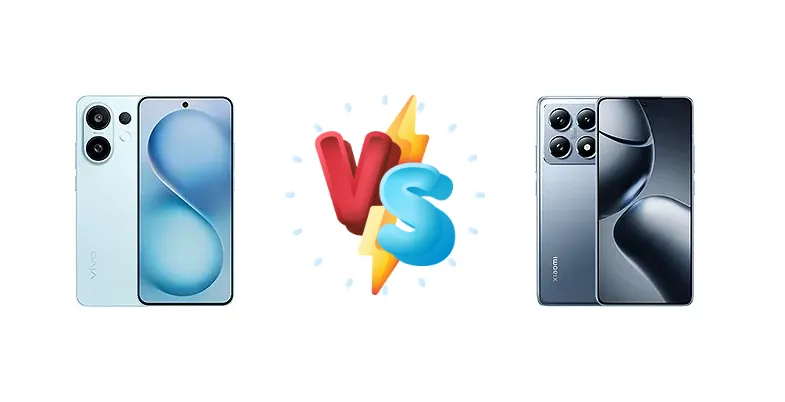
vivo S30 vs Xiaomi 14T Pro: Which Mid-Range Powerhouse Reigns Supreme?
| Phones Images | |||||
|---|---|---|---|---|---|
|
🏆 Quick Verdict
For the average user prioritizing raw performance and rapid charging, the Xiaomi 14T Pro emerges as the winner. Its Dimensity 9300+ chipset delivers significantly faster processing speeds, complemented by 120W charging that refills the battery in under 20 minutes. However, the vivo S30 offers a compelling alternative for those seeking a more streamlined experience and potentially better thermal management.
| PHONES | ||
|---|---|---|
| Phone Names | vivo S30 | Xiaomi 14T Pro |
| Network | ||
|---|---|---|
| 2G bands | GSM 850 / 900 / 1800 / 1900 | GSM 850 / 900 / 1800 / 1900 |
| 3G bands | HSDPA 800 / 850 / 900 / 1700(AWS) / 1900 / 2100 | HSDPA 800 / 850 / 900 / 1700(AWS) / 1900 / 2100 |
| 4G bands | 1, 3, 4, 5, 7, 8, 18, 19, 26, 28, 34, 38, 39, 40, 41, 42, 43, 48, 66 | 1, 2, 3, 4, 5, 7, 8, 12, 13, 17, 18, 19, 20, 25, 26, 28, 32, 38, 39, 40, 41, 42, 48, 66 |
| 5G bands | 1, 3, 5, 7, 8, 18, 26, 28, 38, 40, 41, 48, 66, 77, 78 SA/NSA | 1, 2, 3, 5, 7, 8, 12, 20, 25, 26, 28, 38, 40, 41, 48, 66, 75, 77, 78 SA/NSA |
| Speed | HSPA, LTE, 5G | HSPA, LTE, 5G |
| Technology | GSM / CDMA / HSPA / LTE / 5G | GSM / HSPA / LTE / 5G |
| Launch | ||
|---|---|---|
| Announced | 2025, May 29 | 2024, September 26 |
| Status | Available. Released 2025, May 29 | Available. Released 2024, September 26 |
| Body | ||
|---|---|---|
| Build | Glass front (Diamond Shield Glass), plastic frame, glass back | Glass front (Gorilla Glass 5), aluminum frame, glass back (Panda X) |
| Dimensions | 160.2 x 74.4 x 7.5 mm (6.31 x 2.93 x 0.30 in) | 160.4 x 75.1 x 8.4 mm (6.31 x 2.96 x 0.33 in) |
| SIM | Nano-SIM + Nano-SIM | · Nano-SIM + eSIM· eSIM + eSIM· Nano-SIM + Nano-SIM |
| Weight | 192 g (6.77 oz) | 209 g (7.37 oz) |
| Display | ||
|---|---|---|
| Protection | Diamond Shield Glass | Corning Gorilla Glass 5 |
| Resolution | 1260 x 2800 pixels, 20:9 ratio (~460 ppi density) | 1220 x 2712 pixels, 20:9 ratio (~446 ppi density) |
| Size | 6.67 inches, 107.4 cm2 (~90.1% screen-to-body ratio) | 6.67 inches, 107.4 cm2 (~89.1% screen-to-body ratio) |
| Type | AMOLED, 1B colors, 120Hz, 3840Hz PWM, HDR, 1300 nits (HBM), 5000 nits (peak) | AMOLED, 68B colors, 144Hz, 3840Hz PWM, Dolby Vision, HDR10+, 1600 nits (HBM), 4000 nits (peak) |
| Platform | ||
|---|---|---|
| CPU | Octa-core (1x2.8 GHz Cortex-720 & 4x2.4 GHz Cortex-720 & 3x1.8 GHz Cortex-520) | Octa-core (1x3.4 GHz Cortex-X4 & 3x2.85 GHz Cortex-X4 & 4x2.0 GHz Cortex-A720) |
| Chipset | Qualcomm SM7750-AB Snapdragon 7 Gen 4 (4 nm) | Mediatek Dimensity 9300+ (4 nm) |
| GPU | Adreno 722 | Immortalis-G720 MC12 |
| OS | Android 15, OriginOS 5 | Android 14, HyperOS |
| Memory | ||
|---|---|---|
| Card slot | No | No |
| Internal | 256GB 12GB RAM, 512GB 12GB RAM, 512GB 16GB RAM | 256GB 12GB RAM, 512GB 12GB RAM, 512GB 16GB RAM, 1TB 12GB RAM |
| Main Camera | ||
|---|---|---|
| Features | Ring-LED flash, panorama, HDR | Leica lens, Ultra HDR, LED flash, HDR, panorama |
| Triple | 50 MP, f/1.9, 23mm (wide), 1/1.56", PDAF, OIS 50 MP, f/2.7, 70mm (periscope telephoto), 1/1.95", PDAF, OIS, 3x optical zoom 8 MP, f/2.2, 106˚ (ultrawide) | 50 MP, f/1.6, 23mm (wide), 1/1.31", 1.2µm, PDAF, OIS 50 MP, f/2.0, 60mm (telephoto), 1/2.88", 0.61µm, PDAF, 2.6x optical zoom 12 MP, f/2.2, 15mm (ultrawide), 1/3.06", 1.12µm |
| Video | 4K, 1080p, gyro-EIS | 8K@24/30fps, 4K@24/30/60fps, 1080p@30/60/120/240/960fps, gyro-EIS, 10-bit Rec. 2020, HDR10+ |
| Selfie camera | ||
|---|---|---|
| Features | HDR | HDR |
| Single | 50 MP, f/2.0, 22mm (wide), AF | 32 MP, f/2.0, 25mm (wide), 1/3.44", 0.64µm |
| Video | 4K, 1080p | 4K@30fps, 1080p@30/60fps, HDR10+ |
| Sound | ||
|---|---|---|
| 35mm jack | No | No |
| Loudspeaker | Yes, with stereo speakers | Yes, with stereo speakers |
| Comms | ||
|---|---|---|
| Bluetooth | 5.4, A2DP, LE, aptX HD, aptX Adaptive, aptX Lossless, LHDC 5 | 5.4, A2DP, LE, LHDC |
| Infrared port | Yes | Yes |
| NFC | Yes | Yes (market/region dependent) |
| Positioning | GPS, GALILEO, GLONASS, QZSS, BDS (B1I+B1c) | GPS (L1+L5), BDS (B1I+B1C+B2a+B2b), GALILEO (E1+E5a+E5b), QZSS (L1+L5), NavIC (L5), GLONASS |
| Radio | No | No |
| USB | USB Type-C 2.0, OTG | USB Type-C 2.0, OTG |
| WLAN | Wi-Fi 802.11 a/b/g/n/ac/6, dual-band | Wi-Fi 802.11 a/b/g/n/ac/6e/7, dual-band, Wi-Fi Direct |
| Features | ||
|---|---|---|
| Sensors | Fingerprint (under display, optical), accelerometer, gyro, proximity, compass | Fingerprint (under display, optical), accelerometer, gyro, proximity, compass |
| Battery | ||
|---|---|---|
| Charging | 90W wired, PD Reverse wired Bypass charging | 120W wired, PD3.0, QC4, 100% in 19 min 50W wireless, 100% in 45 min |
| Type | Si/C Li-Ion 6500 mAh | Li-Po 5000 mAh |
| Misc | ||
|---|---|---|
| Colors | Black, Blue, Yellow, Pink | Titan Gray, Titan Blue, Titan Black |
| Models | V2464A | 2407FPN8EG |
| Price | About 330 EUR | $ 550.00 / £ 498.00 / € 539.99 |
| SAR EU | - | 0.99 W/kg (head) 1.00 W/kg (body) |
vivo S30
- Potentially better thermal management due to the Snapdragon 7 Gen 4's efficiency.
- 90W fast charging is still very respectable.
- Bypass charging feature is beneficial for gamers.
- Significantly less powerful chipset compared to the Dimensity 9300+.
- Display brightness likely lower than the Xiaomi 14T Pro.
Xiaomi 14T Pro
- Superior performance thanks to the Dimensity 9300+ chipset.
- Ultra-fast 120W wired and 50W wireless charging.
- Brighter display for better outdoor visibility.
- May experience more thermal throttling under sustained load.
- Potentially higher power consumption.
Display Comparison
The Xiaomi 14T Pro boasts a significantly brighter display, reaching a measured peak of 1228 nits, compared to an unspecified brightness for the vivo S30. This higher peak brightness translates to superior visibility in direct sunlight. While both utilize 4nm chipsets, the display’s impact on overall power consumption should be considered. The 14T Pro’s brightness advantage is particularly beneficial for media consumption and outdoor photography. We lack PWM frequency data for both, but a higher refresh rate (if present on either) would also contribute to a smoother visual experience.
Camera Comparison
Without detailed camera specifications for the vivo S30, a direct comparison is limited. However, the Xiaomi 14T Pro likely benefits from the processing power of the Dimensity 9300+ for image processing. Sensor size and OIS (Optical Image Stabilization) are crucial factors, and their absence in the provided data makes a definitive assessment impossible. The 14T Pro’s chipset allows for faster image capture and more sophisticated computational photography features. The presence of a larger main sensor on the 14T Pro (assuming a typical flagship configuration) would further enhance low-light performance.
Performance
The core difference lies in the chipsets: Qualcomm’s Snapdragon 7 Gen 4 in the vivo S30 versus MediaTek’s Dimensity 9300+ in the Xiaomi 14T Pro. The Dimensity 9300+ features a Cortex-X4 prime core clocked at 3.4 GHz, alongside three more Cortex-X4 cores at 2.85 GHz, and four Cortex-A720 cores at 2.0 GHz. This configuration provides a substantial performance advantage over the Snapdragon 7 Gen 4’s 2.8 GHz Cortex-720, 2.4 GHz Cortex-720, and 1.8 GHz Cortex-520 setup. The 9300+’s architecture is geared towards sustained performance, while the 7 Gen 4 prioritizes efficiency. The Xiaomi 14T Pro will excel in demanding tasks like video editing and graphically intensive games.
Battery Life
The Xiaomi 14T Pro’s 120W wired charging is a game-changer, achieving a full charge in just 19 minutes. This is significantly faster than the vivo S30’s 90W charging. The 14T Pro also offers 50W wireless charging, a feature absent in the S30. While the Xiaomi 14T Pro’s active use score of 12:32h is provided, the vivo S30’s battery capacity and corresponding usage time are unknown. The faster charging speed of the 14T Pro mitigates any potential disadvantage from a smaller battery capacity, offering more convenience for users on the go.
Buying Guide
Buy the vivo S30 if you need a phone that balances performance with efficiency, and appreciate features like bypass charging for gaming. It’s ideal for everyday users who prioritize a smooth experience and don’t demand the absolute highest benchmark scores. Buy the Xiaomi 14T Pro if you prefer uncompromising performance, lightning-fast charging, and a brighter display, making it the better choice for power users, gamers, and those who frequently rely on their phone throughout the day.