
vivo S30 vs. vivo X100 Ultra: A Detailed Comparison of Performance and Value
| Phones Images | |||||
|---|---|---|---|---|---|
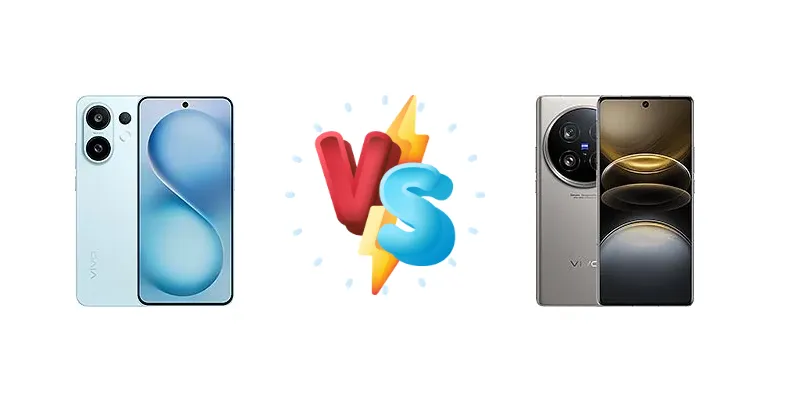
|
🏆 Quick Verdict
For the average user prioritizing value and a sleek design, the vivo S30 is a compelling choice. However, the vivo X100 Ultra justifies its higher price with significantly superior performance, a brighter display, and longer battery life, making it the winner for power users.
| PHONES | ||
|---|---|---|
| Phone Names | vivo S30 | vivo X100 Ultra |
| Network | ||
|---|---|---|
| 2G bands | GSM 850 / 900 / 1800 / 1900 | GSM 850 / 900 / 1800 / 1900 |
| 3G bands | HSDPA 800 / 850 / 900 / 1700(AWS) / 1900 / 2100 | HSDPA 800 / 850 / 900 / 1700(AWS) / 1900 / 2100 |
| 4G bands | 1, 3, 4, 5, 7, 8, 18, 19, 26, 28, 34, 38, 39, 40, 41, 42, 43, 48, 66 | 1, 2, 3, 4, 5, 7, 8, 12, 17, 18, 19, 20, 25, 26, 28, 34, 38, 39, 40, 41, 42, 66 |
| 5G bands | 1, 3, 5, 7, 8, 18, 26, 28, 38, 40, 41, 48, 66, 77, 78 SA/NSA | 1, 2, 3, 5, 7, 8, 12, 20, 25, 26, 28, 38, 40, 41, 66, 77, 78, 79 SA/NSA |
| Speed | HSPA, LTE, 5G | HSPA, LTE, 5G |
| Technology | GSM / CDMA / HSPA / LTE / 5G | GSM / CDMA / HSPA / LTE / 5G |
| Launch | ||
|---|---|---|
| Announced | 2025, May 29 | 2024, May 13 |
| Status | Available. Released 2025, May 29 | Available. Released 2024, May 28 |
| Body | ||
|---|---|---|
| Build | Glass front (Diamond Shield Glass), plastic frame, glass back | Glass front, glass back, aluminum frame |
| Dimensions | 160.2 x 74.4 x 7.5 mm (6.31 x 2.93 x 0.30 in) | 164.1 x 75.6 x 9.2 mm (6.46 x 2.98 x 0.36 in) |
| SIM | Nano-SIM + Nano-SIM | Nano-SIM + Nano-SIM |
| Weight | 192 g (6.77 oz) | 229 g (8.08 oz) |
| Display | ||
|---|---|---|
| Protection | Diamond Shield Glass | - |
| Resolution | 1260 x 2800 pixels, 20:9 ratio (~460 ppi density) | 1440 x 3200 pixels, 20:9 ratio (~517 ppi density) |
| Size | 6.67 inches, 107.4 cm2 (~90.1% screen-to-body ratio) | 6.78 inches, 111.4 cm2 (~89.8% screen-to-body ratio) |
| Type | AMOLED, 1B colors, 120Hz, 3840Hz PWM, HDR, 1300 nits (HBM), 5000 nits (peak) | LTPO AMOLED, 1B colors, 120Hz, Dolby Vision, HDR, 3000 nits (peak) |
| Platform | ||
|---|---|---|
| CPU | Octa-core (1x2.8 GHz Cortex-720 & 4x2.4 GHz Cortex-720 & 3x1.8 GHz Cortex-520) | Octa-core (1x3.3 GHz Cortex-X4 & 3x3.2 GHz Cortex-A720 & 2x3.0 GHz Cortex-A720 & 2x2.3 GHz Cortex-A520) |
| Chipset | Qualcomm SM7750-AB Snapdragon 7 Gen 4 (4 nm) | Qualcomm SM8650-AB Snapdragon 8 Gen 3 (4 nm) |
| GPU | Adreno 722 | Adreno 750 |
| OS | Android 15, OriginOS 5 | Android 14, upgradable to Android 15, OriginOS 5 |
| Memory | ||
|---|---|---|
| Card slot | No | No |
| Internal | 256GB 12GB RAM, 512GB 12GB RAM, 512GB 16GB RAM | 256GB 12GB RAM, 512GB 16GB RAM, 1TB 16GB RAM |
| Main Camera | ||
|---|---|---|
| Features | Ring-LED flash, panorama, HDR | Laser AF, color spectrum sensor, Zeiss optics, Zeiss T* lens coating, LED flash, panorama, HDR, 3D LUT import |
| Triple | 50 MP, f/1.9, 23mm (wide), 1/1.56", PDAF, OIS 50 MP, f/2.7, 70mm (periscope telephoto), 1/1.95", PDAF, OIS, 3x optical zoom 8 MP, f/2.2, 106˚ (ultrawide) | 50 MP, f/1.8, 23mm (wide), 1/0.98", 1.6µm, dual pixel PDAF, gimbal OIS 200 MP, f/2.7, 85mm (periscope telephoto), 1/1.4", 0.56µm, multi-directional PDAF, OIS, 3.7x optical zoom, macro 3.4:1 50 MP, f/2.2, 14mm, 116˚ (ultrawide), 1/2.0", 0.8µm, AF |
| Video | 4K, 1080p, gyro-EIS | 8K@30fps, 4K@30/60/120fps, 1080p@30/60/120/240fps, gyro-EIS, Dolby Vision HDR |
| Selfie camera | ||
|---|---|---|
| Features | HDR | HDR |
| Single | 50 MP, f/2.0, 22mm (wide), AF | 50 MP, f/2.5, 24mm (wide), 1/2.76", 0.64µm, AF |
| Video | 4K, 1080p | 4K@30/60fps, 1080p@30/60fps |
| Sound | ||
|---|---|---|
| 35mm jack | No | No |
| Loudspeaker | Yes, with stereo speakers | Yes, with stereo speakers |
| Comms | ||
|---|---|---|
| Bluetooth | 5.4, A2DP, LE, aptX HD, aptX Adaptive, aptX Lossless, LHDC 5 | 5.4, A2DP, LE, aptX HD, aptX Adaptive, aptX Lossless, LHDC |
| Infrared port | Yes | Yes |
| NFC | Yes | Yes |
| Positioning | GPS, GALILEO, GLONASS, QZSS, BDS (B1I+B1c) | GPS (L1+L5), BDS (B1I+B1c+B2a), GALILEO (E1+E5a), QZSS (L1+L5), GLONASS |
| Radio | No | No |
| USB | USB Type-C 2.0, OTG | USB Type-C 3.2, OTG, DisplayPort |
| WLAN | Wi-Fi 802.11 a/b/g/n/ac/6, dual-band | Wi-Fi 802.11 a/b/g/n/ac/6/7, dual-band |
| Features | ||
|---|---|---|
| Sensors | Fingerprint (under display, optical), accelerometer, gyro, proximity, compass | Fingerprint (under display, ultrasonic), accelerometer, gyro, proximity, compass |
| Battery | ||
|---|---|---|
| Charging | 90W wired, PD Reverse wired Bypass charging | 80W wired, PD, PPS, QC, UFCS 30W wireless Reverse wired Reverse wireless |
| Type | Si/C Li-Ion 6500 mAh | Si/C Li-Ion 5500 mAh |
| Misc | ||
|---|---|---|
| Colors | Black, Blue, Yellow, Pink | Titanium, White, Grey |
| Models | V2464A | V2366GA, V2366HA |
| Price | About 330 EUR | About 980 EUR |
vivo S30
- Potentially faster wired charging (90W)
- More affordable price point
- Sleek and stylish design (assumed based on S-series branding)
- Significantly less powerful processor
- Likely inferior camera performance
- Shorter battery life (estimated)
vivo X100 Ultra
- Flagship-level performance with Snapdragon 8 Gen 3
- Brighter and potentially higher-quality display
- Longer battery life (12:55h active use)
- Higher price tag
- Slightly slower wired charging (80W)
- Larger and heavier form factor (likely)
Display Comparison
The vivo X100 Ultra boasts a significantly brighter display, reaching a measured 1801 nits, compared to the S30 (brightness data unavailable). This translates to superior visibility in direct sunlight. While both utilize 4nm chipsets, the X100 Ultra’s display technology likely benefits from the more powerful GPU for smoother animations and potentially higher refresh rates (spec not provided for either). The S30’s display specs are not available, but given its market positioning, it likely prioritizes cost-effectiveness over peak brightness and advanced features like LTPO.
Camera Comparison
Camera specifications are not provided for either device beyond the model names. However, given the X100 Ultra’s flagship status, it’s reasonable to expect a more advanced camera system with larger sensors, optical image stabilization (OIS), and more sophisticated image processing algorithms. The S30, positioned as a mid-range device, likely features a capable camera but will likely fall short of the X100 Ultra’s image quality, especially in low-light conditions. The absence of detailed camera specs necessitates relying on market segment expectations.
Performance
The core difference lies in the chipsets: the vivo S30 utilizes the Qualcomm SM7750-AB Snapdragon 7 Gen 4, while the X100 Ultra features the flagship SM8650-AB Snapdragon 8 Gen 3. The 8 Gen 3’s octa-core CPU, with its Cortex-X4 prime core clocked at 3.3 GHz, offers a substantial performance advantage over the S30’s 2.8 GHz Cortex-720. This difference is particularly noticeable in demanding tasks like video editing and graphically intensive games. The X100 Ultra’s superior GPU will deliver significantly higher frame rates and better graphics fidelity. While both are built on a 4nm process, the 8 Gen 3’s architecture is more efficient, potentially leading to better sustained performance under load.
Battery Life
The vivo X100 Ultra demonstrates impressive battery life, achieving an active use score of 12:55h. While the S30’s battery capacity is unknown, the X100 Ultra’s longer runtime suggests a combination of a larger battery and the more efficient Snapdragon 8 Gen 3. Charging speeds differ: the S30 supports 90W wired charging, while the X100 Ultra offers 80W wired, 30W wireless, and reverse charging capabilities. The S30’s 90W charging may offer slightly faster 0-100% times, but the X100 Ultra’s wireless and reverse charging options provide added convenience.
Buying Guide
Buy the vivo S30 if you need a stylish, capable phone for everyday tasks, social media, and light gaming, and want to stay within a more reasonable budget. Buy the vivo X100 Ultra if you demand the absolute best performance for demanding games, professional photography, and extended usage, and are willing to pay a premium for a top-tier experience.