
vivo S30 vs. iQOO 12 Pro: A Deep Dive into Performance and Value
| Phones Images | |||||
|---|---|---|---|---|---|
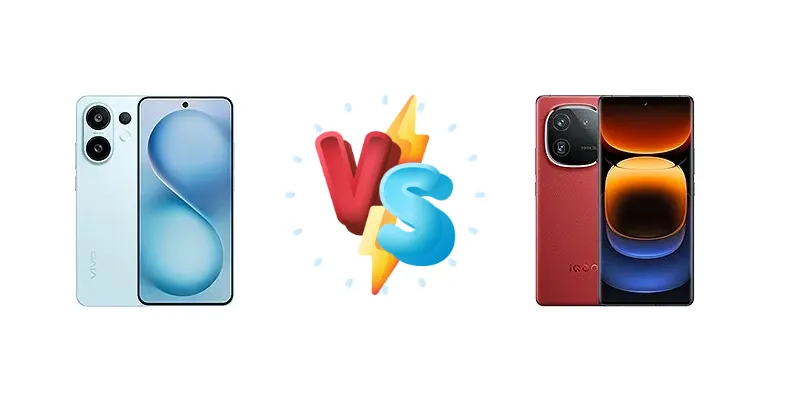
|
🏆 Quick Verdict
For the average user prioritizing value and a sleek design, the vivo S30 is a compelling choice. However, the iQOO 12 Pro emerges as the winner for those demanding uncompromising performance, faster charging, and a more premium experience, justifying its higher price tag.
| PHONES | ||
|---|---|---|
| Phone Names | vivo S30 | vivo iQOO 12 Pro |
| Network | ||
|---|---|---|
| 2G bands | GSM 850 / 900 / 1800 / 1900 | GSM 850 / 900 / 1800 / 1900 |
| 3G bands | HSDPA 800 / 850 / 900 / 1700(AWS) / 1900 / 2100 | HSDPA 800 / 850 / 900 / 1700(AWS) / 1900 / 2100 |
| 4G bands | 1, 3, 4, 5, 7, 8, 18, 19, 26, 28, 34, 38, 39, 40, 41, 42, 43, 48, 66 | 1, 2, 3, 4, 5, 7, 8, 12, 17, 18, 19, 20, 25, 26, 28, 34, 38, 39, 40, 41, 42, 66 |
| 5G bands | 1, 3, 5, 7, 8, 18, 26, 28, 38, 40, 41, 48, 66, 77, 78 SA/NSA | 1, 2, 3, 5, 7, 8, 12, 20, 25, 26, 28, 66, 38, 40, 41, 77, 78 SA/NSA |
| Speed | HSPA, LTE, 5G | HSPA, LTE, 5G |
| Technology | GSM / CDMA / HSPA / LTE / 5G | GSM / CDMA / HSPA / CDMA2000 / LTE / 5G |
| Launch | ||
|---|---|---|
| Announced | 2025, May 29 | 2023, November 07 |
| Status | Available. Released 2025, May 29 | Available. Released 2023, November 14 |
| Body | ||
|---|---|---|
| Build | Glass front (Diamond Shield Glass), plastic frame, glass back | - |
| Dimensions | 160.2 x 74.4 x 7.5 mm (6.31 x 2.93 x 0.30 in) | 164.6 x 75.4 x 8.6 mm or 8.8 mm |
| SIM | Nano-SIM + Nano-SIM | Nano-SIM + Nano-SIM |
| Weight | 192 g (6.77 oz) | 205 g or 210 g (7.23 oz) |
| Display | ||
|---|---|---|
| Protection | Diamond Shield Glass | - |
| Resolution | 1260 x 2800 pixels, 20:9 ratio (~460 ppi density) | 1440 x 3200 pixels, 20:9 ratio (~518 ppi density) |
| Size | 6.67 inches, 107.4 cm2 (~90.1% screen-to-body ratio) | 6.78 inches, 111.0 cm2 (~89.4% screen-to-body ratio) |
| Type | AMOLED, 1B colors, 120Hz, 3840Hz PWM, HDR, 1300 nits (HBM), 5000 nits (peak) | LTPO AMOLED, 1B colors, 144Hz, HDR10+, 1600 nits (HBM), 3000 nits (peak) |
| Platform | ||
|---|---|---|
| CPU | Octa-core (1x2.8 GHz Cortex-720 & 4x2.4 GHz Cortex-720 & 3x1.8 GHz Cortex-520) | Octa-core (1x3.3 GHz Cortex-X4 & 3x3.2 GHz Cortex-A720 & 2x3.0 GHz Cortex-A720 & 2x2.3 GHz Cortex-A520) |
| Chipset | Qualcomm SM7750-AB Snapdragon 7 Gen 4 (4 nm) | Qualcomm SM8650-AB Snapdragon 8 Gen 3 (4 nm) |
| GPU | Adreno 722 | Adreno 750 |
| OS | Android 15, OriginOS 5 | Android 14, up to 2 major Android upgrades, Funtouch 14 (International), OriginOS 4 (China) |
| Memory | ||
|---|---|---|
| Card slot | No | No |
| Internal | 256GB 12GB RAM, 512GB 12GB RAM, 512GB 16GB RAM | 256GB 16GB RAM, 512GB 16GB RAM, 1TB 16GB RAM |
| Main Camera | ||
|---|---|---|
| Features | Ring-LED flash, panorama, HDR | Color spectrum sensor, Dual-LED flash, HDR, panorama |
| Triple | 50 MP, f/1.9, 23mm (wide), 1/1.56", PDAF, OIS 50 MP, f/2.7, 70mm (periscope telephoto), 1/1.95", PDAF, OIS, 3x optical zoom 8 MP, f/2.2, 106˚ (ultrawide) | 50 MP, f/1.7, 23mm (wide), 1/1.3", 1.2µm, ulti-directional PDAF, OIS 64 MP, f/2.6, 70mm (periscope telephoto), 1/2.0", PDAF, OIS, 3x optical zoom 50 MP, f/2.0, 15mm, 119˚ (ultrawide), AF |
| Video | 4K, 1080p, gyro-EIS | 8K@30fps, 4K@24/30/60fps, 1080p@30/60/120/240fps, gyro-EIS |
| Selfie camera | ||
|---|---|---|
| Features | HDR | HDR |
| Single | 50 MP, f/2.0, 22mm (wide), AF | 16 MP, f/2.5, (wide) |
| Video | 4K, 1080p | 1080p@30fps, gyro-EIS |
| Sound | ||
|---|---|---|
| 35mm jack | No | No |
| Loudspeaker | Yes, with stereo speakers | Yes, with stereo speakers |
| Comms | ||
|---|---|---|
| Bluetooth | 5.4, A2DP, LE, aptX HD, aptX Adaptive, aptX Lossless, LHDC 5 | 5.4, A2DP, LE, aptX HD, aptX Adaptive, aptX Lossless |
| Infrared port | Yes | Yes |
| NFC | Yes | Yes |
| Positioning | GPS, GALILEO, GLONASS, QZSS, BDS (B1I+B1c) | GPS (L1+L5), GLONASS (G1), BDS (B1I+B1c+B2a), GALILEO (E1+E5a), QZSS (L1+L5) |
| Radio | No | No |
| USB | USB Type-C 2.0, OTG | USB Type-C 2.0, OTG |
| WLAN | Wi-Fi 802.11 a/b/g/n/ac/6, dual-band | Wi-Fi 802.11 a/b/g/n/ac/6/7, tri-band, Wi-Fi Direct |
| Features | ||
|---|---|---|
| Sensors | Fingerprint (under display, optical), accelerometer, gyro, proximity, compass | Fingerprint (under display, ultrasonic), accelerometer, gyro, proximity, compass |
| Battery | ||
|---|---|---|
| Charging | 90W wired, PD Reverse wired Bypass charging | 120W wired 50W wireless 10W reverse wireless |
| Type | Si/C Li-Ion 6500 mAh | 5100 mAh |
| Misc | ||
|---|---|---|
| Colors | Black, Blue, Yellow, Pink | Black, Red, White (BMW M branding) |
| Models | V2464A | V2329A |
| Price | About 330 EUR | About 650 EUR |
vivo S30
- More affordable price point
- Stylish design and build quality
- 90W fast charging is still very quick
- Less powerful processor for demanding tasks
- Likely a less advanced camera system
- No wireless charging
vivo iQOO 12 Pro
- Flagship-level performance with Snapdragon 8 Gen 3
- Ultra-fast 120W wired and 50W wireless charging
- Superior camera capabilities
- Higher price tag
- Potentially more heat generation under sustained load
- Larger size and weight
Display Comparison
While both devices likely feature OLED panels (based on brand history), the specifics are missing. However, the core difference lies in the processing power driving them. The iQOO 12 Pro, with its Snapdragon 8 Gen 3, will handle graphically intensive tasks and high refresh rates with greater ease. The S30’s Snapdragon 7 Gen 4 is capable, but will show its limitations in demanding scenarios. Expect the iQOO 12 Pro to have a higher peak brightness and potentially LTPO technology for adaptive refresh rates, contributing to better battery life during static content viewing.
Camera Comparison
Without detailed camera specs, a direct comparison is limited. However, the iQOO 12 Pro, being a flagship, is likely to feature a larger main sensor and more advanced image processing algorithms. The Snapdragon 8 Gen 3’s ISP (Image Signal Processor) is significantly more powerful than the one in the Snapdragon 7 Gen 4, resulting in better dynamic range, noise reduction, and overall image quality, especially in low-light conditions. The iQOO 12 Pro is also more likely to include features like 8K video recording and advanced stabilization.
Performance
The performance gap is significant. The iQOO 12 Pro’s Snapdragon 8 Gen 3 (4nm) boasts a prime Cortex-X4 core clocked at 3.3 GHz, compared to the S30’s Snapdragon 7 Gen 4 (4nm) with a Cortex-720 core at 2.8 GHz. This translates to a substantial advantage in CPU-intensive tasks and gaming. The iQOO 12 Pro’s Adreno 750 GPU will deliver significantly higher frame rates and graphical fidelity. The S30’s GPU is adequate for mid-range gaming, but won’t match the iQOO 12 Pro’s capabilities. Both utilize a 4nm process, but the architectural improvements in the 8 Gen 3 provide superior efficiency and sustained performance.
Battery Life
The iQOO 12 Pro’s 120W wired charging is a game-changer, capable of fully charging the battery in under 20 minutes. The S30’s 90W charging is still fast, but noticeably slower. The iQOO 12 Pro also adds 50W wireless charging and 10W reverse wireless charging, features absent on the S30. While battery capacity isn’t specified, the iQOO 12 Pro’s more efficient chipset and faster charging mitigate the impact of a potentially smaller battery size. The S30’s bypass charging feature is a useful addition, allowing for direct power delivery during gaming, reducing heat buildup.
Buying Guide
Buy the vivo S30 if you need a stylish, capable phone for everyday tasks, social media, and light gaming, and want to stay within a more budget-conscious price range. Buy the iQOO 12 Pro if you prioritize top-tier gaming performance, require the fastest possible charging speeds, and are willing to invest in a flagship-level experience with a focus on sustained power.