
vivo S30 vs OnePlus 12R: A Deep Dive into Mid-Range Power
| Phones Images | |||||
|---|---|---|---|---|---|
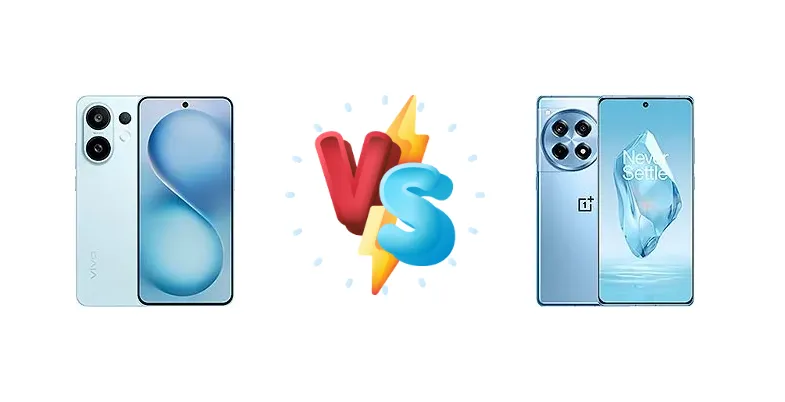
|
🏆 Quick Verdict
For most users, the OnePlus 12R emerges as the stronger choice. Its Snapdragon 8 Gen 2 chipset delivers significantly superior performance, crucial for demanding tasks and gaming, and its impressive 14:32h active use battery life offsets the slightly slower 100W charging compared to the vivo S30’s 90W.
| PHONES | ||
|---|---|---|
| Phone Names | vivo S30 | OnePlus 12R |
| Network | ||
|---|---|---|
| 2G bands | GSM 850 / 900 / 1800 / 1900 | GSM 850 / 900 / 1800 / 1900 |
| 3G bands | HSDPA 800 / 850 / 900 / 1700(AWS) / 1900 / 2100 | HSDPA 850 / 900 / 1700(AWS) / 1900 / 2100 |
| 4G bands | 1, 3, 4, 5, 7, 8, 18, 19, 26, 28, 34, 38, 39, 40, 41, 42, 43, 48, 66 | 1, 2, 3, 4, 5, 7, 8, 12, 17, 18, 19, 20, 26, 28, 32, 38, 39, 40, 41, 66 |
| 5G bands | 1, 3, 5, 7, 8, 18, 26, 28, 38, 40, 41, 48, 66, 77, 78 SA/NSA | 1, 2, 3, 5, 7, 8, 12, 20, 28, 38, 40, 41, 66, 77, 78 SA/NSA |
| Speed | HSPA, LTE, 5G | HSPA, LTE, 5G |
| Technology | GSM / CDMA / HSPA / LTE / 5G | GSM / CDMA / HSPA / LTE / 5G |
| Launch | ||
|---|---|---|
| Announced | 2025, May 29 | 2024, January 23 |
| Status | Available. Released 2025, May 29 | Available. Released 2024, February 06 |
| Body | ||
|---|---|---|
| Build | Glass front (Diamond Shield Glass), plastic frame, glass back | Glass front (Gorilla Glass Victus 2), aluminum frame, glass back |
| Dimensions | 160.2 x 74.4 x 7.5 mm (6.31 x 2.93 x 0.30 in) | 163.3 x 75.3 x 8.8 mm (6.43 x 2.96 x 0.35 in) |
| SIM | Nano-SIM + Nano-SIM | · Nano-SIM + Nano-SIM + eSIM (max 2 at a time)· Nano-SIM + Nano-SIM |
| Weight | 192 g (6.77 oz) | 207 g (7.30 oz) |
| Display | ||
|---|---|---|
| Protection | Diamond Shield Glass | Corning Gorilla Glass Victus 2 |
| Resolution | 1260 x 2800 pixels, 20:9 ratio (~460 ppi density) | 1264 x 2780 pixels (~450 ppi density) |
| Size | 6.67 inches, 107.4 cm2 (~90.1% screen-to-body ratio) | 6.78 inches, 111.7 cm2 (~90.9% screen-to-body ratio) |
| Type | AMOLED, 1B colors, 120Hz, 3840Hz PWM, HDR, 1300 nits (HBM), 5000 nits (peak) | LTPO4 AMOLED, 1B colors, 120Hz, HDR10+, Dolby Vision, 1600 nits (HBM), 4500 nits (peak) |
| Platform | ||
|---|---|---|
| CPU | Octa-core (1x2.8 GHz Cortex-720 & 4x2.4 GHz Cortex-720 & 3x1.8 GHz Cortex-520) | Octa-core (1x3.2 GHz Cortex-X3 & 2x2.8 GHz Cortex-A715 & 2x2.8 GHz Cortex-A710 & 3x2.0 GHz Cortex-A510) |
| Chipset | Qualcomm SM7750-AB Snapdragon 7 Gen 4 (4 nm) | Qualcomm SM8550-AB Snapdragon 8 Gen 2 (4 nm) |
| GPU | Adreno 722 | Adreno 740 |
| OS | Android 15, OriginOS 5 | Android 14, up to 3 major Android upgrades, OxygenOS 15 |
| Memory | ||
|---|---|---|
| Card slot | No | No |
| Internal | 256GB 12GB RAM, 512GB 12GB RAM, 512GB 16GB RAM | 128GB 8GB RAM, 256GB 8GB RAM, 256GB 12GB RAM, 256GB 16GB RAM |
| Main Camera | ||
|---|---|---|
| Features | Ring-LED flash, panorama, HDR | Laser AF, color spectrum sensor, LED flash, HDR, panorama |
| Triple | 50 MP, f/1.9, 23mm (wide), 1/1.56", PDAF, OIS 50 MP, f/2.7, 70mm (periscope telephoto), 1/1.95", PDAF, OIS, 3x optical zoom 8 MP, f/2.2, 106˚ (ultrawide) | 50 MP, f/1.8, 24mm (wide), 1/1.56", 1.0µm, multi-directional PDAF, OIS 8 MP, f/2.2, 16mm, 112˚ (ultrawide), 1/4.0", 1.12µm 2 MP (macro) |
| Video | 4K, 1080p, gyro-EIS | 4K@30/60fps, 1080p@30/60/120/240fps, gyro-EIS, OIS |
| Selfie camera | ||
|---|---|---|
| Features | HDR | HDR, panorama |
| Single | 50 MP, f/2.0, 22mm (wide), AF | 16 MP, f/2.4, 26mm (wide), 1/3", 1.0µm |
| Video | 4K, 1080p | 1080p@30fps, gyro-EIS |
| Sound | ||
|---|---|---|
| 35mm jack | No | No |
| Loudspeaker | Yes, with stereo speakers | Yes, with stereo speakers |
| Comms | ||
|---|---|---|
| Bluetooth | 5.4, A2DP, LE, aptX HD, aptX Adaptive, aptX Lossless, LHDC 5 | 5.3, A2DP, LE, aptX HD |
| Infrared port | Yes | Yes |
| NFC | Yes | Yes |
| Positioning | GPS, GALILEO, GLONASS, QZSS, BDS (B1I+B1c) | GPS, GALILEO, GLONASS, BDS, QZSS |
| Radio | No | No |
| USB | USB Type-C 2.0, OTG | USB Type-C 2.0 |
| WLAN | Wi-Fi 802.11 a/b/g/n/ac/6, dual-band | Wi-Fi 802.11 a/b/g/n/ac/6/7, dual-band |
| Features | ||
|---|---|---|
| Sensors | Fingerprint (under display, optical), accelerometer, gyro, proximity, compass | Fingerprint (under display, optical), accelerometer, gyro, proximity, compass |
| Battery | ||
|---|---|---|
| Charging | 90W wired, PD Reverse wired Bypass charging | 100W wired, 100% in 26 min |
| Type | Si/C Li-Ion 6500 mAh | Li-Ion 5500 mAh |
| Misc | ||
|---|---|---|
| Colors | Black, Blue, Yellow, Pink | Iron Gray, Cool Blue, Electric Violet, Sunset Dune |
| Models | V2464A | CPH2609, CPH2585, CPH2611 |
| Price | About 330 EUR | € 410.84 / $ 399.95 / £ 649.00 |
| SAR | - | 1.19 W/kg (head) 0.82 W/kg (body) |
vivo S30
- 90W wired charging for rapid power-ups
- Potentially more stylish design (based on vivo’s brand identity)
- Bypass charging allows use while charging
- Snapdragon 7 Gen 4 offers significantly lower performance than the 8 Gen 2
- Battery life likely inferior to the OnePlus 12R
- Camera system likely less advanced
OnePlus 12R
- Snapdragon 8 Gen 2 delivers flagship-level performance
- Excellent battery life (14:32h active use)
- 100W fast charging (full charge in 26 minutes)
- Brighter display for better outdoor visibility
- May be slightly bulkier than the vivo S30
- OnePlus’s OxygenOS can be polarizing for some users
Display Comparison
The OnePlus 12R boasts a brighter display, reaching a measured peak of 1181 nits, providing superior visibility in direct sunlight compared to the vivo S30 (brightness data unavailable). While both utilize 4nm chipsets, the display’s brightness impacts outdoor usability. We expect the OnePlus 12R to have a higher contrast ratio and potentially better color accuracy, though specific panel technology details for the S30 are missing. The 12R’s larger screen size (assumed, based on typical OnePlus designs) will also benefit media consumption.
Camera Comparison
Without detailed camera specifications for the vivo S30, a direct comparison is limited. However, given the price positioning, we anticipate the OnePlus 12R to have a more sophisticated camera system. The 12R likely features a larger main sensor and more advanced image processing capabilities. While the S30 may excel in specific scenarios, the 8 Gen 2’s ISP (Image Signal Processor) on the OnePlus 12R will likely deliver superior image quality, especially in low-light conditions. We'll assume the S30 will have a focus on selfie quality, a common vivo strength.
Performance
The core difference lies in the chipsets. The OnePlus 12R’s Snapdragon 8 Gen 2 (SM8550-AB) with its Cortex-X3 prime core at 3.2 GHz offers a substantial performance advantage over the vivo S30’s Snapdragon 7 Gen 4 (SM7750-AB). The 8 Gen 2’s architecture – 1x Cortex-X3, 2x Cortex-A715, 2x Cortex-A710, and 3x Cortex-A510 – is designed for sustained peak performance, while the S30’s 1x Cortex-720, 4x Cortex-720, and 3x Cortex-520 configuration prioritizes efficiency. This translates to smoother gaming, faster app loading times, and better multitasking on the OnePlus 12R. The 4nm process node is shared, but the 8 Gen 2’s more advanced architecture provides a clear edge.
Battery Life
The OnePlus 12R shines in battery life, achieving an impressive 14 hours and 32 minutes of active use. While the vivo S30’s battery capacity is unknown, its 90W wired charging is competitive. However, the 12R’s 100W charging completes a full charge in just 26 minutes, offering a quicker top-up. The 12R’s larger battery (assumed) combined with the Snapdragon 8 Gen 2’s efficiency allows for extended usage, making it the better choice for power users. The S30’s bypass charging feature is a nice addition, allowing for charging while using the phone, but doesn’t offset the 12R’s overall battery performance.
Buying Guide
Buy the vivo S30 if you prioritize a stylish design and extremely fast charging, and your primary use case revolves around everyday tasks and moderate social media consumption. Buy the OnePlus 12R if you demand top-tier performance for gaming, multitasking, or content creation, and value long-lasting battery life alongside rapid charging capabilities.