
vivo S30 Pro mini vs Google Pixel 8a: Which Android Phone Reigns Supreme?
| Phones Images | |||||
|---|---|---|---|---|---|
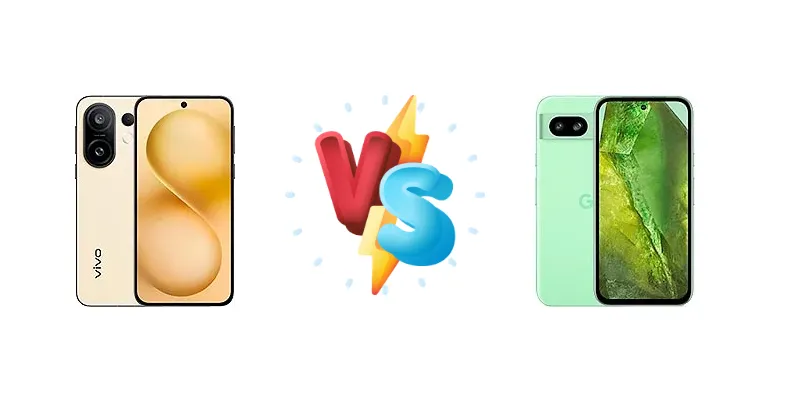
|
🏆 Quick Verdict
For users prioritizing raw processing power and rapid charging, the vivo S30 Pro mini is the clear winner. However, the Google Pixel 8a delivers superior battery endurance, a brighter display, and Google’s signature software experience, making it the better choice for everyday users and photography enthusiasts.
| PHONES | ||
|---|---|---|
| Phone Names | vivo S30 Pro mini | Google Pixel 8a |
| Network | ||
|---|---|---|
| 2G bands | GSM 850 / 900 / 1800 / 1900 | GSM 850 / 900 / 1800 / 1900 |
| 3G bands | HSDPA 800 / 850 / 900 / 1700(AWS) / 1900 / 2100 | HSDPA 800 / 850 / 900 / 1700(AWS) / 1900 / 2100 |
| 4G bands | 1, 3, 4, 5, 7, 8, 18, 19, 26, 28, 34, 38, 39, 40, 41, 42, 43, 48, 66 | 1, 2, 3, 4, 5, 7, 8, 12, 17, 18, 19, 20, 26, 28, 32, 38, 40, 41, 42, 66 - G6GPR (International) |
| 5G bands | 1, 3, 5, 7, 8, 18, 26, 28, 34, 38, 39, 40, 41, 48, 66, 77, 78 SA/NSA | 1, 2, 3, 5, 7, 8, 12, 20, 26, 28, 38, 40, 41, 66, 75, 76, 77, 78 SA/NSA/Sub6 - G6GPR (International) |
| Speed | HSPA, LTE, 5G | HSPA, LTE, 5G |
| Technology | GSM / HSPA / LTE / 5G | GSM / HSPA / LTE / 5G |
| Launch | ||
|---|---|---|
| Announced | 2025, May 29 | 2024, May 07 |
| Status | Available. Released 2025, June 06 | Available. Released 2024, May 14 |
| Body | ||
|---|---|---|
| Build | Glass front (Diamond Shield Glass), aluminum alloy frame, glass back | Glass front (Gorilla Glass 3), aluminum frame, plastic back |
| Dimensions | 150.8 x 71.8 x 8 mm (5.94 x 2.83 x 0.31 in) | 152.1 x 72.7 x 8.9 mm (5.99 x 2.86 x 0.35 in) |
| SIM | Nano-SIM + Nano-SIM | Nano-SIM + eSIM |
| Weight | 186 g (6.56 oz) | 188 g (6.63 oz) |
| Display | ||
|---|---|---|
| Protection | Diamond Shield Glass | Corning Gorilla Glass 3, Mohs level 5 |
| Resolution | 1216 x 2640 pixels, 19.5:9 ratio (~461 ppi density) | 1080 x 2400 pixels, 20:9 ratio (~430 ppi density) |
| Size | 6.31 inches, 97.6 cm2 (~90.2% screen-to-body ratio) | 6.1 inches, 90.3 cm2 (~81.6% screen-to-body ratio) |
| Type | LTPO AMOLED, 1B colors, 120Hz, 4320Hz PWM, HDR, 1300 nits (HBM), 5000 nits (peak) | OLED, HDR, 120Hz, 2000 nits (peak) |
| Platform | ||
|---|---|---|
| CPU | Octa-core (1x3.4 GHz Cortex-X4 & 3x2.85 GHz Cortex-X4 & 4x2.0 GHz Cortex-A720) | Nona-core (1x3.0 GHz Cortex-X3 & 4x2.45 GHz Cortex-A715 & 4x2.15 GHz Cortex-A510) |
| Chipset | Mediatek Dimensity 9300+ (4 nm) | Google Tensor G3 (4 nm) |
| GPU | Immortalis-G720 MC12 | Immortalis-G715s MC10 |
| OS | Android 15, OriginOS 5 | Android 14, upgradable to Android 16, up to 7 major Android upgrades |
| Memory | ||
|---|---|---|
| Card slot | No | No |
| Internal | 256GB 12GB RAM, 512GB 12GB RAM, 512GB 16GB RAM | 128GB 8GB RAM, 256GB 8GB RAM |
| Main Camera | ||
|---|---|---|
| Dual | - | 64 MP (16 MP eff.), f/1.9, 26mm (wide), 1/1.73", 0.8µm, dual pixel PDAF, OIS 13 MP, f/2.2, 120˚ (ultrawide), 1.12µm |
| Features | Ring-LED flash, panorama, HDR | Dual-LED flash, Pixel Shift, Ultra HDR, panorama, Best Take |
| Triple | 50 MP, f/1.9, 23mm (wide), 1/1.56", PDAF, OIS 50 MP, f/2.7, 70mm (periscope telephoto), 1/1.95", PDAF, OIS, 3x optical zoom 8 MP, f/2.2, 106˚ (ultrawide) | - |
| Video | 4K, 1080p, gyro-EIS | 4K@30/60fps, 1080p@30/60/120/240fps, OIS |
| Selfie camera | ||
|---|---|---|
| Features | HDR | HDR, panorama |
| Single | 50 MP, f/2.0, 22mm (wide), AF | 13 MP, f/2.2, 20mm (ultrawide), 1.12µm |
| Video | 4K, 1080p | 4K@30fps, 1080p@30/60fps |
| Sound | ||
|---|---|---|
| 35mm jack | No | No |
| Loudspeaker | Yes, with stereo speakers | Yes, with stereo speakers |
| Comms | ||
|---|---|---|
| Bluetooth | 5.4, A2DP, LE, aptX HD, LHDC 5 | 5.3, A2DP, LE |
| Infrared port | Yes | - |
| NFC | Yes | Yes |
| Positioning | GPS (L1+L5), BDS (B1I+B1C+B2a+B2b), GALILEO (E1+E5a+E5b), QZSS (L1+L5), NavIC (L5), GLONASS | GPS, GLONASS, GALILEO, BDS, QZSS, NavIC |
| Radio | No | No |
| USB | USB Type-C 2.0, OTG | USB Type-C 3.2 |
| WLAN | Wi-Fi 802.11 a/b/g/n/ac/6/7, dual-band | Wi-Fi 802.11 a/b/g/n/ac/6e, dual/tri-band (market/region dependent) |
| Features | ||
|---|---|---|
| Sensors | Fingerprint (under display, optical), accelerometer, gyro, proximity, compass | Fingerprint (under display, optical), accelerometer, gyro, proximity, compass, barometer |
| Battery | ||
|---|---|---|
| Charging | 90W wired, PD Reverse wired Bypass charging | 18W wired, PD3.0 7.5W wireless Bypass charging |
| Type | Si/C Li-Ion 6500 mAh | Li-Po 4492 mAh |
| Misc | ||
|---|---|---|
| Colors | Black, Blue, Yellow, Pink | Obsidian, Porcelain, Bay, Aloe |
| Models | V2465A | GKV4X, G6GPR, G8HHN, G576D |
| Price | About 430 EUR | $ 229.98 / C$ 417.99 / £ 279.00 / € 299.99 / ₹ 33,300 |
| EU LABEL | ||
|---|---|---|
| Battery | - | 40:06h endurance, 1000 cycles |
| Energy | - | Class B |
| Free fall | - | Class A (270 falls) |
| Repairability | - | Class B |
vivo S30 Pro mini
- Blazing-fast Dimensity 9300+ processor
- Ultra-fast 90W wired charging
- Potentially superior gaming performance
- Battery life is unknown and potentially weaker
- Software experience may not be as refined as Pixel
Google Pixel 8a
- Exceptional battery life (40:06h endurance)
- Google’s excellent camera and software
- Bright and vibrant OLED display
- Slower 18W charging
- Less powerful processor compared to Dimensity 9300+
Display Comparison
The Google Pixel 8a boasts a significantly brighter display, reaching a measured 1508 nits, compared to an unstated peak brightness for the vivo S30 Pro mini. This translates to superior visibility under direct sunlight. While the S30 Pro mini’s panel technology isn’t specified, the Pixel 8a’s OLED panel delivers vibrant colors and deep blacks. The absence of LTPO on either device suggests neither offers adaptive refresh rates for power saving, a common feature in higher-end phones.
Camera Comparison
The Pixel 8a’s camera prowess is well-documented, leveraging Google’s computational photography expertise. While specific sensor details are missing for both phones, the Pixel 8a’s image processing is known for its realistic color reproduction and excellent dynamic range. The S30 Pro mini’s camera performance is less known, but the Dimensity 9300+’s ISP capabilities are substantial. Without detailed sensor information, it’s difficult to definitively declare a winner, but the Pixel 8a’s software advantage is a significant factor. We can assume the Pixel 8a will have superior video stabilization and low-light performance.
Performance
The vivo S30 Pro mini’s Mediatek Dimensity 9300+ is a powerhouse, featuring a unique core configuration with a 3.4 GHz Cortex-X4 prime core, three 2.85 GHz Cortex-X4 cores, and four 2.0 GHz Cortex-A720 cores. This contrasts with the Google Pixel 8a’s Google Tensor G3, a nona-core chip with a 3.0 GHz Cortex-X3 core. While clock speeds favor the Dimensity 9300+, the Tensor G3 benefits from Google’s AI optimizations. The Dimensity 9300+'s 4nm process node should offer excellent efficiency, but the Pixel 8a’s Tensor G3 is designed for machine learning tasks, potentially excelling in areas like voice recognition and image processing. The S30 Pro mini likely has an edge in sustained CPU performance due to its more aggressive core configuration.
Battery Life
The Google Pixel 8a shines in battery endurance, offering a remarkable 40:06h endurance rating and 11:25h of active use. This is a substantial advantage over the vivo S30 Pro mini, which lacks published battery life data. The Pixel 8a’s 18W wired charging is considerably slower than the S30 Pro mini’s 90W wired charging, allowing the vivo to potentially reach 100% in under 30 minutes, while the Pixel 8a will take significantly longer. However, the Pixel 8a’s longer overall battery life mitigates the slower charging speed for most users. Both phones support bypass charging, allowing for direct power delivery while charging, reducing heat buildup.
Buying Guide
Buy the vivo S30 Pro mini if you need uncompromising performance for demanding tasks like gaming or video editing, and value the convenience of 90W fast charging. Buy the Google Pixel 8a if you prioritize all-day battery life, a consistently excellent camera experience powered by Google’s AI, and a clean, regularly updated software experience.