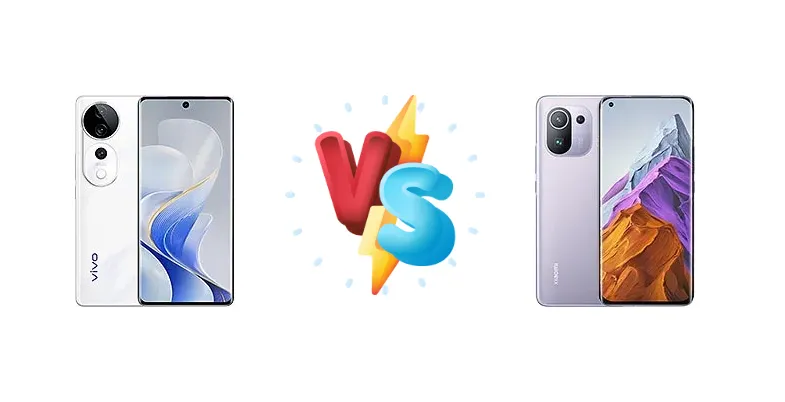
The vivo S21 Pro and Xiaomi Mi 11 Pro represent different points in the Android flagship timeline. The Mi 11 Pro, released in 2021, was a top-tier device in its era, while the S21 Pro, a more recent offering, brings a modern chipset and charging technology to the table. This comparison dissects their key differences to determine which phone offers the best value in today's market.
🏆 Quick Verdict
For most users, the vivo S21 Pro emerges as the better choice. Its Mediatek Dimensity 9300+ chipset provides a significant performance uplift and improved efficiency compared to the Snapdragon 888 in the Mi 11 Pro. While the Mi 11 Pro counters with faster wireless charging, the S21 Pro’s overall package is more compelling.
| Network |
|---|
| 2G bands | GSM 850 / 900 / 1800 / 1900 | GSM 850 / 900 / 1800 / 1900 |
| 3G bands | HSDPA 800 / 850 / 900 / 1700(AWS) / 1900 / 2100 | HSDPA 850 / 900 / 1700(AWS) / 1900 / 2100 |
| 4G bands | LTE | 1, 2, 3, 4, 5, 7, 8, 12, 17, 18, 19, 20, 26, 28, 34, 38, 39, 40, 41, 42 - China |
| 5G bands | SA/NSA | 1, 3, 28, 41, 77, 78, 79 SA/NSA - China |
| Speed | HSPA, LTE, 5G | HSPA, LTE, 5G |
| Technology | GSM / CDMA / HSPA / LTE / 5G | GSM / CDMA / HSPA / EVDO / LTE / 5G |
| | - | CDMA2000 1xEV-DO |
| Launch |
|---|
| Announced | Not announced yet | 2021, March 29 |
| Status | Cancelled | Available. Released 2021, April 02 |
| Body |
|---|
| Build | Glass front, plastic frame, glass back | - |
| Dimensions | - | 164.3 x 74.6 x 8.5 mm (6.47 x 2.94 x 0.33 in) |
| SIM | Nano-SIM + Nano-SIM | Nano-SIM + Nano-SIM |
| Weight | - | 208 g (7.34 oz) |
| | - | IP68 dust/water resistant (up to 1.5m for 30 min) |
| Display |
|---|
| Protection | - | Corning Gorilla Glass Victus |
| Resolution | 1260 x 2800 pixels, 20:9 ratio (~460 ppi density) | 1440 x 3200 pixels, 20:9 ratio (~515 ppi density) |
| Size | 6.67 inches, 107.4 cm2 | 6.81 inches, 112.0 cm2 (~91.4% screen-to-body ratio) |
| Type | AMOLED, 1B colors, 120Hz | AMOLED, 1B colors, 120Hz, HDR10+, Dolby Vision, 1500 nits (peak) |
| Platform |
|---|
| CPU | Octa-core (1x3.25 GHz Cortex-X4 & 3x2.85 GHz Cortex-X4 & 4x2.0 GHz Cortex-A720) | Octa-core (1x2.84 GHz Cortex-X1 & 3x2.42 GHz Cortex-A78 & 4x1.80 GHz Cortex-A55) |
| Chipset | Mediatek Dimensity 9300+ (4 nm) | Qualcomm SM8350 Snapdragon 888 5G (5 nm) |
| GPU | Immortalis-G720 MC12 | Adreno 660 |
| OS | Android 15, OriginOS 5 | Android 11, MIUI 12.5 |
| Memory |
|---|
| Card slot | No | No |
| Internal | Up to 512GB 16GB RAM | 128GB 8GB RAM, 256GB 8GB RAM, 256GB 12GB RAM |
| | - | UFS 3.1 |
| Main Camera |
|---|
| Features | Ring-LED flash, panorama, HDR | Color spectrum sensor, LED flash, HDR, panorama |
| Single | - | 20 MP, f/2.2, 27mm (wide), 1/3.4", 0.8µm |
| Triple | 50 MP, f/1.9, (wide), 1/1.56", PDAF, OIS
50 MP, f/1.9, (telephoto), 1/1.95", PDAF, OIS, 3x optical zoom
50 MP, f/2.2, (ultrawide) | 50 MP, f/2.0, 24mm (wide), 1/1.12", 1.4µm, dual pixel PDAF, OIS
8 MP, 120mm (periscope telephoto), PDAF, OIS, 5x optical zoom
13 MP, f/2.4, 16mm, 123˚ (ultrawide) |
| Video | 4K@30fps, 1080p@30fps, gyro-EIS, OIS | 8K@24fps, 4K@30/60fps, 1080p@30/60fps, gyro-EIS, HDR10+ rec. |
| Selfie camera |
|---|
| Features | Dual-LED flash, HDR | HDR, panorama |
| Single | 50 MP, f/2.0, 22mm (wide), AF | 20 MP, f/2.2, 27mm (wide), 1/3.4", 0.8µm |
| Video | 4K@30fps, 1080p@30fps | 1080p@30/60fps, 720p@120fps, gyro-EIS |
| Sound |
|---|
| 3.5mm jack | - | No |
| 35mm jack | No | No |
| Loudspeaker | Yes, with stereo speakers | Yes, with stereo speakers |
| | - | 24-bit/192kHz audio
Tuned by Harman Kardon |
| Comms |
|---|
| Bluetooth | 5.3, A2DP, LE, aptX HD | 5.2, A2DP, LE, aptX HD, aptX Adaptive |
| Infrared port | Yes | Yes |
| NFC | Yes | Yes |
| Positioning | GPS (L1+L5), GLONASS, BDS (B1I+B1c+B2a), GALILEO (E1+E5a), QZSS (L1+L5), NavIC (L5) | GPS (L1+L5), GLONASS (L1), BDS (B1I+B1c+B2a), GALILEO (E1+E5a), QZSS (L1+L5), NavIC (L5) |
| Radio | No | No |
| USB | USB Type-C 2.0, OTG | USB Type-C 2.0, OTG |
| WLAN | Wi-Fi 802.11 a/b/g/n/ac/6/7, dual-band, Wi-Fi Direct | Wi-Fi 802.11 a/b/g/n/ac/6e, dual-band, Wi-Fi Direct, DLNA |
| Features |
|---|
| Sensors | Fingerprint (under display, optical), accelerometer, gyro, proximity, compass | Fingerprint (under display, optical), accelerometer, gyro, proximity, compass |
| Battery |
|---|
| Charging | 90W wired, PD
Reverse wired | 67W wired, PD3.0, QC4, 100% in 36 min
67W wireless, 100% in 39 min
10W reverse wireless |
| Type | Si/C Li-Ion 5500 mAh | Li-Po 5000 mAh |
| Misc |
|---|
| Colors | Gray; other colors | Black, Green, Purple |
| Models | - | M2102K1AC |
| Price | - | About 370 EUR |
vivo S21 Pro
- Significantly more powerful processor (Dimensity 9300+)
- Improved thermal efficiency and reduced throttling
- Faster wired charging (90W)
- Lacks wireless charging
- Potentially higher price point
Xiaomi Mi 11 Pro
- Fast 67W wired and wireless charging
- Mature software experience
- Potentially lower price due to age
- Older, less efficient processor (Snapdragon 888)
- Prone to thermal throttling under heavy load
- Potentially outdated display technology
Display Comparison
Neither device's display specifications are provided, but given their market positioning, both likely feature high-refresh-rate AMOLED panels. However, the age difference suggests the Mi 11 Pro may lack the latest advancements in panel technology like LTPO for variable refresh rates, potentially impacting battery life. The S21 Pro, being newer, likely benefits from improved color calibration and peak brightness, offering a more vibrant viewing experience. Bezels are expected to be minimal on both, but the S21 Pro may have a slightly more modern design.
Camera Comparison
Without detailed camera specs, a direct comparison is difficult. However, the Mi 11 Pro is known for its excellent camera system, particularly its large main sensor. The S21 Pro, being a more recent device, likely incorporates advancements in image processing algorithms and potentially a larger sensor as well. The presence of OIS (Optical Image Stabilization) is expected on both, but the S21 Pro may benefit from improved stabilization technology. The Mi 11 Pro’s image processing tends towards more saturated colors, while vivo often aims for a more natural look. We can assume both phones will offer a versatile camera experience, but the S21 Pro’s newer processing capabilities give it an edge.
Performance
The core difference lies in the chipsets. The vivo S21 Pro’s Mediatek Dimensity 9300+ (4nm) boasts a significantly more modern architecture than the Xiaomi Mi 11 Pro’s Snapdragon 888 (5nm). The Dimensity 9300+ features a tri-cluster configuration with Cortex-X4 cores, promising substantial gains in CPU performance and efficiency. The Snapdragon 888, while powerful for its time, is known to throttle under sustained load due to thermal limitations. The S21 Pro’s 4nm process further enhances thermal efficiency, mitigating throttling. The S21 Pro’s CPU configuration (1x3.25 GHz Cortex-X4, 3x2.85 GHz Cortex-X4, 4x2.0 GHz Cortex-A720) is a clear upgrade over the Mi 11 Pro’s (1x2.84 GHz Cortex-X1, 3x2.42 GHz Cortex-A78, 4x1.80 GHz Cortex-A55).
Battery Life
The Xiaomi Mi 11 Pro offers a compelling charging solution with 67W wired, 67W wireless, and 10W reverse wireless charging. Achieving a full charge in 36 minutes (wired) and 39 minutes (wireless) is impressive. The vivo S21 Pro counters with 90W wired charging and reverse wired charging, but lacks wireless charging. While the S21 Pro’s wired charging is faster, the Mi 11 Pro’s wireless charging capability is a significant advantage for users who prefer cable-free power-ups. The actual battery life will depend on the mAh capacity of each device (not provided), but the Dimensity 9300+'s efficiency should translate to longer runtime on the S21 Pro.
Buying Guide
Buy the vivo S21 Pro if you prioritize raw performance, future-proofing, and efficient power management for demanding tasks like gaming and content creation. Buy the Xiaomi Mi 11 Pro if you heavily rely on wireless charging and appreciate a slightly more mature software experience, potentially at a lower price point due to its age.
Frequently Asked Questions
❓ Does the Snapdragon 888 in the Xiaomi Mi 11 Pro overheat during prolonged gaming sessions?
Yes, the Snapdragon 888 is known to experience thermal throttling under sustained load, particularly during demanding games. This can lead to reduced performance and frame rate drops over time. The vivo S21 Pro’s Dimensity 9300+ and 4nm process are significantly more efficient and less prone to overheating.
❓ Is the 90W charging on the vivo S21 Pro significantly faster than the 67W charging on the Xiaomi Mi 11 Pro in real-world use?
While both offer fast charging, the 90W charging on the S21 Pro will likely result in a noticeably quicker 0-100% charge time. The difference is approximately 10-15 minutes, making it ideal for users who need to quickly top up their battery.
❓ How does the software experience differ between the vivo S21 Pro and the Xiaomi Mi 11 Pro?
The Xiaomi Mi 11 Pro likely has a more mature software experience, having received several updates since its release. However, it may also be nearing the end of its major software update cycle. The vivo S21 Pro benefits from a newer version of Android and vivo’s Funtouch OS, which offers a different user interface and feature set. User preference will play a significant role in determining which software experience is better.