
vivo S20 vs Samsung Galaxy A52s 5G: A Deep Dive into Mid-Range Power
| Phones Images | |||||
|---|---|---|---|---|---|
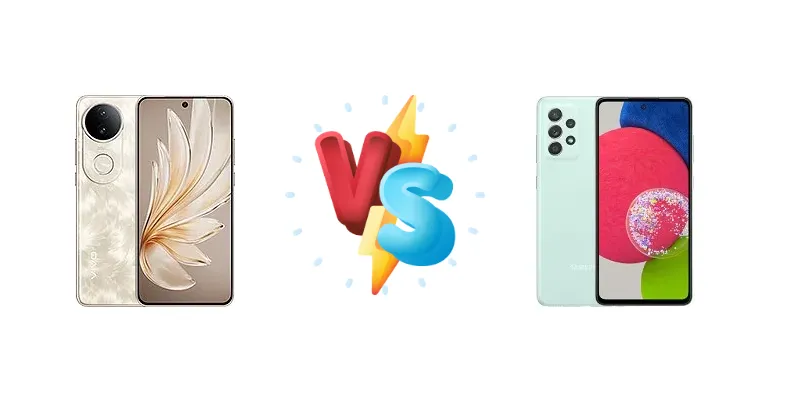
|
🏆 Quick Verdict
For most users, the vivo S20 emerges as the superior choice. Its Snapdragon 7 Gen 3 chipset delivers a noticeable performance uplift over the A52s 5G’s Snapdragon 778G, and the 90W charging is a game-changer. While the A52s 5G still offers respectable battery endurance, the S20’s advancements justify the potential price premium.
| PHONES | ||
|---|---|---|
| Phone Names | vivo S20 | Samsung Galaxy A52s 5G |
| Network | ||
|---|---|---|
| 2G bands | GSM 850 / 900 / 1800 / 1900 | GSM 850 / 900 / 1800 / 1900 |
| 3G bands | HSDPA 800 / 850 / 900 / 1700(AWS) / 1900 / 2100 | HSDPA 850 / 900 / 1700(AWS) / 1900 / 2100 |
| 4G bands | 1, 3, 4, 5, 7, 8, 18, 19, 26, 28, 34, 38, 39, 40, 41 | 1, 2, 3, 4, 5, 7, 8, 12, 17, 20, 26, 28, 32, 38, 40, 41, 66 |
| 5G bands | 1, 3, 5, 8, 28, 38, 40, 41, 77, 78 SA/NSA | 1, 3, 5, 7, 8, 20, 28, 38, 40, 41, 66, 78 SA/NSA/Sub6 |
| Speed | HSPA, LTE, 5G | HSPA 42.2/5.76 Mbps, LTE Cat18 1200/150 Mbps, 5G |
| Technology | GSM / CDMA / HSPA / LTE / 5G | GSM / HSPA / LTE / 5G |
| Launch | ||
|---|---|---|
| Announced | 2024, November 28 | 2021, August 17 |
| Status | Available. Released 2024, December 06 | Available. Released 2021, September 01 |
| Body | ||
|---|---|---|
| Build | - | Glass front (Gorilla Glass 5), plastic back |
| Dimensions | 160.4 x 74.2 x 7.2 mm (6.31 x 2.92 x 0.28 in) | 159.9 x 75.1 x 8.4 mm (6.30 x 2.96 x 0.33 in) |
| SIM | Nano-SIM + Nano-SIM | · Nano-SIM· Nano-SIM + Nano-SIM |
| Weight | 186 g (6.56 oz) | 189 g (6.67 oz) |
| - | IP67 dust/water resistant (up to 1m for 30 min) | |
| Display | ||
|---|---|---|
| Protection | Scratch/drop-resistant glass | Corning Gorilla Glass 5 |
| Resolution | 1260 x 2800 pixels, 20:9 ratio (~460 ppi density) | 1080 x 2400 pixels, 20:9 ratio (~405 ppi density) |
| Size | 6.67 inches, 107.4 cm2 (~90.2% screen-to-body ratio) | 6.5 inches, 102.0 cm2 (~84.9% screen-to-body ratio) |
| Type | AMOLED, 1B colors, 120Hz, 1300 nits (HBM), 5000 nits (peak) | Super AMOLED, 120Hz, 800 nits (HBM) |
| Platform | ||
|---|---|---|
| CPU | Octa-core (1x2.63 GHz Cortex-A715 & 3x2.4 GHz Cortex-A715 & 4x1.8 GHz Cortex-A510) | Octa-core (1x2.4 GHz Cortex-A78 & 3x2.2 GHz Cortex-A78 & 4x1.9 GHz Cortex-A55) |
| Chipset | Qualcomm SM7550-AB Snapdragon 7 Gen 3 (4 nm) | Qualcomm SM7325 Snapdragon 778G 5G (6 nm) |
| GPU | Adreno 720 | Adreno 642L |
| OS | Android 15, OriginOS 5 | Android 11, upgradable to Android 14, One UI 6 |
| Memory | ||
|---|---|---|
| Card slot | No | microSDXC (uses shared SIM slot) |
| Internal | 256GB 8GB RAM, 256GB 12GB RAM, 512GB 12GB RAM, 512GB 16GB RAM | 128GB 4GB RAM, 128GB 6GB RAM, 128GB 8GB RAM, 256GB 6GB RAM, 256GB 8GB RAM |
| Main Camera | ||
|---|---|---|
| Dual | 50 MP, f/1.9, 23mm (wide), 1/1.55", PDAF, OIS 8 MP, f/2.2, 106˚ (ultrawide), AF | - |
| Features | Ring-LED flash, panorama, HDR | LED flash, panorama, HDR |
| Quad | - | 64 MP, f/1.8, 26mm (wide), 1/1.7", 0.8µm, PDAF, OIS 12 MP, f/2.2, 123˚ (ultrawide), 1.12µm 5 MP (macro) Auxiliary lens |
| Single | - | 32 MP, f/2.2, 26mm (wide), 1/2.8", 0.8µm |
| Video | 4K, 1080p, gyro-EIS | 4K@30fps, 1080p@30/60fps; gyro-EIS |
| Selfie camera | ||
|---|---|---|
| Features | HDR | HDR |
| Single | 50 MP, f/2.0, 22mm (wide), AF | 32 MP, f/2.2, 26mm (wide), 1/2.8", 0.8µm |
| Video | 4K, 1080p | 4K@30fps, 1080p@30/60fps |
| Sound | ||
|---|---|---|
| 3.5mm jack | - | Yes |
| 35mm jack | No | Yes |
| Loudspeaker | Yes, with stereo speakers | Yes, with stereo speakers |
| Comms | ||
|---|---|---|
| Bluetooth | 5.4, A2DP, LE, aptX HD, aptX Adaptive, aptX Lossless, LHDC 5 | 5.0, A2DP, LE |
| Infrared port | Yes | - |
| NFC | Yes | Yes (market/region dependent) |
| Positioning | GPS, GALILEO, GLONASS, QZSS, BDS (B1I+B1c) | GPS, GLONASS, GALILEO, BDS, QZSS |
| Radio | No | No |
| USB | USB Type-C 2.0, OTG | USB Type-C 2.0, OTG |
| WLAN | Wi-Fi 802.11 a/b/g/n/ac/6, dual-band, Wi-Fi Direct | Wi-Fi 802.11 a/b/g/n/ac/6, dual-band, Wi-Fi Direct |
| Features | ||
|---|---|---|
| Sensors | Fingerprint (under display, optical), accelerometer, gyro, proximity, compass | Fingerprint (under display, optical), accelerometer, gyro, compass |
| - | Virtual Proximity Sensing | |
| Battery | ||
|---|---|---|
| Charging | 90W wired, PD Reverse wired | 25W wired |
| Type | Si/C Li-Ion 6500 mAh | Li-Ion 4500 mAh |
| Misc | ||
|---|---|---|
| Colors | Gray, Gold, White | Awesome Black, Awesome White, Awesome Purple, Awesome Mint |
| Models | V2429A | SM-A528B, SM-A528B/DS, SM-A528N |
| Price | About 300 EUR | £ 112.98 / € 249.47 |
| SAR | - | 0.72 W/kg (head) |
| SAR EU | - | 0.88 W/kg (head) 0.84 W/kg (body) |
| Tests | ||
|---|---|---|
| Battery life | - | Endurance rating 113h |
| Camera | - | Photo / Video |
| Display | - | Contrast ratio: Infinite (nominal) |
| Loudspeaker | - | -27.5 LUFS (Good) |
| Performance | - | AnTuTu: 429675 (v8), 506432(v9) GeekBench: 11060 (v4.4), 2801 (v5.1) GFXBench: 28fps (ES 3.1 onscreen) |
vivo S20
- Proven reliability and software support
- Excellent battery endurance (113h)
- Good value for money
- Slower charging speed (25W)
- Older chipset (Snapdragon 778G)
- Less powerful CPU
Samsung Galaxy A52s 5G
- Faster and more efficient Snapdragon 7 Gen 3
- Ultra-fast 90W wired charging
- Potentially improved camera processing
- Battery capacity currently unknown
- Long-term software support is unconfirmed
- May be more expensive than the A52s 5G
Display Comparison
The Samsung Galaxy A52s 5G boasts a measured peak brightness of 800 nits, providing good visibility outdoors. However, the vivo S20’s display specifications are currently unavailable, making a direct brightness comparison difficult. Given vivo’s recent focus on display quality, it’s reasonable to expect a comparable or potentially brighter panel. Both phones feature an 'Infinite' (Samsung) contrast ratio, typical for OLED displays. Without PWM frequency data for the S20, it's impossible to assess potential flicker-related eye strain compared to the A52s 5G.
Camera Comparison
Both devices offer photo and video capabilities, but detailed camera specifications are limited. The A52s 5G’s camera performance is well-documented, delivering good results in various lighting conditions. Without sensor size or aperture information for the vivo S20, a direct comparison is challenging. However, the newer chipset’s image signal processor (ISP) likely offers improved image processing algorithms, potentially resulting in better dynamic range and low-light performance. The prevalence of 2MP macro lenses on both devices suggests they are largely marketing features with limited practical utility.
Performance
The vivo S20’s Qualcomm Snapdragon 7 Gen 3 (4nm) represents a significant architectural leap over the A52s 5G’s Snapdragon 778G (6nm). The 7 Gen 3 utilizes Cortex-A715 cores, offering improved performance and efficiency compared to the A78 cores in the 778G. The 4nm process node further enhances efficiency, potentially leading to better thermal management and sustained performance during extended gaming sessions. While the A52s 5G’s CPU configuration includes a single Cortex-A78 prime core, the S20’s combination of a single A715 and three additional A715 cores suggests a more balanced and powerful multi-core performance profile. The S20's newer architecture will likely translate to faster app loading times and smoother multitasking.
Battery Life
The Samsung Galaxy A52s 5G achieves an impressive endurance rating of 113 hours, indicating excellent battery life. The vivo S20’s battery capacity is currently unknown, but its 90W wired charging capability is a major advantage. This allows for significantly faster charging times compared to the A52s 5G’s 25W charging. While the A52s 5G offers all-day battery life for moderate users, the S20’s rapid charging can quickly top up the battery, minimizing downtime. The efficiency gains from the 4nm process in the S20 could also contribute to comparable or even improved battery endurance despite a potentially smaller battery capacity.
Buying Guide
Buy the vivo S20 if you prioritize performance for demanding apps and games, and value incredibly fast charging speeds. This phone is ideal for users who frequently multitask or consume a lot of media on the go. Buy the Samsung Galaxy A52s 5G if you are looking for a proven, reliable device with good battery life and a more established software ecosystem, and are less concerned with having the absolute latest processor or fastest charging.