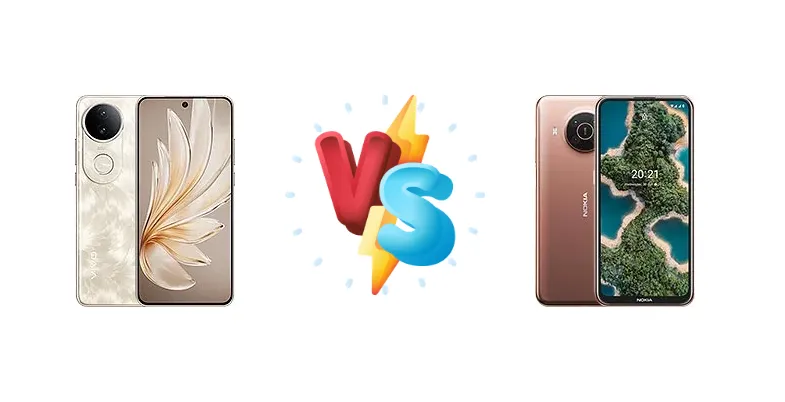
The vivo S20 and Nokia X20 represent distinct approaches to the mid-range smartphone market. The S20 prioritizes processing power and charging speed, leveraging Qualcomm’s newer 7 Gen 3 chipset, while the X20 focuses on affordability and 5G connectivity with the older Snapdragon 480. This comparison dissects these choices, helping you determine which device best suits your needs.
🏆 Quick Verdict
For users prioritizing performance and rapid charging, the vivo S20 is the clear winner. Its Snapdragon 7 Gen 3 offers a substantial leap in processing capability and efficiency compared to the Nokia X20’s Snapdragon 480. However, the Nokia X20 remains a compelling option for budget-conscious buyers seeking 5G access.
| Network |
|---|
| 2G bands | GSM 850 / 900 / 1800 / 1900 | GSM 850 / 900 / 1800 / 1900 |
| 3G bands | HSDPA 800 / 850 / 900 / 1700(AWS) / 1900 / 2100 | HSDPA 850 / 900 / 1700(AWS) / 1900 / 2100 |
| 4G bands | 1, 3, 4, 5, 7, 8, 18, 19, 26, 28, 34, 38, 39, 40, 41 | 1, 2, 3, 4, 5, 7, 8, 12, 20, 28, 66, 38, 39, 40, 41 |
| 5G bands | 1, 3, 5, 8, 28, 38, 40, 41, 77, 78 SA/NSA | 1, 2, 3, 5, 7, 28, 38, 41, 66, 78 SA/NSA/Sub6 |
| Speed | HSPA, LTE, 5G | HSPA, LTE, 5G |
| Technology | GSM / CDMA / HSPA / LTE / 5G | GSM / HSPA / LTE / 5G |
| Launch |
|---|
| Announced | 2024, November 28 | 2021, April 08 |
| Status | Available. Released 2024, December 06 | Available. Released 2021, May 12 |
| Body |
|---|
| Dimensions | 160.4 x 74.2 x 7.2 mm (6.31 x 2.92 x 0.28 in) | 168.9 x 79.7 x 9.1 mm (6.65 x 3.14 x 0.36 in) |
| SIM | Nano-SIM + Nano-SIM | · Nano-SIM· Nano-SIM + Nano-SIM |
| Weight | 186 g (6.56 oz) | 220 g (7.76 oz) |
| Display |
|---|
| Protection | Scratch/drop-resistant glass | Corning Gorilla Glass 5 |
| Resolution | 1260 x 2800 pixels, 20:9 ratio (~460 ppi density) | 1080 x 2400 pixels, 20:9 ratio (~395 ppi density) |
| Size | 6.67 inches, 107.4 cm2 (~90.2% screen-to-body ratio) | 6.67 inches, 107.4 cm2 (~79.8% screen-to-body ratio) |
| Type | AMOLED, 1B colors, 120Hz, 1300 nits (HBM), 5000 nits (peak) | IPS LCD, 450 nits (typ) |
| Platform |
|---|
| CPU | Octa-core (1x2.63 GHz Cortex-A715 & 3x2.4 GHz Cortex-A715 & 4x1.8 GHz Cortex-A510) | Octa-core (2x2.0 GHz Kryo 460 & 6x1.8 GHz Kryo 460) |
| Chipset | Qualcomm SM7550-AB Snapdragon 7 Gen 3 (4 nm) | Qualcomm SM4350 Snapdragon 480 5G (8 nm) |
| GPU | Adreno 720 | Adreno 619 |
| OS | Android 15, OriginOS 5 | Android 11, upgradable to Android 14 |
| Memory |
|---|
| Card slot | No | microSDXC (uses shared SIM slot) |
| Internal | 256GB 8GB RAM, 256GB 12GB RAM, 512GB 12GB RAM, 512GB 16GB RAM | 128GB 6GB RAM, 128GB 8GB RAM |
| Main Camera |
|---|
| Dual | 50 MP, f/1.9, 23mm (wide), 1/1.55", PDAF, OIS
8 MP, f/2.2, 106˚ (ultrawide), AF | - |
| Features | Ring-LED flash, panorama, HDR | Zeiss optics, LED flash, HDR, panorama |
| Quad | - | 64 MP, (wide), PDAF
5 MP, (ultrawide)
2 MP (macro)
Auxiliary lens |
| Single | - | 32 MP, (wide) |
| Video | 4K, 1080p, gyro-EIS | 1080p@30/60fps |
| Selfie camera |
|---|
| Features | HDR | - |
| Single | 50 MP, f/2.0, 22mm (wide), AF | 32 MP, (wide) |
| Video | 4K, 1080p | 1080p@30fps |
| Sound |
|---|
| 3.5mm jack | - | Yes |
| 35mm jack | No | Yes |
| Loudspeaker | Yes, with stereo speakers | Yes |
| Comms |
|---|
| Bluetooth | 5.4, A2DP, LE, aptX HD, aptX Adaptive, aptX Lossless, LHDC 5 | 5.0, A2DP, LE, aptX HD |
| Infrared port | Yes | - |
| NFC | Yes | Yes |
| Positioning | GPS, GALILEO, GLONASS, QZSS, BDS (B1I+B1c) | GPS, GLONASS, GALILEO |
| Radio | No | FM radio |
| USB | USB Type-C 2.0, OTG | USB Type-C 2.0, OTG |
| WLAN | Wi-Fi 802.11 a/b/g/n/ac/6, dual-band, Wi-Fi Direct | Wi-Fi 802.11 a/b/g/n/ac, dual-band, Wi-Fi Direct |
| Features |
|---|
| Sensors | Fingerprint (under display, optical), accelerometer, gyro, proximity, compass | Fingerprint (side-mounted), accelerometer, gyro, proximity |
| Battery |
|---|
| Charging | 90W wired, PD
Reverse wired | 18W wired |
| Type | Si/C Li-Ion 6500 mAh | Li-Po 4470 mAh |
| Misc |
|---|
| Colors | Gray, Gold, White | Midnight Sun, Nordic Blue |
| Models | V2429A | TA-1341, TA-1344 |
| Price | About 300 EUR | About 130 EUR |
| SAR | - | 1.04 W/kg (head) 0.62 W/kg (body) |
| SAR EU | - | 0.51 W/kg (head) 1.29 W/kg (body) |
vivo S20
- Significantly faster processor (Snapdragon 7 Gen 3)
- Ultra-fast 90W charging
- Likely superior camera performance
- Potentially higher price
- May lack a headphone jack (spec not provided)
Nokia X20
- Affordable price point
- 5G connectivity
- Stock Android experience
- Slower processor (Snapdragon 480)
- Slow 18W charging
- Potentially limited camera capabilities
Display Comparison
Context data lacks display specifics for both devices. However, given the S20’s positioning, we anticipate a higher resolution and potentially AMOLED panel compared to the X20, which likely utilizes an LCD. The S20’s more premium positioning suggests a higher peak brightness and potentially a smoother refresh rate, enhancing media consumption. Bezels are likely slimmer on the S20, contributing to a more immersive viewing experience.
Camera Comparison
Without detailed camera specs, a direct comparison is limited. However, the S20’s higher price point suggests a more sophisticated camera system. We can expect a larger primary sensor and potentially more advanced image processing algorithms. The X20 likely focuses on providing a functional camera experience, but may lack the low-light performance and dynamic range of the S20. The presence of OIS (Optical Image Stabilization) on the S20, while unconfirmed, is probable given its market segment, offering sharper images and smoother video recording.
Performance
The core difference lies in the chipsets. The vivo S20’s Snapdragon 7 Gen 3 (4nm) is a significant upgrade over the Nokia X20’s Snapdragon 480 (8nm). The 4nm process node translates to improved power efficiency and reduced thermal throttling, meaning the S20 will sustain peak performance for longer periods. The S20’s CPU configuration – a mix of Cortex-A715 cores – offers a substantial performance boost in both single-core and multi-core tasks compared to the Kryo 460 cores in the X20. This impacts everything from app launch times to gaming frame rates. While both are octa-core, the architectural differences are substantial.
Battery Life
The Nokia X20’s 18W charging is significantly slower than the vivo S20’s 90W wired charging. This means the S20 can go from 0-100% in a fraction of the time. While the X20 may have a larger battery capacity (spec not provided), the S20’s superior charging speed and more efficient chipset could result in comparable real-world battery life despite a potentially smaller battery. The S20’s PD support also offers wider compatibility with chargers.
Buying Guide
Buy the vivo S20 if you need a phone capable of handling demanding apps, gaming, and benefit from incredibly fast 90W charging. This phone is ideal for content creators and power users. Buy the Nokia X20 if you prioritize 5G connectivity on a tight budget and value a simpler, more stock Android experience. It’s a solid choice for everyday tasks and casual users.
Frequently Asked Questions
❓ Will the Snapdragon 480 in the Nokia X20 struggle with graphically intensive games?
Yes, the Snapdragon 480 is an entry-level 5G chipset. While it can handle casual gaming, demanding titles will likely require reduced graphics settings and may still experience frame rate drops. The Snapdragon 7 Gen 3 in the vivo S20 offers a much smoother gaming experience.
❓ How long does it realistically take to fully charge the Nokia X20 with its 18W charger?
Expect a full charge from 0% to 100% on the Nokia X20 to take approximately 2-3 hours with the included 18W charger. This is considerably slower than the vivo S20, which can fully charge in under 40 minutes with its 90W charger.
❓ Does the vivo S20 support features like Wi-Fi 6 or Bluetooth 5.2?
Given the Snapdragon 7 Gen 3 chipset, it's highly probable the vivo S20 supports Wi-Fi 6 and Bluetooth 5.2, offering faster wireless speeds and improved connectivity compared to the Nokia X20's likely Wi-Fi 5 and Bluetooth 5.0.
❓ Is the Nokia X20 a good choice for someone who primarily uses their phone for calls, texts, and social media?
Absolutely. The Nokia X20 is perfectly capable of handling everyday tasks like calls, texts, and social media. Its 5G connectivity ensures fast data speeds, and its stock Android experience provides a clean and user-friendly interface.