
vivo S20 Pro vs Samsung Galaxy S20+ 5G: A Deep Dive into Performance and Value
| Phones Images | |||||
|---|---|---|---|---|---|
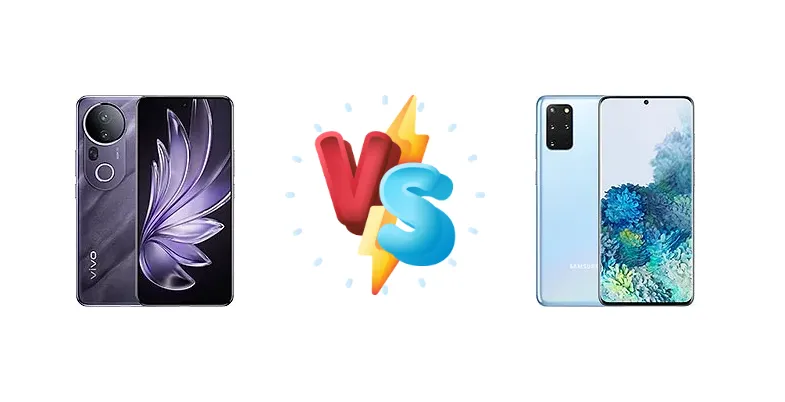
|
🏆 Quick Verdict
For most users, the vivo S20 Pro emerges as the superior choice. Its Mediatek Dimensity 9300+ chipset delivers significantly improved CPU and GPU performance, coupled with blazing-fast 90W charging. While the S20+ retains a strong brand reputation, the S20 Pro offers a more modern and powerful package.
| PHONES | ||
|---|---|---|
| Phone Names | vivo S20 Pro | Samsung Galaxy S20+ 5G |
| Network | ||
|---|---|---|
| 2G bands | GSM 850 / 900 / 1800 / 1900 | GSM 850 / 900 / 1800 / 1900 |
| 3G bands | HSDPA 800 / 850 / 900 / 1700(AWS) / 1900 / 2100 | HSDPA 850 / 900 / 1700(AWS) / 1900 / 2100 |
| 4G bands | 1, 3, 4, 5, 7, 8, 18, 19, 26, 28, 34, 38, 39, 40, 41 | 1, 2, 3, 4, 5, 7, 8, 12, 13, 17, 18, 19, 20, 25, 26, 28, 32, 38, 39, 40, 41, 66 - SM-G986B |
| 5G bands | 1, 3, 5, 8, 28, 38, 40, 41, 77, 78 SA/NSA | 1, 3, 5, 7, 8, 28, 40, 77, 78 SA/NSA/Sub6 - SM-G986B |
| Speed | HSPA, LTE, 5G | HSPA 42.2/5.76 Mbps, LTE (7CA) Cat20 2000/200 Mbps, 5G (5+ Gbps DL) |
| Technology | GSM / CDMA / HSPA / LTE / 5G | GSM / CDMA / HSPA / EVDO / LTE / 5G |
| Launch | ||
|---|---|---|
| Announced | 2024, November 28 | 2020, February 11 |
| Status | Available. Released 2024, December 12 | Available. Released 2020, March 06 |
| Body | ||
|---|---|---|
| Build | - | Glass front (Gorilla Glass 6), glass back (Gorilla Glass 6), aluminum frame |
| Dimensions | 160.6 x 75 x 7.5 mm (6.32 x 2.95 x 0.30 in) | 161.9 x 73.7 x 7.8 mm (6.37 x 2.90 x 0.31 in) |
| SIM | Nano-SIM + Nano-SIM | · Nano-SIM + eSIM· Nano-SIM + Nano-SIM |
| Weight | 194 g (6.84 oz) | 188 g (6.63 oz) |
| Display | ||
|---|---|---|
| Protection | - | Corning Gorilla Glass 6 |
| Resolution | 1260 x 2800 pixels, 20:9 ratio (~460 ppi density) | 1440 x 3200 pixels, 20:9 ratio (~525 ppi density) |
| Size | 6.67 inches, 107.4 cm2 (~89.2% screen-to-body ratio) | 6.7 inches, 108.0 cm2 (~90.5% screen-to-body ratio) |
| Type | AMOLED, 1B colors, 120Hz, 1600 nits (HBM), 5000 nits (peak) | Dynamic AMOLED 2X, 120Hz, HDR10+, 1200 nits (peak) |
| Platform | ||
|---|---|---|
| CPU | Octa-core (1x3.4 GHz Cortex-X4 & 3x2.85 GHz Cortex-X4 & 4x2.0 GHz Cortex-A720) | Octa-core (2x2.73 GHz Mongoose M5 & 2x2.50 GHz Cortex-A76 & 4x2.0 GHz Cortex-A55) - GlobalOcta-core (1x2.84 GHz Cortex-A77 & 3x2.42 GHz Cortex-A77 & 4x1.80 GHz Cortex-A55) - USA |
| Chipset | Mediatek Dimensity 9300+ (4 nm) | Exynos 990 (7 nm+) - GlobalQualcomm SM8250 Snapdragon 865 5G (7 nm+) - USA |
| GPU | Immortalis-G720 MC12 | Mali-G77 MP11 - GlobalAdreno 650 - USA |
| OS | Android 15, OriginOS 5 | Android 10, upgradable to Android 13, One UI 5.1 |
| Memory | ||
|---|---|---|
| Card slot | No | microSDXC (uses shared SIM slot) |
| Internal | 256GB 12GB RAM, 512GB 12GB RAM, 512GB 16GB RAM | 128GB 8GB RAM, 128GB 12GB RAM, 256GB 12GB RAM, 512GB 12GB RAM |
| Main Camera | ||
|---|---|---|
| Features | Ring-LED flash, panorama, HDR | LED flash, auto-HDR, panorama |
| Triple | 50 MP, f/1.9, 23mm (wide), 1/1.56", PDAF, OIS 50 MP, f/2.6, 85mm (periscope telephoto), 1/1.95", 0.8µm, PDAF (15cm - ∞), OIS, 3x optical zoom 50 MP, f/2.1, (ultrawide), AF | 12 MP, f/1.8, 26mm (wide), 1/1.76", 1.8µm, dual pixel PDAF, OIS 64 MP, f/2.0, 29mm (telephoto), 1/1.72", 0.8µm, PDAF, OIS, 1.1x optical zoom, 3x hybrid zoom 12 MP, f/2.2, 13mm, 120˚ (ultrawide), 1/2.55" 1.4µm, Super Steady video 0.3 MP, TOF 3D, f/1.0, (depth) |
| Video | 4K, 1080p, gyro-EIS | 8K@24fps, 4K@30/60fps, 1080p@30/60/240fps, 720p@960fps, HDR10+, stereo sound rec., gyro-EIS & OIS |
| Selfie camera | ||
|---|---|---|
| Features | HDR | HDR |
| Single | 50 MP, f/2.0, 22mm (wide), AF | 10 MP, f/2.2, 26mm (wide), 1/3.24", 1.22µm, dual pixel PDAF |
| Video | 4K, 1080p | 4K@30/60fps, 1080p@30fps |
| Sound | ||
|---|---|---|
| 3.5mm jack | - | No |
| 35mm jack | No | No |
| Loudspeaker | Yes, with stereo speakers | Yes, with stereo speakers |
| Comms | ||
|---|---|---|
| Bluetooth | 5.4, A2DP, LE, aptX HD, LHDC 5 | 5.0, A2DP, LE |
| Infrared port | Yes | - |
| NFC | Yes | Yes |
| Positioning | GPS (L1+L5), GLONASS, BDS (B1I+B1c+B2a), GALILEO (E1+E5a), QZSS (L1+L5), NavIC (L5) | GPS, GLONASS, BDS, GALILEO |
| Radio | No | FM radio (Snapdragon model only; market/operator dependent) |
| USB | USB Type-C 2.0, OTG | USB Type-C 3.2, OTG |
| WLAN | Wi-Fi 802.11 a/b/g/n/ac/6/7, dual-band, Wi-Fi Direct | Wi-Fi 802.11 a/b/g/n/ac/6, dual-band, Wi-Fi Direct |
| Features | ||
|---|---|---|
| Sensors | Fingerprint (under display, optical), accelerometer, gyro, proximity, compass | Fingerprint (under display, ultrasonic), accelerometer, gyro, proximity, compass, barometer |
| Battery | ||
|---|---|---|
| Charging | 90W wired, PD Reverse wired | 25W wired, PD3.0 15W wireless (Qi) 4.5W reverse wireless |
| Type | Si/C Li-Ion 5500 mAh | Li-Ion 4500 mAh |
| Misc | ||
|---|---|---|
| Colors | Gray, Purple, Gold | Cosmic Black, Cosmic Grey, Cloud Blue, Cloud White, Aura Red, Aura Blue |
| Models | V2430A | SM-G986, SM-G986F, SM-G986F/DS, SM-G986U, SM-G986U1, SM-G9860, SM-G986B/DS, SM-G986N, SM-G986B, SM-G986W, SCG02 |
| Price | About 450 EUR | $ 174.17 / C$ 684.99 / € 299.97 |
| SAR | - | 1.08 W/kg (head) 1.02 W/kg (body) |
| SAR EU | - | 1.09 W/kg (head) 1.57 W/kg (body) |
vivo S20 Pro
- Significantly faster processor (Dimensity 9300+)
- Blazing-fast 90W wired charging
- More efficient 4nm process node
- Likely improved camera processing
- Brand recognition not as strong as Samsung
- Battery capacity not specified
Samsung Galaxy S20+ 5G
- Established brand reputation
- High-quality AMOLED display (likely)
- Wireless charging and reverse wireless charging
- Potentially more compact form factor
- Older, less powerful processor (Exynos 990/Snapdragon 865)
- Slower 25W wired charging
- Potential for thermal throttling
Display Comparison
The provided specs lack detailed display information for both devices. However, given the S20+’s launch year, it likely features a 120Hz Dynamic AMOLED 2X display. The S20 Pro, being a more recent device, likely employs an AMOLED panel as well, potentially with LTPO technology for variable refresh rates and improved power efficiency. The S20+’s display is known for its excellent color accuracy and brightness, but the S20 Pro could potentially surpass it with newer panel technology and higher peak brightness levels. Bezels are likely comparable, given both phones target a premium aesthetic.
Camera Comparison
Without detailed camera specs, a direct comparison is limited. However, the S20 Pro likely benefits from newer image processing algorithms and potentially larger sensor sizes. The S20+’s camera system was competitive in its time, but the S20 Pro’s newer chipset allows for more sophisticated computational photography. The presence of a 2MP macro camera on the S20+ is likely a marketing feature with limited real-world utility, while the S20 Pro’s camera system is likely more focused on delivering high-quality images across all focal lengths.
Performance
The performance gap is substantial. The vivo S20 Pro’s Mediatek Dimensity 9300+ (4nm) is a generational leap over the Samsung Galaxy S20+ 5G’s Exynos 990 (7nm+) or Snapdragon 865 (7nm+). The Dimensity 9300+’s Cortex-X4 prime core clocked at 3.4GHz, combined with its advanced architecture, provides significantly higher single-core and multi-core performance. The Snapdragon 865 (USA variant) offers a performance boost over the Exynos 990, but still falls short of the Dimensity 9300+. The 4nm process node of the Dimensity 9300+ also translates to better thermal efficiency, reducing the likelihood of throttling during sustained workloads. The S20 Pro will excel in demanding tasks like video editing, gaming, and multitasking.
Battery Life
The battery capacity isn’t specified for either device. However, the charging speed is a major differentiator. The vivo S20 Pro’s 90W wired charging is dramatically faster than the Samsung Galaxy S20+ 5G’s 25W wired charging. This means the S20 Pro can go from 0-100% in significantly less time, potentially under 30 minutes. The S20+’s 15W wireless charging and 4.5W reverse wireless charging are also slower than the S20 Pro’s reverse wired charging capabilities. Even with a similar battery capacity, the S20 Pro’s faster charging mitigates range anxiety.
Buying Guide
Buy the vivo S20 Pro if you prioritize raw performance, especially for gaming and demanding applications, and value incredibly fast charging. You'll benefit from a more future-proof chipset and a quicker top-up experience. Buy the Samsung Galaxy S20+ 5G if you prefer a more established brand with a proven track record, and are comfortable with a slower charging speed and older processor. The S20+ may appeal to those seeking a more compact form factor, though this isn't explicitly stated in the provided specs.