
vivo S20 Pro vs Huawei P40 Pro+: A Head-to-Head Comparison of Flagship Power
| Phones Images | |||||
|---|---|---|---|---|---|
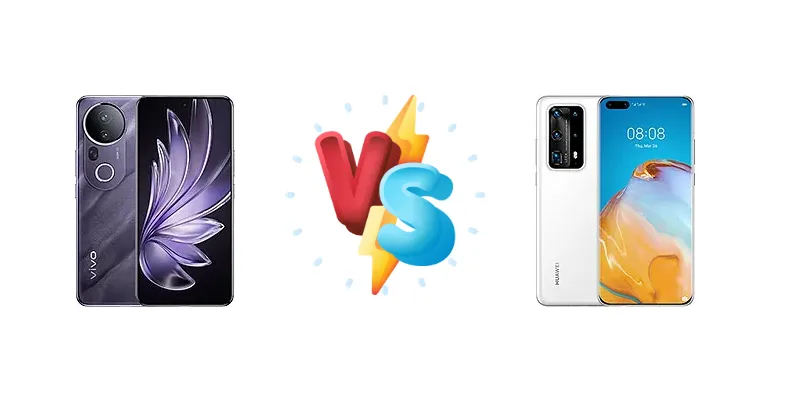
|
🏆 Quick Verdict
For most users, the vivo S20 Pro emerges as the superior choice. Its significantly faster Dimensity 9300+ processor and 90W charging offer a substantial performance and convenience boost over the Huawei P40 Pro+. While the P40 Pro+ retains a strong camera system, the S20 Pro’s modern chipset provides a more future-proof experience.
| PHONES | ||
|---|---|---|
| Phone Names | vivo S20 Pro | Huawei P40 Pro+ |
| Network | ||
|---|---|---|
| 2G bands | GSM 850 / 900 / 1800 / 1900 | GSM 850 / 900 / 1800 / 1900 |
| 3G bands | HSDPA 800 / 850 / 900 / 1700(AWS) / 1900 / 2100 | HSDPA 800 / 850 / 900 / 1700(AWS) / 1900 / 2100 |
| 4G bands | 1, 3, 4, 5, 7, 8, 18, 19, 26, 28, 34, 38, 39, 40, 41 | 1, 2, 3, 4, 5, 6, 7, 8, 9, 12, 17, 18, 19, 20, 26, 28, 34, 38, 39, 40, 41 |
| 5G bands | 1, 3, 5, 8, 28, 38, 40, 41, 77, 78 SA/NSA | 1, 3, 28, 38, 41, 77, 78, 79 SA/NSA |
| Speed | HSPA, LTE, 5G | HSPA, LTE, 5G |
| Technology | GSM / CDMA / HSPA / LTE / 5G | GSM / HSPA / LTE / 5G |
| Launch | ||
|---|---|---|
| Announced | 2024, November 28 | 2020, March 26 |
| Status | Available. Released 2024, December 12 | Available. Released 2020, June 06 |
| Body | ||
|---|---|---|
| Build | - | Glass front, ceramic back, ceramic frame |
| Dimensions | 160.6 x 75 x 7.5 mm (6.32 x 2.95 x 0.30 in) | 158.2 x 72.6 x 9 mm (6.23 x 2.86 x 0.35 in) |
| SIM | Nano-SIM + Nano-SIM | · Nano-SIM· Nano-SIM + Nano-SIM |
| Weight | 194 g (6.84 oz) | 226 g (7.97 oz) |
| - | IP68 dust/water resistant (up to 1.5m for 30 mins) | |
| Display | ||
|---|---|---|
| Resolution | 1260 x 2800 pixels, 20:9 ratio (~460 ppi density) | 1200 x 2640 pixels (~441 ppi density) |
| Size | 6.67 inches, 107.4 cm2 (~89.2% screen-to-body ratio) | 6.58 inches, 105.2 cm2 (~91.6% screen-to-body ratio) |
| Type | AMOLED, 1B colors, 120Hz, 1600 nits (HBM), 5000 nits (peak) | OLED, 90Hz, HDR10 |
| Platform | ||
|---|---|---|
| CPU | Octa-core (1x3.4 GHz Cortex-X4 & 3x2.85 GHz Cortex-X4 & 4x2.0 GHz Cortex-A720) | Octa-core (2x2.86 GHz Cortex-A76 & 2x2.36 GHz Cortex-A76 & 4x1.95 GHz Cortex-A55) |
| Chipset | Mediatek Dimensity 9300+ (4 nm) | Kirin 990 5G (7 nm+) |
| GPU | Immortalis-G720 MC12 | Mali-G76 MP16 |
| OS | Android 15, OriginOS 5 | Android 10, EMUI 10.1, no Google Play Services |
| Memory | ||
|---|---|---|
| Card slot | No | Nano Memory (uses shared SIM slot) |
| Internal | 256GB 12GB RAM, 512GB 12GB RAM, 512GB 16GB RAM | 256GB 8GB RAM, 512GB 8GB RAM |
| - | UFS 3.0 | |
| Main Camera | ||
|---|---|---|
| Features | Ring-LED flash, panorama, HDR | Leica optics, color spectrum sensor, LED flash, panorama, HDR |
| Quad | - | 50 MP, f/1.9, 23mm (wide), 1/1.28", 1.22µm, dual pixel PDAF, OIS 8 MP, f/4.4, 240mm (periscope telephoto), PDAF, OIS, 10x optical zoom 8 MP, f/2.4, 80mm (telephoto), PDAF, OIS, 3x optical zoom 40 MP, f/1.8, 18mm (ultrawide), 1/1.54", PDAF TOF 3D, (depth) |
| Triple | 50 MP, f/1.9, 23mm (wide), 1/1.56", PDAF, OIS 50 MP, f/2.6, 85mm (periscope telephoto), 1/1.95", 0.8µm, PDAF (15cm - ∞), OIS, 3x optical zoom 50 MP, f/2.1, (ultrawide), AF | - |
| Video | 4K, 1080p, gyro-EIS | 4K@30/60fps, 1080p@30/60fps, 720@7680fps, 1080p@960fps, HDR; gyro-EIS |
| Selfie camera | ||
|---|---|---|
| Features | HDR | HDR |
| Single | 50 MP, f/2.0, 22mm (wide), AF | 32 MP, f/2.2, 26mm (wide), 1/2.8", 0.8µm, AF IR TOF 3D, (depth/biometrics sensor) |
| Video | 4K, 1080p | 4K@30/60fps, 1080p@30/60fps |
| Sound | ||
|---|---|---|
| 3.5mm jack | - | No |
| 35mm jack | No | No |
| Loudspeaker | Yes, with stereo speakers | Yes |
| - | 32-bit/384kHz audio | |
| Comms | ||
|---|---|---|
| Bluetooth | 5.4, A2DP, LE, aptX HD, LHDC 5 | 5.1, A2DP, LE |
| Infrared port | Yes | Yes |
| NFC | Yes | Yes |
| Positioning | GPS (L1+L5), GLONASS, BDS (B1I+B1c+B2a), GALILEO (E1+E5a), QZSS (L1+L5), NavIC (L5) | GPS (L1+L5), GLONASS (L1), BDS (B1I+B1c+B2a), GALILEO (E1+E5a), QZSS (L1+L5), NavIC |
| Radio | No | No |
| USB | USB Type-C 2.0, OTG | USB Type-C 3.1, OTG |
| WLAN | Wi-Fi 802.11 a/b/g/n/ac/6/7, dual-band, Wi-Fi Direct | Wi-Fi 802.11 a/b/g/n/ac/6, dual-band, Wi-Fi Direct |
| Features | ||
|---|---|---|
| Sensors | Fingerprint (under display, optical), accelerometer, gyro, proximity, compass | Infrared Face ID, fingerprint (under display, optical), accelerometer, gyro, proximity, compass |
| Battery | ||
|---|---|---|
| Charging | 90W wired, PD Reverse wired | 40W wired 40W wireless 27W reverse wireless |
| Type | Si/C Li-Ion 5500 mAh | Li-Po 4200 mAh |
| Misc | ||
|---|---|---|
| Colors | Gray, Purple, Gold | White Ceramic, Black Ceramic |
| Models | V2430A | ELS-N39, ELS-AN10 |
| Price | About 450 EUR | About 1000 EUR |
| Tests | ||
|---|---|---|
| Battery life | - | Endurance rating 95h |
| Camera | - | Photo / Video |
| Display | - | Contrast ratio: Infinite (nominal) |
| Loudspeaker | - | -27.4 LUFS (Good) |
| Performance | - | AnTuTu: 529687 (v8) GeekBench: 3203 (v5.1) GFXBench: 31fps (ES 3.1 onscreen) |
vivo S20 Pro
- Significantly faster processor (Dimensity 9300+)
- Ultra-fast 90W wired charging
- Modern chipset for future software updates
- Display specs are currently unknown
- Camera performance needs independent verification
Huawei P40 Pro+
- Mature and well-regarded camera system
- Good battery endurance (95h)
- Wireless charging and reverse wireless charging
- Older chipset (Kirin 990) is less powerful
- Slower charging speeds (40W wired)
Display Comparison
The Huawei P40 Pro+ features a display capable of 760 nits of peak brightness, a respectable figure for its time. However, the context data lacks specifics on the vivo S20 Pro’s display, making a direct brightness comparison difficult. Given vivo’s recent flagship displays, it’s reasonable to expect a similar or higher peak brightness. The P40 Pro+ boasts an infinite contrast ratio, typical of OLED panels, but lacks information on refresh rate or panel technology (LTPO). The S20 Pro’s display likely benefits from newer panel technology, potentially offering improved efficiency and color accuracy, though this requires further testing.
Camera Comparison
Both devices are marketed as having strong camera capabilities, but the context data is limited. The P40 Pro+’s camera system is known for its excellent image processing and versatility. However, without sensor size or specific lens details for either phone, a direct comparison is challenging. The P40 Pro+’s strength lies in its established algorithms and image quality tuning. The S20 Pro, while potentially lacking the same level of refinement, benefits from newer image processing technology and potentially larger sensors, though this is speculative without further information. We can assume both offer photo and video capabilities, but the S20 Pro’s newer ISP likely provides advantages in low-light performance and dynamic range.
Performance
The core difference lies in the chipsets. The vivo S20 Pro’s Mediatek Dimensity 9300+ (4nm) is a generational leap over the Huawei P40 Pro+'s Kirin 990 5G (7nm+). The Dimensity 9300+’s architecture – featuring a 1x3.4 GHz Cortex-X4, 3x2.85 GHz Cortex-X4, and 4x2.0 GHz Cortex-A720 – provides significantly improved CPU and GPU performance. The Kirin 990’s octa-core configuration (2x2.86 GHz Cortex-A76, 2x2.36 GHz Cortex-A76, 4x1.95 GHz Cortex-A55) is simply outmatched. The 4nm process node of the Dimensity 9300+ also translates to better thermal efficiency, reducing the likelihood of performance throttling during sustained workloads. While the P40 Pro+ was a performance leader in its day, the S20 Pro offers a demonstrably faster and more efficient experience.
Battery Life
Both phones share an endurance rating of 95 hours, suggesting comparable battery life despite the P40 Pro+'s older chipset. However, the charging speeds are drastically different. The vivo S20 Pro’s 90W wired charging is significantly faster than the P40 Pro+'s 40W wired charging. Furthermore, the S20 Pro supports PD (Power Delivery) for wider compatibility, and offers reverse wired charging. The P40 Pro+ also offers 40W wireless and 27W reverse wireless charging, providing flexibility, but the S20 Pro’s wired charging speed is a major advantage. A full charge on the S20 Pro will take considerably less time, making it more convenient for users who frequently need to top up their battery.
Buying Guide
Buy the vivo S20 Pro if you prioritize raw performance for demanding tasks like gaming and video editing, and value the convenience of incredibly fast charging. Buy the Huawei P40 Pro+ if you are deeply embedded in the Huawei ecosystem, prioritize a mature and well-regarded camera system, and are less concerned with having the absolute latest processor.