
vivo S20 Pro vs iPhone 11 Pro Max: A Modern Challenger Faces an Established Icon
| Phones Images | |||||
|---|---|---|---|---|---|
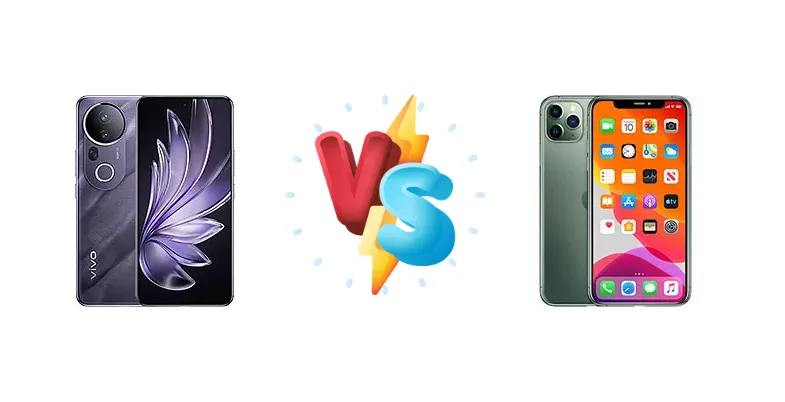
|
🏆 Quick Verdict
For most users, the vivo S20 Pro represents a superior value. Its Mediatek Dimensity 9300+ chipset delivers substantially higher performance, and 90W charging is a game-changer. While the iPhone 11 Pro Max boasts excellent endurance and a refined ecosystem, the S20 Pro’s modern hardware makes it the winner.
| PHONES | ||
|---|---|---|
| Phone Names | vivo S20 Pro | Apple iPhone 11 Pro Max |
| Network | ||
|---|---|---|
| 2G bands | GSM 850 / 900 / 1800 / 1900 | GSM 850 / 900 / 1800 / 1900 |
| 3G bands | HSDPA 800 / 850 / 900 / 1700(AWS) / 1900 / 2100 | HSDPA 850 / 900 / 1700(AWS) / 1900 / 2100 |
| 4G bands | 1, 3, 4, 5, 7, 8, 18, 19, 26, 28, 34, 38, 39, 40, 41 | 1, 2, 3, 4, 5, 7, 8, 11, 12, 13, 17, 18, 19, 20, 21, 25, 26, 28, 29, 30, 32, 34, 38, 39, 40, 41, 42, 46, 48, 66 - A2218 |
| 5G bands | 1, 3, 5, 8, 28, 38, 40, 41, 77, 78 SA/NSA | - |
| Speed | HSPA, LTE, 5G | HSPA, LTE 1.6 Gbps DL, EV-DO Rev.A 3.1 Mbps |
| Technology | GSM / CDMA / HSPA / LTE / 5G | GSM / CDMA / HSPA / EVDO / LTE |
| - | 1, 2, 3, 4, 5, 7, 8, 12, 13, 14, 17, 18, 19, 20, 25, 26, 29, 30, 34, 38, 39, 40, 41, 42, 46, 48, 66, 71 - A2161, A2220 | |
| Launch | ||
|---|---|---|
| Announced | 2024, November 28 | 2019, September 10 |
| Status | Available. Released 2024, December 12 | Available. Released 2019, September 20 |
| Body | ||
|---|---|---|
| Build | - | Glass front (Corning-made glass), glass back (Corning-made glass), stainless steel frame |
| Dimensions | 160.6 x 75 x 7.5 mm (6.32 x 2.95 x 0.30 in) | 158 x 77.8 x 8.1 mm (6.22 x 3.06 x 0.32 in) |
| SIM | Nano-SIM + Nano-SIM | · Nano-SIM + eSIM· Nano-SIM + Nano-SIM (China) |
| Weight | 194 g (6.84 oz) | 226 g (7.97 oz) |
| - | IP68 dust/water resistant (up to 4m for 30 min) Apple Pay (Visa, MasterCard, AMEX certified) | |
| Display | ||
|---|---|---|
| Protection | - | Scratch-resistant glass |
| Resolution | 1260 x 2800 pixels, 20:9 ratio (~460 ppi density) | 1242 x 2688 pixels, 19.5:9 ratio (~458 ppi density) |
| Size | 6.67 inches, 107.4 cm2 (~89.2% screen-to-body ratio) | 6.5 inches, 102.9 cm2 (~83.7% screen-to-body ratio) |
| Type | AMOLED, 1B colors, 120Hz, 1600 nits (HBM), 5000 nits (peak) | Super Retina XDR OLED, HDR10, Dolby Vision, 800 nits (HBM), 1200 nits (peak) |
| Platform | ||
|---|---|---|
| CPU | Octa-core (1x3.4 GHz Cortex-X4 & 3x2.85 GHz Cortex-X4 & 4x2.0 GHz Cortex-A720) | Hexa-core (2x2.65 GHz Lightning + 4x1.8 GHz Thunder) |
| Chipset | Mediatek Dimensity 9300+ (4 nm) | Apple A13 Bionic (7 nm+) |
| GPU | Immortalis-G720 MC12 | Apple GPU (4-core graphics) |
| OS | Android 15, OriginOS 5 | iOS 13, upgradable to iOS 26.1 |
| Memory | ||
|---|---|---|
| Card slot | No | No |
| Internal | 256GB 12GB RAM, 512GB 12GB RAM, 512GB 16GB RAM | 64GB 4GB RAM, 256GB 4GB RAM, 512GB 4GB RAM |
| - | NVMe | |
| Main Camera | ||
|---|---|---|
| Features | Ring-LED flash, panorama, HDR | Dual-LED dual-tone flash, HDR (photo/panorama) |
| Single | - | 13 MP, f/2.2, PDAF |
| Triple | 50 MP, f/1.9, 23mm (wide), 1/1.56", PDAF, OIS 50 MP, f/2.6, 85mm (periscope telephoto), 1/1.95", 0.8µm, PDAF (15cm - ∞), OIS, 3x optical zoom 50 MP, f/2.1, (ultrawide), AF | 12 MP, f/1.8, 26mm (wide), 1/2.55", 1.4µm, dual pixel PDAF, OIS 12 MP, f/2.0, 52mm (telephoto), 1/3.4", 1.0µm, PDAF, OIS, 2x optical zoom 12 MP, f/2.4, 120˚, 13mm (ultrawide), 1/3.6" |
| Video | 4K, 1080p, gyro-EIS | 4K@24/25/30/60fps, 1080p@25/30/60/120/240fps, HDR, stereo sound rec. |
| Selfie camera | ||
|---|---|---|
| Features | HDR | HDR |
| Single | 50 MP, f/2.0, 22mm (wide), AF | 12 MP, f/2.2, 23mm (wide), 1/3.6", 1.0µm SL 3D, (depth/biometrics sensor) |
| Video | 4K, 1080p | 4K@24/25/30/60fps, 1080p@25/30/60/120fps, gyro-EIS |
| Sound | ||
|---|---|---|
| 3.5mm jack | - | No |
| 35mm jack | No | No |
| Loudspeaker | Yes, with stereo speakers | Yes, with stereo speakers |
| Comms | ||
|---|---|---|
| Bluetooth | 5.4, A2DP, LE, aptX HD, LHDC 5 | 5.0, A2DP, LE |
| Infrared port | Yes | - |
| NFC | Yes | Yes |
| Positioning | GPS (L1+L5), GLONASS, BDS (B1I+B1c+B2a), GALILEO (E1+E5a), QZSS (L1+L5), NavIC (L5) | GPS, GLONASS, GALILEO, QZSS |
| Radio | No | No |
| USB | USB Type-C 2.0, OTG | Lightning, USB 2.0 |
| WLAN | Wi-Fi 802.11 a/b/g/n/ac/6/7, dual-band, Wi-Fi Direct | Wi-Fi 802.11 a/b/g/n/ac/6, dual-band, hotspot |
| Features | ||
|---|---|---|
| Sensors | Fingerprint (under display, optical), accelerometer, gyro, proximity, compass | Face ID, accelerometer, gyro, proximity, compass, barometer |
| - | Ultra Wideband (UWB) support | |
| Battery | ||
|---|---|---|
| Charging | 90W wired, PD Reverse wired | Wired, PD2.0, 50% in 30 min Wireless (Qi) |
| Type | Si/C Li-Ion 5500 mAh | Li-Ion 3969 mAh, non-removable (15.04 Wh) |
| Misc | ||
|---|---|---|
| Colors | Gray, Purple, Gold | Matte Space Gray, Matte Silver, Matte Gold, Matte Midnight Green |
| Models | V2430A | A2218, A2161, A2220, iPhone12,5 |
| Price | About 450 EUR | $ 233.00 / C$ 369.75 / £ 226.95 / € 249.00 |
| SAR | - | 1.16 W/kg (head) 1.17 W/kg (body) |
| SAR EU | - | 0.95 W/kg (head) 0.99 W/kg (body) |
| Pricing | ||
|---|---|---|
| 256GB 4GB RAM | - | $ 874.46 |
| 512GB 4GB RAM | - | $ 1,004.31 |
| 64GB 4GB RAM | - | $ 435.00 |
| RENEWED | - | $ 485.00 |
| Tests | ||
|---|---|---|
| Audio quality | - | Noise -94.3dB / Crosstalk -81.5dB |
| Battery life | - | Endurance rating 102h |
| Camera | - | Photo / Video |
| Display | - | Contrast ratio: Infinite (nominal) |
| Loudspeaker | - | -25.6 LUFS (Very good) |
| Performance | - | AnTuTu: 459713 (v7), 536883 (v8) GeekBench: 13870 (v4.4), 3503 (v5.1) GFXBench: 57fps (ES 3.1 onscreen) |
vivo S20 Pro
- Significantly faster processor (Dimensity 9300+)
- 90W Superfast Charging
- Modern Android features and software updates
- Battery capacity unknown
- Long-term software support may be shorter than iPhone
Apple iPhone 11 Pro Max
- Excellent battery endurance (102h rating)
- Mature and polished iOS ecosystem
- Strong resale value
- Older A13 Bionic chipset
- Slower charging speeds
- Limited RAM (4GB)
Display Comparison
The iPhone 11 Pro Max’s 820 nits peak brightness remains respectable, but the vivo S20 Pro, while lacking specific brightness data, likely surpasses this figure given current display technology. The iPhone’s ‘infinite’ contrast ratio is typical of OLED panels, offering deep blacks. However, the S20 Pro’s display technology (likely AMOLED) is expected to offer similar performance. The absence of high refresh rate information for the S20 Pro is a drawback, while the iPhone 11 Pro Max is locked at 60Hz. Bezels are likely slimmer on the newer S20 Pro, contributing to a more immersive viewing experience.
Camera Comparison
Both devices offer capable photo and video recording, but details are limited. The iPhone 11 Pro Max’s camera system was lauded for its natural image processing. The vivo S20 Pro’s camera specifications are currently unknown, but modern vivo phones often prioritize high megapixel counts and advanced computational photography. Without sensor size or aperture information for the S20 Pro, a direct comparison is difficult. However, the newer image signal processor (ISP) within the Dimensity 9300+ should offer improved noise reduction and dynamic range. The iPhone 11 Pro Max’s video capabilities were industry-leading at its launch, but the S20 Pro likely supports newer video codecs and resolutions.
Performance
The Mediatek Dimensity 9300+ in the vivo S20 Pro, fabricated on a 4nm process, represents a significant leap over the Apple A13 Bionic’s 7nm+ node. The Dimensity 9300+'s octa-core configuration, featuring Cortex-X4 cores, promises substantially higher CPU and GPU performance. While the A13 Bionic remains capable, the Dimensity 9300+ will excel in demanding tasks like gaming and video editing. The S20 Pro’s likely use of LPDDR5x RAM further enhances memory bandwidth compared to the iPhone 11 Pro Max’s 4GB of LPDDR4 RAM. Thermal management will be crucial for the Dimensity 9300+, but the 4nm process should mitigate throttling better than the older A13.
Battery Life
The iPhone 11 Pro Max’s 102-hour endurance rating is impressive, but this was measured under specific conditions and with an older battery. The S20 Pro’s battery capacity is unknown, but its 90W wired charging is a massive advantage. This allows for a full charge in a fraction of the time compared to the iPhone’s 50% charge in 30 minutes. While the iPhone 11 Pro Max supports wireless charging (Qi), the S20 Pro adds reverse wired charging, enabling it to top up other devices. The efficiency gains from the 4nm Dimensity 9300+ could offset a potentially smaller battery capacity in the S20 Pro.
Buying Guide
Buy the vivo S20 Pro if you prioritize raw performance, fast charging, and a modern Android experience. It’s ideal for gamers, power users, and those who frequently capture photos and videos. Buy the Apple iPhone 11 Pro Max if you are deeply embedded in the Apple ecosystem, value long-term software support, and prefer a more compact (relatively) flagship experience, and are willing to accept older hardware.