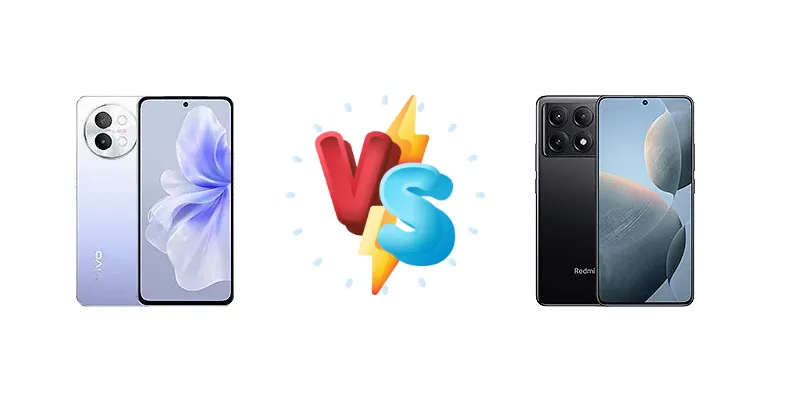
The Xiaomi Redmi K70E and vivo S18e represent compelling options in the increasingly competitive mid-range smartphone market. Both leverage MediaTek's Dimensity series, but with a significant performance gap. The K70E, with its Dimensity 8300 Ultra, aims for near-flagship performance, while the S18e focuses on a balance of features and efficiency with the Dimensity 7200. This comparison will dissect their key differences to help you determine which device best suits your needs.
🏆 Quick Verdict
For most users, the Xiaomi Redmi K70E emerges as the stronger choice. Its Dimensity 8300 Ultra delivers substantially better CPU and GPU performance, making it ideal for demanding tasks and gaming. While the vivo S18e offers a respectable experience, the K70E’s performance advantage justifies the potential price difference.
| Network |
|---|
| 2G bands | GSM 850 / 900 / 1800 / 1900 | GSM 850 / 900 / 1800 / 1900 |
| 3G bands | HSDPA 850 / 900 / 1700(AWS) / 1900 / 2100 | HSDPA 800 / 850 / 900 / 1700(AWS) / 2100 |
| 4G bands | 1, 3, 5, 8, 28, 34, 38, 39, 40, 41 | 1, 3, 4, 5, 8, 18, 19, 26, 28, 34, 38, 39, 40, 41, 42, 48, 66 |
| 5G bands | 1, 3, 5, 8, 28, 38, 40, 41, 77, 78 SA/NSA | 1, 3, 5, 8, 28, 38, 41, 48, 66, 77, 78 SA/NSA |
| Speed | HSPA, LTE, 5G | HSPA, LTE, 5G |
| Technology | GSM / CDMA / HSPA / CDMA2000 / LTE / 5G | GSM / CDMA / HSPA / CDMA2000 / LTE / 5G |
| Launch |
|---|
| Announced | 2023, December 14 | 2023, November 29 |
| Status | Available. Released 2023, January 13 | Available. Released 2023, November 29 |
| Body |
|---|
| Build | Glass front, plastic frame | - |
| Dimensions | 162.4 x 74.9 x 7.7 mm (6.39 x 2.95 x 0.30 in) | 160.5 x 74.3 x 8.1 mm (6.32 x 2.93 x 0.32 in) |
| SIM | Nano-SIM + Nano-SIM | Nano-SIM + Nano-SIM |
| Weight | 193 g (6.81 oz) | 198 g (6.98 oz) |
| Display |
|---|
| Resolution | 1080 x 2400 pixels, 20:9 ratio (~395 ppi density) | 1220 x 2712 pixels, 20:9 ratio (~446 ppi density) |
| Size | 6.67 inches, 107.4 cm2 (~88.3% screen-to-body ratio) | 6.67 inches, 107.4 cm2 (~90.1% screen-to-body ratio) |
| Type | AMOLED, 120Hz, 1800 nits (peak) | OLED, 68B colors, 120Hz, Dolby Vision, HDR10+, 1800 nits (peak) |
| Platform |
|---|
| CPU | Octa-core (2x2.8 GHz Cortex-A715 & 6x Cortex-A510) | Octa-core (1x3.35 GHz Cortex-A715 & 3x3.20 GHz Cortex-A715 & 4x2.20 GHz Cortex-A510) |
| Chipset | Mediatek Dimensity 7200 (4 nm) | Mediatek Dimensity 8300 Ultra (4 nm) |
| GPU | Mali-G610 MC4 | Mali G615-MC6 |
| OS | Android 14, OriginOS 4 | Android 14, HyperOS |
| Memory |
|---|
| Card slot | No | No |
| Internal | 256GB 8GB RAM, 256GB 12GB RAM, 512GB 12GB RAM | 256GB 8GB RAM, 256GB 12GB RAM, 512GB 12GB RAM, 1TB 16GB RAM |
| Main Camera |
|---|
| Dual | 50 MP, f/1.8, (wide), 1/1.95", 0.65µm, PDAF, OIS
Auxiliary lens | - |
| Features | Ring-LED flash, panorama, HDR | LED flash, HDR, panorama |
| Triple | - | 64 MP, (wide), 1/2.0", PDAF, OIS
8 MP, 120˚, (ultrawide)
2 MP (macro) |
| Video | 4K@30fps, 1080p@30fps | 4K@24/30fps, 1080p@30/60/120/240/960fps, 720p@1920fps, gyro-EIS |
| Selfie camera |
|---|
| Features | - | HDR, panorama |
| Single | 16 MP, f/2.0, (wide) | 16 MP, (wide) |
| Video | 1080p@30fps | 1080p@30/60fps, gyro-EIS |
| Sound |
|---|
| 35mm jack | No | No |
| Loudspeaker | Yes | Yes, with stereo speakers |
| Comms |
|---|
| Bluetooth | 5.3, A2DP, LE, aptX HD | 5.4, A2DP, LE |
| Infrared port | - | Yes |
| NFC | Yes | Yes |
| Positioning | GPS, GALILEO, GLONASS, QZSS, BDS | GPS, GALILEO, GLONASS, QZSS, BDS (B1I+B1c) |
| Radio | No | No |
| USB | USB Type-C 2.0, OTG | USB Type-C, OTG |
| WLAN | Wi-Fi 802.11 a/b/g/n/ac/6, dual-band, Wi-Fi Direct | Wi-Fi 802.11 a/b/g/n/ac/6, dual-band, Wi-Fi Direct |
| Features |
|---|
| Sensors | Fingerprint (under display, optical), accelerometer, gyro, proximity, compass | Fingerprint (under display, optical), accelerometer, proximity, gyro, compass |
| Battery |
|---|
| Charging | 80W wired, PD
Reverse wired | 90W wired, PD3.0, QC2, 100% in 34 min |
| Type | 4800 mAh | Li-Po 5500 mAh |
| Misc |
|---|
| Colors | Black, Purple, Silver | Black, White, Mint |
| Models | V2334A | 2311DRK48C |
| Price | About 270 EUR | About 260 EUR |
vivo S18e
- Faster 80W wired charging with PD and reverse wired charging.
- Potentially more efficient Dimensity 7200 chipset for longer battery life during light use.
- Sleek and stylish design typical of vivo’s S series.
- Significantly less powerful Dimensity 7200 chipset compared to the K70E.
- Likely lower gaming performance.
- Charging speed is slower than the K70E.
Xiaomi Redmi K70E
- Much more powerful Dimensity 8300 Ultra chipset for superior performance.
- Faster 90W wired charging with PD3.0 and QC2.
- Excellent gaming capabilities due to the powerful GPU.
- Potentially less battery life during heavy use due to the more powerful chipset.
- May run slightly warmer under sustained load.
- Design may be less focused on aesthetics compared to the S18e.
Display Comparison
Both phones utilize 4nm chipsets, suggesting a focus on efficiency, but neither specification details screen technology. Assuming typical market positioning, the S18e likely employs an AMOLED panel, while the K70E may also feature AMOLED. The absence of refresh rate or resolution data makes a direct comparison difficult. However, the K70E’s target audience suggests a higher likelihood of a 120Hz refresh rate for smoother scrolling and gaming. Bezels are likely comparable, given the similar overall design philosophies of both brands.
Camera Comparison
Without detailed camera specifications, a direct comparison is limited. However, both brands typically prioritize camera performance in their mid-range offerings. The K70E, positioned as a performance-focused device, may feature a larger main sensor and more advanced image processing algorithms. The S18e, while capable, likely focuses on a more balanced camera system. The absence of information regarding OIS (Optical Image Stabilization) is a key omission; its presence on either device would be a significant advantage for low-light photography and video recording. We can assume both will have a standard array of lenses, but sensor size and aperture will be the deciding factors.
Performance
The core difference lies in the chipsets. The Redmi K70E’s Dimensity 8300 Ultra boasts a 1x3.35 GHz Cortex-A715 core alongside 3x3.20 GHz Cortex-A715 cores and 4x2.20 GHz Cortex-A510 cores. This configuration significantly outperforms the vivo S18e’s Dimensity 7200, which features 2x2.8 GHz Cortex-A715 cores and 6x Cortex-A510 cores. The K70E’s higher clock speeds and additional high-performance cores translate to a noticeable advantage in CPU-intensive tasks and gaming. The K70E’s GPU will also be substantially more powerful, offering a smoother experience in graphically demanding games. Both likely utilize LPDDR5x RAM, but the K70E’s superior chipset will be able to leverage it more effectively.
Battery Life
The Redmi K70E’s 90W wired charging is a clear advantage over the vivo S18e’s 80W charging. The K70E is advertised to reach 100% charge in 34 minutes, while the S18e’s charging time is unspecified but will likely be longer. While battery capacity isn’t specified for either device, the K70E’s faster charging mitigates the impact of a potentially smaller battery. Both support PD (Power Delivery), offering compatibility with a wider range of chargers. The K70E’s inclusion of QC2 (Quick Charge 2.0) adds further charging versatility.
Buying Guide
Buy the vivo S18e if you prioritize a sleek design and efficient power consumption for everyday tasks like social media, browsing, and light photography. Buy the Xiaomi Redmi K70E if you’re a gamer, a power user who frequently multitasks, or simply want the fastest possible performance in this price bracket. The K70E is the clear winner for those who demand more from their smartphone.
Frequently Asked Questions
❓ Will the Redmi K70E’s Dimensity 8300 Ultra get noticeably hot during extended gaming sessions?
While the Dimensity 8300 Ultra is a powerful chip, it's built on a 4nm process, which aids in thermal efficiency. However, sustained gaming will inevitably generate heat. Xiaomi typically employs effective cooling solutions in the K series, but prolonged, high-intensity gaming may still result in some throttling to maintain stable performance. Expect warm, but not uncomfortably hot, temperatures.
❓ Does the vivo S18e support high refresh rate gaming, even with the Dimensity 7200?
The Dimensity 7200 is capable of supporting high refresh rate gaming, but the experience will be limited compared to the K70E. While it can likely handle many popular titles at 60Hz, demanding games may require reduced graphics settings to maintain a smooth frame rate. The S18e’s gaming performance is best suited for casual gamers or those who prioritize battery life over maximum graphical fidelity.
❓ Is the 90W charging on the Redmi K70E safe for long-term battery health?
Modern smartphones employ sophisticated charging management systems to protect battery health even with fast charging technologies like 90W. While faster charging *can* contribute to slightly increased battery degradation over time, the difference is often negligible for typical usage patterns. Xiaomi’s charging algorithms are designed to minimize this effect, and the convenience of rapid charging generally outweighs the minor potential impact on long-term battery health.