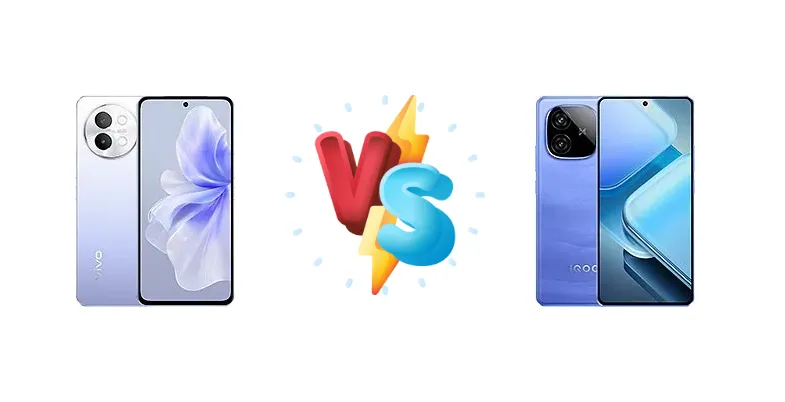
vivo offers a compelling duo in the mid-range segment with the S18e and iQOO Z9 Turbo Endurance. While both boast 80W charging and similar aesthetics, they diverge significantly under the hood. The S18e prioritizes a sleek design and balanced performance with the Dimensity 7200, while the iQOO Z9 Turbo Endurance aims for raw power and extended battery life with the Snapdragon 8s Gen 3. This comparison dissects these differences to determine which phone best suits your needs.
🏆 Quick Verdict
For the average user prioritizing sustained gaming and future-proofing, the vivo iQOO Z9 Turbo Endurance is the clear winner. The Snapdragon 8s Gen 3 offers a substantial performance uplift over the Dimensity 7200, and its optimized power efficiency translates to longer gaming sessions. However, the S18e remains a strong contender for those seeking a more refined, everyday experience.
| Network |
|---|
| 2G bands | GSM 850 / 900 / 1800 / 1900 | GSM 850 / 900 / 1800 / 1900 |
| 3G bands | HSDPA 850 / 900 / 1700(AWS) / 1900 / 2100 | HSDPA 850 / 900 / 2100 |
| 4G bands | 1, 3, 5, 8, 28, 34, 38, 39, 40, 41 | 1, 3, 5, 8, 28, 34, 38, 39, 40, 41 |
| 5G bands | 1, 3, 5, 8, 28, 38, 40, 41, 77, 78 SA/NSA | 1, 5, 8, 28, 41, 77, 78 SA/NSA |
| Speed | HSPA, LTE, 5G | HSPA, LTE, 5G |
| Technology | GSM / CDMA / HSPA / CDMA2000 / LTE / 5G | GSM / CDMA / HSPA / LTE / 5G |
| Launch |
|---|
| Announced | 2023, December 14 | 2025, January 03 |
| Status | Available. Released 2023, January 13 | Available. Released 2025, January 03 |
| Body |
|---|
| Build | Glass front, plastic frame | Glass front, plastic back, plastic frame |
| Dimensions | 162.4 x 74.9 x 7.7 mm (6.39 x 2.95 x 0.30 in) | 163.7 x 75.9 x 8 mm (6.44 x 2.99 x 0.31 in) |
| SIM | Nano-SIM + Nano-SIM | Nano-SIM + Nano-SIM |
| Weight | 193 g (6.81 oz) | 196 g (6.91 oz) |
| Display |
|---|
| Resolution | 1080 x 2400 pixels, 20:9 ratio (~395 ppi density) | 1260 x 2800 pixels, 20:9 ratio (~453 ppi density) |
| Size | 6.67 inches, 107.4 cm2 (~88.3% screen-to-body ratio) | 6.78 inches, 111.0 cm2 (~89.3% screen-to-body ratio) |
| Type | AMOLED, 120Hz, 1800 nits (peak) | AMOLED, 1B colors, 144Hz, HDR |
| Platform |
|---|
| CPU | Octa-core (2x2.8 GHz Cortex-A715 & 6x Cortex-A510) | Octa-core (1x3.0 GHz Cortex-X4 & 4x2.8 GHz Cortex-A720 & 3x2.0 GHz Cortex-A520) |
| Chipset | Mediatek Dimensity 7200 (4 nm) | Qualcomm SM8635 Snapdragon 8s Gen 3 (4 nm) |
| GPU | Mali-G610 MC4 | Adreno 735 |
| OS | Android 14, OriginOS 4 | Android 14, OriginOS 4 |
| Memory |
|---|
| Card slot | No | No |
| Internal | 256GB 8GB RAM, 256GB 12GB RAM, 512GB 12GB RAM | 256GB 12GB RAM, 256GB 16GB RAM, 512GB 12GB RAM, 512GB 16GB RAM |
| Main Camera |
|---|
| Dual | 50 MP, f/1.8, (wide), 1/1.95", 0.65µm, PDAF, OIS
Auxiliary lens | 50 MP, f/1.8, (wide), 1/1.95", 0.8µm, PDAF, OIS
8 MP, f/2.2, (ultrawide) |
| Features | Ring-LED flash, panorama, HDR | LED flash, panorama, HDR |
| Video | 4K@30fps, 1080p@30fps | 4K@30/60fps, 1080p, gyro-EIS, OIS |
| Selfie camera |
|---|
| Single | 16 MP, f/2.0, (wide) | 16 MP, f/2.5, (wide), 1/3.0", 1.0µm |
| Video | 1080p@30fps | 1080p@30fps |
| Sound |
|---|
| 35mm jack | No | No |
| Loudspeaker | Yes | Yes, with stereo speakers |
| Comms |
|---|
| Bluetooth | 5.3, A2DP, LE, aptX HD | 5.4, A2DP, LE, aptX HD, aptX Adaptive, aptX Lossless |
| Infrared port | - | Yes |
| NFC | Yes | Yes |
| Positioning | GPS, GALILEO, GLONASS, QZSS, BDS | GPS (L1+L5), GLONASS (G1), BDS (B1I+B1c+B2a), GALILEO (E1+E5a), QZSS (L1+L5) |
| Radio | No | No |
| USB | USB Type-C 2.0, OTG | USB Type-C 2.0, OTG |
| WLAN | Wi-Fi 802.11 a/b/g/n/ac/6, dual-band, Wi-Fi Direct | Wi-Fi 802.11 a/b/g/n/ac/6, dual-band |
| Features |
|---|
| Sensors | Fingerprint (under display, optical), accelerometer, gyro, proximity, compass | Fingerprint (under display, optical), accelerometer, gyro, proximity, compass |
| Battery |
|---|
| Charging | 80W wired, PD
Reverse wired | 80W wired
7.5W reverse wired |
| Type | 4800 mAh | Si/C Li-Ion 6400 mAh |
| Misc |
|---|
| Colors | Black, Purple, Silver | Black, White, Blue |
| Models | V2334A | V2352GA |
| Price | About 270 EUR | About 250 EUR |
vivo S18e
- Sleek and stylish design
- Balanced performance for everyday tasks
- Fast 80W wired charging
- Dimensity 7200 chipset is outperformed by Snapdragon 8s Gen 3
- May exhibit more throttling during prolonged gaming
vivo iQOO Z9 Turbo Endurance
- Superior gaming performance with Snapdragon 8s Gen 3
- Improved power efficiency for longer battery life
- Fast 80W wired charging
- Design may be less refined than the S18e
- Potentially higher price point
Display Comparison
Both devices lack detailed display specifications in the provided data, but given their market positioning, we can infer similarities. Expect both to feature AMOLED panels, likely with FHD+ resolution. The iQOO series historically prioritizes higher refresh rates for gaming, suggesting a potential advantage in smoothness. The S18e, focusing on aesthetics, might prioritize color accuracy and viewing angles. Without specific nit brightness or PWM dimming rate data, a direct comparison is difficult, but the iQOO's gaming focus hints at a potentially brighter panel.
Camera Comparison
The provided data lacks camera specifications. However, based on vivo’s typical strategy, the S18e likely emphasizes selfie camera quality and portrait modes, aligning with its lifestyle-focused branding. The iQOO Z9 Turbo Endurance, geared towards gamers, might prioritize overall image quality and low-light performance. Without sensor size, aperture, or OIS details, it’s difficult to make a definitive judgment. We can assume both will feature multi-camera setups, but the iQOO is more likely to have a larger main sensor for improved dynamic range and detail.
Performance
The core difference lies in the chipsets. The iQOO Z9 Turbo Endurance’s Snapdragon 8s Gen 3 (4nm) is a significant step up from the S18e’s Dimensity 7200 (4nm). The Snapdragon 8s Gen 3 features a 1x Cortex-X4 prime core clocked at 3.0 GHz, alongside 4x Cortex-A720 performance cores at 2.8 GHz, and 3x Cortex-A520 efficiency cores at 2.0 GHz. This contrasts with the S18e’s 2x Cortex-A715 performance cores at 2.8 GHz and 6x Cortex-A510 efficiency cores. The X4 core in the Snapdragon provides a substantial single-core performance advantage, crucial for responsiveness and demanding applications. While both are 4nm chips, Qualcomm’s architecture generally offers better sustained performance and thermal management, meaning less throttling during extended gaming sessions. The iQOO also benefits from potentially faster LPDDR5x RAM, further enhancing performance.
Battery Life
Both phones feature 80W wired charging, promising rapid replenishment. However, the Snapdragon 8s Gen 3 in the iQOO Z9 Turbo Endurance is more power-efficient than the Dimensity 7200. This translates to longer battery life despite potentially similar battery capacities (which are not specified). While both offer 80W charging, the iQOO’s more efficient chipset means it can spend more time *using* the battery, rather than recharging it. The 7.5W reverse wired charging on both is a convenient, but relatively slow, feature for topping up accessories.
Buying Guide
Buy the vivo S18e if you need a stylish, well-rounded smartphone for everyday tasks, social media, and casual gaming. Its Dimensity 7200 chipset provides ample power for most users, and its design is geared towards aesthetics. Buy the vivo iQOO Z9 Turbo Endurance if you prioritize gaming performance, demanding multitasking, and extended battery life. The Snapdragon 8s Gen 3 delivers a significant performance boost, making it ideal for mobile gamers and power users.
Frequently Asked Questions
❓ Will the Snapdragon 8s Gen 3 in the iQOO Z9 Turbo Endurance handle demanding games like Genshin Impact at max settings?
Yes, the Snapdragon 8s Gen 3 is specifically designed for demanding games. It should comfortably run Genshin Impact at maximum settings with high frame rates, offering a smooth and immersive gaming experience. The improved thermal management will also help maintain consistent performance during extended play sessions.
❓ Does the Dimensity 7200 in the vivo S18e struggle with multitasking or heavy app usage?
The Dimensity 7200 is a capable chipset, but it will show its limitations when faced with extremely heavy multitasking or running multiple resource-intensive apps simultaneously. While it handles everyday tasks and moderate gaming well, the Snapdragon 8s Gen 3 offers a more fluid experience under heavy load.
❓ How long does it realistically take to charge both phones from 0% to 100% with the 80W charger?
Both phones should charge from 0% to 100% in approximately 35-45 minutes with the included 80W charger. However, the iQOO Z9 Turbo Endurance might reach 100% slightly faster due to its more efficient power management.
❓ Is the reverse wired charging feature useful for charging accessories like earbuds or smartwatches?
The 7.5W reverse wired charging is a convenient feature for emergencies, but it's relatively slow. It's suitable for topping up small accessories like earbuds or smartwatches, but don't expect to fully charge a larger device quickly.