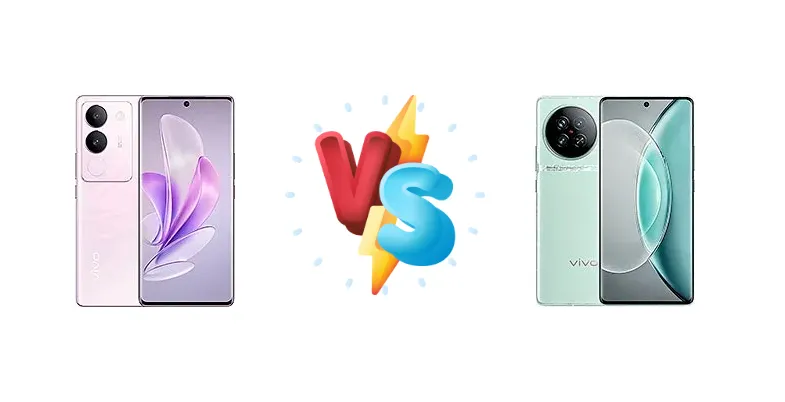
The vivo S17 and X90s represent distinct approaches within vivo’s smartphone lineup. The S17 aims for a balance of style and efficiency, leveraging the Snapdragon 778G+ platform. Conversely, the X90s is positioned as a more premium offering, equipped with the powerful Mediatek Dimensity 9200+ chipset and faster charging capabilities. This comparison dissects the key differences to help you determine which device best suits your needs.
🏆 Quick Verdict
For the average user prioritizing raw performance and rapid charging, the vivo X90s is the clear winner. Its Dimensity 9200+ chipset offers a substantial leap in processing power, and the 120W charging significantly reduces downtime. However, the vivo S17 remains a compelling option for those seeking a more efficient and affordable device.
| Network |
|---|
| 2G bands | GSM 850 / 900 / 1800 / 1900 | GSM 850 / 900 / 1800 / 1900 |
| 3G bands | HSDPA 800 / 850 / 900 / 1700(AWS) / 1900 / 2100 | HSDPA 800 / 850 / 900 / 1700(AWS) / 1900 / 2100 |
| 4G bands | 1, 3, 4, 5, 8, 19, 28, 34, 38, 39, 40, 41 | 1, 2, 3, 4, 5, 7, 8, 18, 19, 26, 28, 34, 38, 39, 40, 41 |
| 5G bands | 1, 3, 5, 8, 28, 38, 40, 41, 77, 78 SA/NSA | 1, 3, 5, 8, 28, 41, 77, 88 SA/NSA |
| Speed | HSPA, LTE, 5G | HSPA, LTE, 5G |
| Technology | GSM / CDMA / HSPA / CDMA2000 / LTE / 5G | GSM / CDMA / HSPA / CDMA2000 / LTE / 5G |
| Launch |
|---|
| Announced | 2023, May 31 | 2023, June 26 |
| Status | Available. Released 2023, June 08 | Available. Released 2023, June 30 |
| Body |
|---|
| Build | - | Glass front, glass back or eco leather back |
| Dimensions | 164.2 x 74.4 x 7.5 mm (6.46 x 2.93 x 0.30 in) | 164.1 x 74.4 x 8.5 mm or 8.9 mm |
| SIM | Nano-SIM + Nano-SIM | Nano-SIM + Nano-SIM |
| Weight | 186 g (6.56 oz) | 197.5 / 201.5 / 202.2 / 203.5 g (6.98 oz) |
| Display |
|---|
| Resolution | 1260 x 2800 pixels, 20:9 ratio (~453 ppi density) | 1260 x 2800 pixels, 20:9 ratio (~453 ppi density) |
| Size | 6.78 inches, 111.0 cm2 (~90.8% screen-to-body ratio) | 6.78 inches, 111.0 cm2 (~90.9% screen-to-body ratio) |
| Type | AMOLED, 1B colors, 120Hz, HDR10+, 1300 nits (peak) | AMOLED, 1B colors, 120Hz, HDR10+, 1300 nits (peak) |
| Platform |
|---|
| CPU | Octa-core (1x2.5 GHz Cortex-A78 & 3x2.4 GHz Cortex-A78 & 4x1.9 GHz Cortex-A55) | Octa-core (1x3.35 GHz Cortex-X3 & 3x3.0 GHz Cortex-A715 & 4x2.0 GHz Cortex-A510) |
| Chipset | Qualcomm SM7325-AE Snapdragon 778G+ 5G (6 nm) | Mediatek Dimensity 9200+ (4 nm) |
| GPU | Adreno 642L | Immortalis-G715 MC11 |
| OS | Android 13, OriginOS 3 | Android 13, OriginOS 3 |
| Memory |
|---|
| Card slot | No | No |
| Internal | 256GB 8GB RAM, 256GB 12GB RAM, 512GB 12GB RAM | 256GB 8GB RAM, 256GB 12GB RAM, 512GB 12GB RAM |
| Main Camera |
|---|
| Dual | 50 MP, f/1.9, (wide), 1/1.56", 1.0µm, PDAF, OIS
8 MP, f/2.2, (ultrawide) | - |
| Features | Color spectrum sensor, Ring-LED flash, panorama, HDR | Laser AF, color spectrum sensor, Zeiss optics, Zeiss T* lens coating, Pixel Shift, dual-LED dual-tone flash, HDR, panorama |
| Triple | - | 50 MP, f/1.8, (wide), 1/1.49", 1.0µm, PDAF, OIS
12 MP, f/2.0, 50mm (telephoto), 1/2.93", 1.22µm, AF, 2x optical zoom
12 MP, f/2.0, 16mm (ultrawide), 1/2.93", 1.22µm, AF |
| Video | 4K@30fps, 1080p@30fps | 4K@30/60fps, 1080p@30/60fps, gyro-EIS |
| Selfie camera |
|---|
| Features | Dual-LED flash, HDR | HDR |
| Single | 50 MP, f/2.0, 22mm (wide), AF | 32 MP, f/2.5, 24mm (wide), 1/2.8", 0.8µm |
| Video | 1080p@30fps | 1080p@30/60fps |
| Sound |
|---|
| 35mm jack | No | No |
| Loudspeaker | Yes | Yes, with stereo speakers |
| Comms |
|---|
| Bluetooth | 5.2, A2DP, LE, aptX HD, aptX Adaptive | 5.3, A2DP, LE, aptX HD |
| Infrared port | - | Yes |
| NFC | Yes | Yes |
| Positioning | GPS (L1), GLONASS (G1), BDS (B1I), GALILEO (E1), QZSS (L1) | GPS (L1+L5), GLONASS (G1), BDS (B1I+B2a+B2c), GALILEO (E1+E5a), QZSS (L1+L5), NavIC (L5) |
| Radio | No | No |
| USB | USB Type-C 2.0, OTG | USB Type-C 2.0, OTG |
| WLAN | Wi-Fi 802.11 a/b/g/n/ac/6, dual-band, Wi-Fi Direct | Wi-Fi 802.11 a/b/g/n/ac/6/7, tri-band |
| Features |
|---|
| Sensors | Fingerprint (under display, optical), accelerometer, gyro, proximity, compass | Fingerprint (under display, optical), accelerometer, gyro, proximity, compass |
| Battery |
|---|
| Charging | 80W wired, 70% in 30 min | 120W wired, 50% in 8 min
Reverse wired |
| Type | 4600 mAh | 4810 mAh |
| Misc |
|---|
| Colors | Black, Blue, Pink | Black, White, Red, Green |
| Models | V2283A | V2241HA |
| Price | About 330 EUR | About 510 EUR |
vivo S17
- More affordable price point
- Efficient Snapdragon 778G+ chipset
- Stylish design and build quality
- Less powerful processor for demanding tasks
- Slower charging speed compared to X90s
vivo X90s
- Flagship-level performance with Dimensity 9200+
- Ultra-fast 120W wired charging
- Likely superior camera system
- Higher price tag
- Potentially higher power consumption
Display Comparison
While specific display specs aren't provided, both phones likely feature AMOLED panels, common in this price range. However, the X90s, being the higher-tier device, likely boasts a higher peak brightness and potentially a more sophisticated color calibration. The Snapdragon 778G+ in the S17 may necessitate a slightly less power-hungry panel, potentially impacting peak brightness. Bezels are expected to be minimal on both, reflecting current design trends. The X90s may also benefit from a higher refresh rate for smoother scrolling and animations.
Camera Comparison
Without detailed camera specs, it's difficult to make a definitive judgment. However, the X90s, as the flagship model, is expected to have a larger main sensor and a more advanced image signal processor (ISP). The Dimensity 9200+’s ISP is likely more capable of handling complex image processing tasks, resulting in better dynamic range and low-light performance. While both phones may include multiple lenses, the X90s is more likely to feature optical image stabilization (OIS) on its primary sensor, reducing blur in photos and videos. The S17 may rely more heavily on software processing to compensate for a potentially smaller sensor.
Performance
The core difference lies in the chipsets. The Mediatek Dimensity 9200+ (4nm) in the X90s is a significant upgrade over the Qualcomm Snapdragon 778G+ (6nm) in the S17. The Dimensity 9200+ features a Cortex-X3 prime core clocked at 3.35 GHz, offering substantially higher single-core performance, crucial for responsive app launches and demanding tasks. The 4nm process node also translates to improved thermal efficiency, meaning the X90s can sustain peak performance for longer periods without throttling. The S17’s Snapdragon 778G+ is still a capable chip, but it will struggle with graphically intensive games at maximum settings compared to the X90s. The X90s likely utilizes faster LPDDR5x RAM, further enhancing performance.
Battery Life
The X90s’ 120W wired charging is a game-changer, capable of charging 50% in just 8 minutes. This is a significant advantage over the S17’s 80W charging, which takes 30 minutes to reach 70%. While battery capacity isn’t specified, the faster charging of the X90s effectively mitigates any potential difference in mAh size. The X90s also includes reverse wired charging, a convenient feature for topping up accessories. The Snapdragon 778G+’s efficiency in the S17 may result in comparable real-world battery life despite a potentially smaller battery capacity, but the X90s’ faster charging will minimize any downtime.
Buying Guide
Buy the vivo S17 if you need a stylish, everyday smartphone with good battery life and don't demand the absolute highest performance. It's ideal for social media, casual gaming, and everyday tasks. Buy the vivo X90s if you prioritize demanding applications like mobile gaming, video editing, or frequently use power-hungry apps, and value the convenience of incredibly fast charging. It's geared towards power users and those who want a more future-proof device.
Frequently Asked Questions
❓ Does the Dimensity 9200+ in the X90s tend to overheat during prolonged gaming sessions?
The Dimensity 9200+ is known for its performance, and vivo likely implemented robust thermal management solutions in the X90s. The 4nm process node also contributes to better thermal efficiency compared to the 6nm Snapdragon 778G+. While some heat generation is inevitable during intense gaming, the X90s should be able to sustain peak performance for longer periods without significant throttling.
❓ Is the 80W charging on the vivo S17 sufficient for most users, or is the 120W on the X90s a necessity?
80W charging is still quite fast and will fully charge the S17 in a reasonable timeframe. However, the 120W charging on the X90s is a significant convenience, especially for users who frequently find themselves with low battery and need a quick top-up. If you prioritize minimizing downtime, the X90s’ charging speed is a compelling advantage.
❓ How does the Snapdragon 778G+ handle graphically demanding games like Genshin Impact or PUBG?
The Snapdragon 778G+ can run Genshin Impact and PUBG, but you may need to lower the graphics settings to achieve a smooth frame rate. The X90s, with its Dimensity 9200+, will provide a significantly better gaming experience, allowing you to play these games at higher settings with more consistent performance.