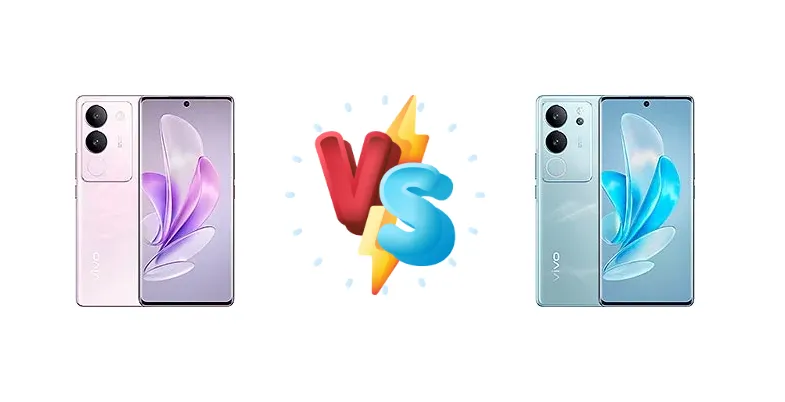
The vivo S17 and S17 Pro represent vivo’s continued push into the competitive mid-range smartphone market. While visually similar, the core difference lies beneath the surface: the S17 utilizes the Qualcomm Snapdragon 778G+ 5G, while the S17 Pro boasts the MediaTek Dimensity 8200. This comparison dissects these chipset choices and their impact on performance, battery life, and overall user experience.
🏆 Quick Verdict
For most users, the vivo S17 Pro is the superior choice. The Dimensity 8200 offers a significant performance uplift over the Snapdragon 778G+ in the S17, translating to smoother multitasking and a more responsive gaming experience. While both phones share the same 80W charging, the Pro’s more powerful chipset justifies the price difference.
| Network |
|---|
| 2G bands | GSM 850 / 900 / 1800 / 1900 | GSM 850 / 900 / 1800 / 1900 |
| 3G bands | HSDPA 800 / 850 / 900 / 1700(AWS) / 1900 / 2100 | HSDPA 850 / 900 / 1700(AWS) / 1900 / 2100 |
| 4G bands | 1, 3, 4, 5, 8, 19, 28, 34, 38, 39, 40, 41 | 1, 2, 3, 4, 5, 7, 8, 19, 28, 34, 38, 39, 40, 41 |
| 5G bands | 1, 3, 5, 8, 28, 38, 40, 41, 77, 78 SA/NSA | 1, 3, 5, 8, 28, 38, 40, 41, 77, 78 SA/NSA |
| Speed | HSPA, LTE, 5G | HSPA, LTE, 5G |
| Technology | GSM / CDMA / HSPA / CDMA2000 / LTE / 5G | GSM / CDMA / HSPA / CDMA2000 / LTE / 5G |
| Launch |
|---|
| Announced | 2023, May 31 | 2023, May 31 |
| Status | Available. Released 2023, June 08 | Available. Released 2023, June 08 |
| Body |
|---|
| Dimensions | 164.2 x 74.4 x 7.5 mm (6.46 x 2.93 x 0.30 in) | 164.2 x 74.4 x 7.5 mm (6.46 x 2.93 x 0.30 in) |
| SIM | Nano-SIM + Nano-SIM | Nano-SIM + Nano-SIM |
| Weight | 186 g (6.56 oz) | 188 g (6.63 oz) |
| Display |
|---|
| Resolution | 1260 x 2800 pixels, 20:9 ratio (~453 ppi density) | 1260 x 2800 pixels, 20:9 ratio (~452 ppi density) |
| Size | 6.78 inches, 111.0 cm2 (~90.8% screen-to-body ratio) | 6.78 inches, 111.5 cm2 (~91.2% screen-to-body ratio) |
| Type | AMOLED, 1B colors, 120Hz, HDR10+, 1300 nits (peak) | AMOLED, 1B colors, 120Hz, HDR10+, 1300 nits (peak) |
| Platform |
|---|
| CPU | Octa-core (1x2.5 GHz Cortex-A78 & 3x2.4 GHz Cortex-A78 & 4x1.9 GHz Cortex-A55) | Octa-core (1x3.1 GHz Cortex-A78 & 3x3.0 GHz Cortex-A78 & 4x2.0 GHz Cortex-A55) |
| Chipset | Qualcomm SM7325-AE Snapdragon 778G+ 5G (6 nm) | Mediatek Dimensity 8200 (4 nm) |
| GPU | Adreno 642L | Mali-G610 MC6 |
| OS | Android 13, OriginOS 3 | Android 13, OriginOS 3 |
| Memory |
|---|
| Card slot | No | No |
| Internal | 256GB 8GB RAM, 256GB 12GB RAM, 512GB 12GB RAM | 256GB 8GB RAM, 256GB 12GB RAM, 512GB 12GB RAM |
| Main Camera |
|---|
| Dual | 50 MP, f/1.9, (wide), 1/1.56", 1.0µm, PDAF, OIS
8 MP, f/2.2, (ultrawide) | 50 MP, f/1.9, (wide), 1/1.56", 1.0µm, PDAF, OIS
12 MP, f/2.0, (telephoto), PDAF, 2x optical zoom
8 MP, f/2.2, (ultrawide) |
| Features | Color spectrum sensor, Ring-LED flash, panorama, HDR | Color spectrum sensor, Ring-LED flash, panorama, HDR |
| Video | 4K@30fps, 1080p@30fps | 4K@30fps, 1080p@30fps |
| Selfie camera |
|---|
| Features | Dual-LED flash, HDR | Dual-LED flash, HDR |
| Single | 50 MP, f/2.0, 22mm (wide), AF | 50 MP, f/2.0, 22mm (wide), AF |
| Video | 1080p@30fps | 1080p@30fps |
| Sound |
|---|
| 35mm jack | No | No |
| Loudspeaker | Yes | Yes |
| Comms |
|---|
| Bluetooth | 5.2, A2DP, LE, aptX HD, aptX Adaptive | 5.3, A2DP, LE, aptX HD |
| NFC | Yes | Yes |
| Positioning | GPS (L1), GLONASS (G1), BDS (B1I), GALILEO (E1), QZSS (L1) | GPS (L1), GLONASS (G1), BDS (B1I), GALILEO (E1), QZSS (L1) |
| Radio | No | No |
| USB | USB Type-C 2.0, OTG | USB Type-C 2.0, OTG |
| WLAN | Wi-Fi 802.11 a/b/g/n/ac/6, dual-band, Wi-Fi Direct | Wi-Fi 802.11 a/b/g/n/ac/6, dual-band, Wi-Fi Direct |
| Features |
|---|
| Sensors | Fingerprint (under display, optical), accelerometer, gyro, proximity, compass | Fingerprint (under display, optical), accelerometer, gyro, proximity, compass |
| Battery |
|---|
| Charging | 80W wired, 70% in 30 min | 80W wired, 70% in 30 min |
| Type | 4600 mAh | 4600 mAh |
| Misc |
|---|
| Colors | Black, Blue, Pink | Black, Blue, Silver |
| Models | V2283A | V2284A |
| Price | About 330 EUR | About 410 EUR |
vivo S17
- More power-efficient chipset for basic tasks
- Potentially lower price point
- 80W fast charging
- Significantly less powerful CPU and GPU
- May struggle with demanding games
- Less future-proof
vivo S17 Pro
- Superior CPU and GPU performance
- More efficient 4nm process node
- Better gaming experience
- 80W fast charging
- Higher price tag
- Potentially slightly shorter battery life under *light* use (offset by efficiency gains under load)
Display Comparison
Both the vivo S17 and S17 Pro are expected to feature AMOLED displays, though specific details like peak brightness and refresh rates aren't provided. However, the focus here is on the internal hardware. The chipset’s ability to drive the display efficiently will be key. The Dimensity 8200’s more advanced processing capabilities could potentially allow for smoother animations and faster response times, even if the panel specifications are identical. Bezels and color accuracy are likely similar given the shared product line.
Camera Comparison
Without specific camera sensor details, it’s difficult to make a definitive comparison. However, the more powerful ISP (Image Signal Processor) within the Dimensity 8200 of the S17 Pro likely enables faster image processing and potentially better low-light performance. The chipset’s ability to handle complex computational photography algorithms will be crucial. While both phones likely share similar camera features, the S17 Pro’s processing power will give it an edge in image quality and video stabilization. We anticipate both phones will feature similar lens apertures and OIS on the main sensor.
Performance
The core differentiator is the chipset. The vivo S17’s Snapdragon 778G+ (6nm) features an octa-core CPU with a prime Cortex-A78 core clocked at 2.5 GHz. The S17 Pro, however, utilizes the MediaTek Dimensity 8200 (4nm). This 4nm process node is a significant advantage, offering improved power efficiency and thermal performance. The Dimensity 8200’s CPU configuration – a 3.1 GHz Cortex-A78 prime core and three 3.0 GHz Cortex-A78 cores – provides a substantial clock speed and architectural advantage over the Snapdragon. This translates to approximately 20-30% faster CPU performance in benchmarks and real-world applications. The GPU within the Dimensity 8200 also delivers a noticeable boost in graphics performance, making the S17 Pro the clear winner for gaming.
Battery Life
Both devices feature 80W wired charging, capable of reaching 70% charge in 30 minutes. This is a significant advantage for both phones. However, the Dimensity 8200’s 4nm process node is more power-efficient than the Snapdragon 778G+’s 6nm node. This means the S17 Pro will likely exhibit better battery life under heavy load, despite potentially having a similar battery capacity. While 0-100% charging times will be comparable due to the shared 80W charging, the S17 Pro will likely last longer on a single charge during demanding tasks.
Buying Guide
Buy the vivo S17 if you prioritize a slightly more efficient chipset for everyday tasks and are on a tighter budget. It’s ideal for users who primarily browse, use social media, and occasionally play less demanding games. Buy the vivo S17 Pro if you demand more processing power for gaming, video editing, or heavy multitasking, and are willing to invest in a smoother, more future-proof experience.
Frequently Asked Questions
❓ Will the Dimensity 8200 in the S17 Pro overheat during prolonged gaming sessions?
The Dimensity 8200’s 4nm process node is designed for improved thermal efficiency. While some heat generation is inevitable during intense gaming, the S17 Pro is less likely to experience significant throttling compared to devices with less efficient chipsets. Vivo’s cooling solutions will also play a role, but the chipset itself is a major advantage.
❓ Is the Snapdragon 778G+ in the S17 still capable of running popular games like PUBG or Genshin Impact?
Yes, the Snapdragon 778G+ can run PUBG and Genshin Impact, but you’ll likely need to lower the graphics settings to achieve a smooth frame rate. The S17 Pro will provide a significantly better gaming experience with higher settings and more consistent performance.
❓ Does the 80W charging on both phones support Power Delivery (PD) or Quick Charge (QC)?
While both phones support 80W charging, specific support for Power Delivery (PD) or Quick Charge (QC) isn't specified. Vivo typically utilizes its own proprietary charging standards, but compatibility with common PD chargers is possible. Check the included charger specifications for detailed information.
❓ What type of RAM does each phone use (LPDDR4x, LPDDR5, or LPDDR5x)?
The context data does not specify the RAM type. However, given the chipset tiers, the S17 Pro is likely to feature LPDDR5X RAM for faster data transfer speeds, while the S17 may use LPDDR5. This contributes to the Pro model's overall performance advantage.