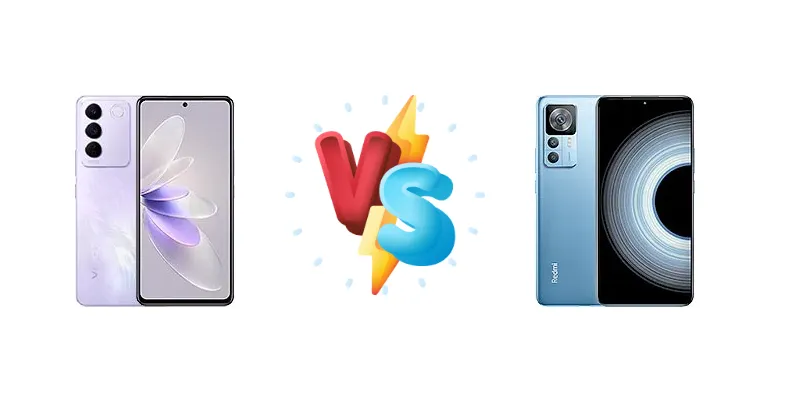
Choosing a new smartphone can be overwhelming. The vivo S16e and Xiaomi Redmi K50 Ultra both offer compelling features, but cater to different needs. This comprehensive comparison will help you decide which device is the perfect fit for you.
🏆 Quick Verdict
The Redmi K50 Ultra is the clear performance winner thanks to its Snapdragon 8+ Gen 1 chipset and blazing-fast 120W charging. However, the vivo S16e might appeal to users prioritizing a more refined design and potentially better selfie camera, offering a good balance for everyday use.
| Network |
|---|
| 2G bands | GSM 850 / 900 / 1800 / 1900 | GSM 850 / 900 / 1800 / 1900 |
| 3G bands | HSDPA 850 / 900 / 2100 | HSDPA 850 / 900 / 1700(AWS) / 1900 / 2100 |
| 4G bands | 1, 3, 5, 8, 28, 34, 38, 39, 40, 41 | 1, 3, 4, 5, 8, 18, 19, 26, 34, 38, 39, 40, 41, 42 |
| 5G bands | 1, 5, 8, 28, 41, 77, 78 SA/NSA | 1, 3, 5, 8, 28, 38, 40, 41, 77, 78 SA/NSA |
| Speed | HSPA, LTE, 5G | HSPA, LTE, 5G |
| Technology | GSM / CDMA / HSPA / CDMA2000 / LTE / 5G | GSM / CDMA / HSPA / CDMA2000 / LTE / 5G |
| | CDMA2000 1x | CDMA2000 1x |
| Launch |
|---|
| Announced | 2022, December 22 | 2022, August 11 |
| Status | Available. Released 2022, December 30 | Available. Released 2022, August 25 |
| Body |
|---|
| Dimensions | 162.5 x 75.8 x 7.7 mm or 7.8 mm | 163.1 x 75.9 x 8.6 mm (6.42 x 2.99 x 0.34 in) |
| SIM | Nano-SIM + Nano-SIM | Nano-SIM + Nano-SIM |
| Weight | 187.7 g or 189 g (6.63 oz) | 202 g (7.13 oz) |
| Display |
|---|
| Resolution | 1080 x 2400 pixels, 20:9 ratio (~398 ppi density) | 1220 x 2712 pixels, 20:9 ratio (~446 ppi density) |
| Size | 6.62 inches, 105.8 cm2 (~85.9% screen-to-body ratio) | 6.67 inches, 107.4 cm2 (~86.7% screen-to-body ratio) |
| Type | AMOLED, 120Hz, HDR10+, 1300 nits (peak) | OLED, 68B colors, 144Hz, HDR10+, Dolby Vision |
| Platform |
|---|
| CPU | Octa-core (1x2.8 GHz Cortex-A78 & 3x2.6 GHz Cortex-A78 & 4x2.0 GHz Cortex-A55) | Octa-core (1x3.19 GHz Cortex-X2 & 3x2.75 GHz Cortex-A710 & 4x1.80 GHz Cortex-A510) |
| Chipset | Exynos 1080 (5 nm) | Qualcomm SM8475 Snapdragon 8+ Gen 1 (4 nm) |
| GPU | Mali-G78 MP10 | Adreno 730 |
| OS | Android 11, OriginOS Ocean | Android 12, MIUI 13 |
| Memory |
|---|
| Card slot | No | No |
| Internal | 128GB 8GB RAM, 256GB 8GB RAM, 256GB 12GB RAM | 128GB 8GB RAM, 256GB 8GB RAM, 256GB 12GB RAM, 512GB 12GB RAM |
| | UFS 3.1 | UFS 3.1 |
| Main Camera |
|---|
| Features | Color spectrum sensor, Ring-LED flash, panorama, HDR | Color spectrum sensor, LED flash, HDR, panorama |
| Single | 16 MP, f/2.0, (wide) | - |
| Triple | 50 MP, f/1.8, (wide), PDAF, OIS
2 MP (macro)
Auxiliary lens | 108 MP, f/1.6, (wide), 1/1.67", PDAF, OIS
8 MP, f/2.2, 120˚, (ultrawide)
2 MP (macro) |
| Video | 4K@30fps, 1080p@30fps | 4K@30/60fps, 1080p@30/60/120/240/960fps |
| Selfie camera |
|---|
| Features | Dual-LED flash | HDR |
| Single | 16 MP, f/2.0, (wide) | 20 MP, (wide) |
| Video | 1080p@30fps | 1080p@30/60fps, 720p@120fps |
| Sound |
|---|
| 3.5mm jack | No | No |
| 35mm jack | No | No |
| Loudspeaker | Yes | Yes, with stereo speakers |
| | 24-bit/192kHz audio | 24-bit/192kHz audio |
| Comms |
|---|
| Bluetooth | 5.2, A2DP, LE, aptX HD | 5.2, A2DP, LE, aptX HD, aptX Adaptive |
| Infrared port | - | Yes |
| NFC | Yes | Yes |
| Positioning | GPS, GLONASS, GALILEO, BDS | GPS (L1+L5), GLONASS (L1), BDS (B1I+B1c+B2a), GALILEO (E1+E5a), QZSS (L1+L5), NavIC (L5) |
| Radio | No | No |
| USB | USB Type-C 2.0, OTG | USB Type-C 2.0, OTG |
| WLAN | Wi-Fi 802.11 a/b/g/n/ac/6, dual-band, Wi-Fi Direct | Wi-Fi 802.11 a/b/g/n/ac/6e, dual-band, Wi-Fi Direct |
| Features |
|---|
| Sensors | Fingerprint (under display, optical), accelerometer, gyro, proximity, compass | Fingerprint (under display, optical), accelerometer, gyro, proximity, compass |
| Battery |
|---|
| Charging | 66W wired, 50% in 19 min | 120W wired, PD3.0, 100% in 19 min |
| Type | 4600 mAh | Li-Po 5000 mAh |
| Misc |
|---|
| Colors | Black, Green, Purple | Black, Gray, Blue, Mercedes AMG |
| Models | V2239A | 22081212C |
| Price | About 280 EUR | About 430 EUR |
vivo S16e
- Stylish Design
- Excellent Selfie Camera (Expected)
- Smooth Everyday Performance
- 66W Fast Charging
- Less Powerful Chipset
- Potentially Lower Refresh Rate Display
- Less Versatile Camera System (Compared to K50 Ultra)
Xiaomi Redmi K50 Ultra
- Flagship Performance (Snapdragon 8+ Gen 1)
- Blazing-Fast 120W Charging
- Vibrant 144Hz AMOLED Display
- Versatile Camera System
- Potentially Less Refined Design
- Selfie Camera May Not Be as Strong
- Software Experience Can Vary
Display Comparison
The Redmi K50 Ultra boasts a 6.67-inch AMOLED display with a 144Hz refresh rate, offering vibrant colors and smooth scrolling. The vivo S16e likely features a smaller AMOLED display (around 6.5-6.6 inches) with a potentially lower refresh rate (90Hz or 120Hz). The K50 Ultra's larger size and higher refresh rate give it an edge for media consumption and gaming.
Camera Comparison
While both phones offer capable camera systems, the vivo S16e is expected to excel in selfie photography, often a focus for vivo devices. The Redmi K50 Ultra likely has a more versatile main camera system with a higher resolution sensor, potentially offering better low-light performance and zoom capabilities. Specific camera specs need further review.
Performance
Here, the Redmi K50 Ultra dominates. The Snapdragon 8+ Gen 1 is significantly more powerful than the Exynos 1080, providing noticeably faster performance in demanding games and applications. Expect smoother multitasking and quicker app loading times on the K50 Ultra.
Battery Life
The Redmi K50 Ultra's 120W charging is a game-changer, allowing for incredibly fast charging times. The vivo S16e's 66W charging is still fast, but not as impressive. Both phones likely have similar battery capacities (around 4500-5000mAh), but the K50 Ultra's charging speed gives it a significant advantage.
Buying Guide
Who should buy the vivo S16e? Users seeking a stylish phone with a focus on selfie photography and a smooth, everyday experience. Who should buy the Xiaomi Redmi K50 Ultra? Power users and gamers who demand top-tier performance, incredibly fast charging, and a large, vibrant display.
Frequently Asked Questions
❓ Is the Redmi K50 Ultra worth the extra cost?
If you prioritize performance and fast charging, the Redmi K50 Ultra is definitely worth the investment. However, if you're on a tighter budget and primarily need a stylish phone for everyday tasks and selfies, the vivo S16e is a solid alternative.
❓ Which phone has better software?
This is subjective. Xiaomi's MIUI can be polarizing, while vivo's Funtouch OS is generally considered more streamlined. Both have their quirks and strengths, so it's best to research user reviews for the latest software versions.