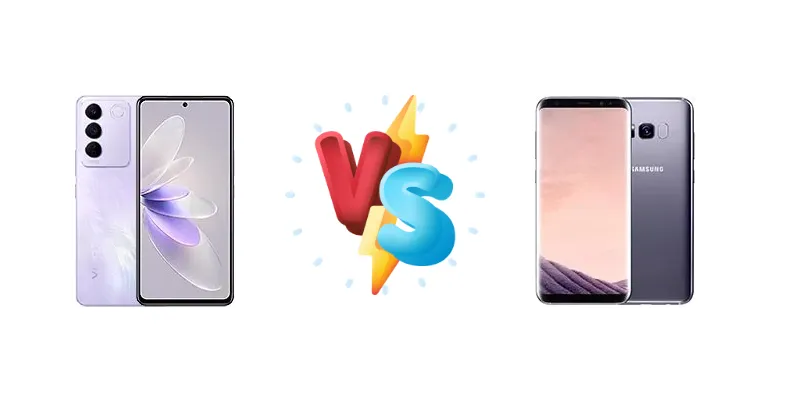
The smartphone landscape is constantly evolving. Today, we pit a modern mid-ranger, the vivo S16e, against a seasoned veteran, the Samsung Galaxy S8+. Can the newer phone's advancements overcome the S8+'s enduring appeal and impressive battery life?
🏆 Quick Verdict
The vivo S16e boasts a significantly faster chipset and blazing-fast charging, making it ideal for performance-focused users. However, the Galaxy S8+ shines with its exceptional battery endurance and a more mature software experience. It's a trade-off between speed and longevity.
| Network |
|---|
| 2G bands | GSM 850 / 900 / 1800 / 1900 | GSM 850 / 900 / 1800 / 1900 - SIM 1 & SIM 2 (dual-SIM model only) |
| 3G bands | HSDPA 850 / 900 / 2100 | HSDPA 850 / 900 / 1700(AWS) / 1900 / 2100 |
| 4G bands | 1, 3, 5, 8, 28, 34, 38, 39, 40, 41 | 1, 2, 3, 4, 5, 7, 8, 17, 20, 28 |
| 5G bands | 1, 5, 8, 28, 41, 77, 78 SA/NSA | - |
| Speed | HSPA, LTE, 5G | HSPA 42.2/5.76 Mbps, LTE (5CA) Cat16 1024/150 Mbps |
| Technology | GSM / CDMA / HSPA / CDMA2000 / LTE / 5G | GSM / HSPA / LTE |
| | CDMA2000 1x | - |
| Launch |
|---|
| Announced | 2022, December 22 | 2017, March 29. Released 2017, April |
| Status | Available. Released 2022, December 30 | Discontinued |
| Body |
|---|
| Build | - | Glass front (Gorilla Glass 5), glass back (Gorilla Glass 5), aluminum frame |
| Dimensions | 162.5 x 75.8 x 7.7 mm or 7.8 mm | 159.5 x 73.4 x 8.1 mm (6.28 x 2.89 x 0.32 in) |
| SIM | Nano-SIM + Nano-SIM | · Nano-SIM· Nano-SIM + Nano-SIM |
| Weight | 187.7 g or 189 g (6.63 oz) | 173 g (6.10 oz) |
| | - | IP68 dust/water resistant (up to 1.5m for 30 mins) |
| Display |
|---|
| Protection | - | Corning Gorilla Glass 5 |
| Resolution | 1080 x 2400 pixels, 20:9 ratio (~398 ppi density) | 1440 x 2960 pixels, 18.5:9 ratio (~529 ppi density) |
| Size | 6.62 inches, 105.8 cm2 (~85.9% screen-to-body ratio) | 6.2 inches, 98.3 cm2 (~84.0% screen-to-body ratio) |
| Type | AMOLED, 120Hz, HDR10+, 1300 nits (peak) | Super AMOLED |
| Platform |
|---|
| CPU | Octa-core (1x2.8 GHz Cortex-A78 & 3x2.6 GHz Cortex-A78 & 4x2.0 GHz Cortex-A55) | Octa-core (4x2.3 GHz Mongoose M2 & 4x1.7 GHz Cortex-A53) - EMEAOcta-core (4x2.35 GHz Kryo & 4x1.9 GHz Kryo) - USA & China |
| Chipset | Exynos 1080 (5 nm) | Exynos 8895 (10 nm) - EMEAQualcomm MSM8998 Snapdragon 835 (10 nm) - USA & China |
| GPU | Mali-G78 MP10 | Mali-G71 MP20 - EMEAAdreno 540 - USA & China |
| OS | Android 11, OriginOS Ocean | Android 7.0 (Nougat), upgradable to Android 9.0 (Pie), One UI |
| Memory |
|---|
| Card slot | No | microSDXC (uses shared SIM slot) - dual SIM model only |
| Internal | 128GB 8GB RAM, 256GB 8GB RAM, 256GB 12GB RAM | 64GB 4GB RAM, 128GB 6GB RAM |
| | UFS 3.1 | UFS 2.0 or UFS 2.1 |
| Main Camera |
|---|
| Features | Color spectrum sensor, Ring-LED flash, panorama, HDR | LED flash, auto-HDR, panorama |
| Single | 16 MP, f/2.0, (wide) | 12 MP, f/1.7, 26mm (wide), 1/2.55", 1.4µm, dual pixel PDAF, OIS |
| Triple | 50 MP, f/1.8, (wide), PDAF, OIS
2 MP (macro)
Auxiliary lens | - |
| Video | 4K@30fps, 1080p@30fps | 4K@30fps, 1080p@30/60fps, 720p@240fps, HDR, stereo sound rec., gyro-EIS, OIS |
| Selfie camera |
|---|
| Dual | - | 8 MP, f/1.7, 25mm (wide), 1/3.6", 1.22µm, AF
2 MP (dedicated iris scanner camera) |
| Features | Dual-LED flash | HDR |
| Single | 16 MP, f/2.0, (wide) | - |
| Video | 1080p@30fps | 1440p@30fps |
| Sound |
|---|
| 3.5mm jack | No | Yes |
| 35mm jack | No | Yes |
| Loudspeaker | Yes | Yes |
| | 24-bit/192kHz audio | 32-bit/384kHz audio
|
| Comms |
|---|
| Bluetooth | 5.2, A2DP, LE, aptX HD | 5.0, A2DP, LE, aptX |
| NFC | Yes | Yes |
| Positioning | GPS, GLONASS, GALILEO, BDS | GPS, GLONASS, BDS, GALILEO |
| Radio | No | No |
| USB | USB Type-C 2.0, OTG | USB Type-C 3.1 |
| WLAN | Wi-Fi 802.11 a/b/g/n/ac/6, dual-band, Wi-Fi Direct | Wi-Fi 802.11 a/b/g/n/ac, dual-band, Wi-Fi Direct |
| Features |
|---|
| Sensors | Fingerprint (under display, optical), accelerometer, gyro, proximity, compass | Iris scanner, fingerprint (rear-mounted), accelerometer, gyro, proximity, compass, barometer, heart rate, SpO2 |
| | - | Samsung DeX (desktop experience support)
ANT+
Bixby natural language commands and dictation
Samsung Pay (Visa, MasterCard certified) |
| Battery |
|---|
| Charging | 66W wired, 50% in 19 min | 15W wired, QC2
Wireless (Qi) (market dependent) |
| Type | 4600 mAh | Li-Ion 3500 mAh, non-removable (13.48 Wh) |
| Misc |
|---|
| Colors | Black, Green, Purple | Midnight Black, Orchid Gray, Arctic Silver, Coral Blue, Maple Gold, Rose Pink |
| Models | V2239A | SM-G955F, SM-G955FD, SM-G955W, SM-G955A, SM-G955P, SM-G955T, SM-G955V, SM-G955R4, SM-G955U, SM-G955S, SM-G955K, SM-G955L, SM-G955, SM-G955U1, SM-G955N, SM-G9550, SC-03J, G955F |
| Price | About 280 EUR | About 430 EUR |
| SAR | - | 0.67 W/kg (head) 0.97 W/kg (body) |
| SAR EU | - | 0.27 W/kg (head) 1.00 W/kg (body) |
| Tests |
|---|
| Audio quality | - |
Noise -92.2dB / Crosstalk -93.3dB |
| Battery life | - |
Endurance rating 88h
|
| Camera | - |
Photo / Video |
| Display | - |
Contrast ratio: Infinite (nominal), 4.658(sunlight) |
| Loudspeaker | - |
Voice 68dB / Noise 69dB / Ring 71dB
|
| Performance | - |
GeekBench: 6754 (v4.4)
GFXBench: 13fps (ES 3.1 onscreen) |
vivo S16e
- Faster Processor
- 66W Fast Charging
- Modern Design
- Likely Better Camera
- Shorter Battery Life
- Potentially Less Mature Software
Samsung Galaxy S8+
- Exceptional Battery Life
- Comfortable Size
- Mature Software
- Excellent Display
- Older Processor
- Slower Charging
- Outdated Design
- Limited Software Updates
Display Comparison
The vivo S16e likely features a vibrant AMOLED display with a higher resolution and refresh rate (likely 90Hz or 120Hz), offering smoother visuals. The Galaxy S8+ has a beautiful Super AMOLED display, known for its excellent contrast and color accuracy, but lacks a high refresh rate. Both offer excellent sunlight visibility, as indicated by the contrast ratio of 4.658.
Camera Comparison
While both phones offer 'Photo/Video' capabilities, the vivo S16e likely has a more modern camera system with improved image processing and features like night mode and portrait mode enhancements. The S8+ camera is still very good, but the S16e's newer sensors and software should provide an edge in image quality, especially in challenging lighting conditions. Expect better selfie capabilities on the S16e.
Performance
The Exynos 1080 in the vivo S16e is considerably more powerful than either Exynos 8895 or Snapdragon 835 found in the Galaxy S8+. Expect significantly faster app loading times, smoother multitasking, and better gaming performance on the S16e. The S8+ remains capable for everyday tasks but will struggle with demanding applications.
Battery Life
This is where the Galaxy S8+ truly shines. Its endurance rating of 88h is remarkable. The vivo S16e, while offering 66W fast charging, likely has a smaller battery capacity and won't match the S8+'s longevity. The S8+ can easily last multiple days on a single charge, while the S16e will require more frequent charging.
Buying Guide
Who should buy the vivo S16e? Gamers, social media enthusiasts, and those prioritizing fast charging and a modern design. Who should buy the Samsung Galaxy S8+? Users seeking exceptional battery life, a comfortable size, and a reliable, albeit older, smartphone experience.
Frequently Asked Questions
❓ Is the Samsung Galaxy S8+ still worth buying in [current year]?
The S8+ remains a solid option if battery life is your top priority and you can find it at a very low price. However, be aware of its age and limited software updates.
❓ Which phone is better for gaming?
The vivo S16e is significantly better for gaming due to its much more powerful processor and likely higher refresh rate display.