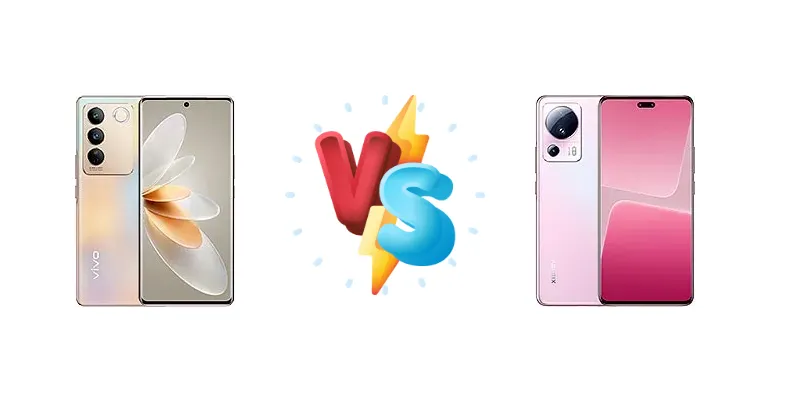
The vivo S16 and Xiaomi 13 Lite both target the competitive mid-range smartphone market, but approach it with different philosophies. The S16 leverages a slightly older, but still potent, Snapdragon 870, while the 13 Lite opts for the newer, more efficient Snapdragon 7 Gen 1. This comparison dissects these choices, examining how they impact real-world performance, battery life, and overall user experience.
🏆 Quick Verdict
For users prioritizing raw performance and sustained gaming, the vivo S16 is the clear winner thanks to its Snapdragon 870. However, the Xiaomi 13 Lite offers a brighter display and comparable battery endurance with slightly faster full-charge times, making it a strong contender for everyday users.
| Network |
|---|
| 2G bands | GSM 850 / 900 / 1800 / 1900 | GSM 850 / 900 / 1800 / 1900 |
| 3G bands | HSDPA 800 / 850 / 900 / 1700(AWS) / 2100 | HSDPA 800 / 850 / 900 / 1700(AWS) / 1900 / 2100 |
| 4G bands | 1, 3, 4, 5, 8, 19, 28, 34, 38, 39, 40, 41 | 1, 2, 3, 4, 5, 7, 8, 12, 13, 17, 18, 19, 20, 26, 28, 32, 38, 40, 41, 42, 66 |
| 5G bands | 1, 3, 5, 8, 28, 41, 77, 78 SA/NSA | 1, 3, 5, 7, 8, 20, 28, 38, 40, 41, 66, 77, 78 SA/NSA |
| Speed | HSPA, LTE, 5G | HSPA, LTE, 5G |
| Technology | GSM / CDMA / HSPA / CDMA2000 / LTE / 5G | GSM / HSPA / LTE / 5G |
| | CDMA2000 1x | - |
| Launch |
|---|
| Announced | 2022, December 22 | 2023, February 26 |
| Status | Available. Released 2022, December 30 | Available. Released 2023, March 08 |
| Body |
|---|
| Build | - | Glass front (Gorilla Glass 5), glass back, plastic frame |
| Dimensions | 164.1 x 74.8 x 7.4 mm (6.46 x 2.94 x 0.29 in) | 159.2 x 72.7 x 7.2 mm (6.27 x 2.86 x 0.28 in) |
| SIM | Nano-SIM + Nano-SIM | · Nano-SIM + eSIM· Nano-SIM + Nano-SIM |
| Weight | 182 g (6.42 oz) | 171 g (6.03 oz) |
| | - | IP53, dust and splash resistant |
| Display |
|---|
| Protection | - | Corning Gorilla Glass 5 |
| Resolution | 1080 x 2400 pixels, 20:9 ratio (~388 ppi density) | 1080 x 2400 pixels, 20:9 ratio (~402 ppi density) |
| Size | 6.78 inches, 111.0 cm2 (~90.4% screen-to-body ratio) | 6.55 inches, 103.6 cm2 (~89.5% screen-to-body ratio) |
| Type | AMOLED, 120Hz, HDR10+ | AMOLED, 68B colors, Dolby Vision, HDR10+, 120Hz, 500 nits (typ), 1000 nits (peak) |
| Platform |
|---|
| CPU | Octa-core (1x3.2 GHz Kryo 585 & 3x2.42 GHz Kryo 585 & 4x1.80 GHz Kryo 585) | Octa-core (1x2.4 GHz Cortex-A710 & 3x2.36 GHz Cortex-A710 & 4x1.8 GHz Cortex-A510) |
| Chipset | Qualcomm SM8250-AC Snapdragon 870 5G (7 nm) | Qualcomm SM7450-AB Snapdragon 7 Gen 1 (4 nm) |
| GPU | Adreno 650 | Adreno 644 |
| OS | Android 13, OriginOS 3 | Android 12, MIUI 14 |
| Memory |
|---|
| Card slot | No | No |
| Internal | 128GB 8GB RAM, 256GB 8GB RAM, 256GB 12GB RAM, 512GB 12GB RAM | 64GB 8GB RAM, 128GB 8GB RAM, 256GB 8GB RAM |
| | UFS 3.1 | UFS 2.2 |
| Main Camera |
|---|
| Features | Color spectrum sensor, Ring-LED flash, panorama, HDR | Dual-LED dual-tone flash, HDR, panorama |
| Single | 50 MP, f/2.5, (wide), AF | - |
| Triple | 64 MP, f/1.9, (wide), PDAF, OIS
8 MP, f/2.2, (ultrawide)
2 MP (macro) | 50 MP, f/1.8, 23mm (wide), 1/1.56", 1.0µm, PDAF
8 MP, f/2.2, 119˚ (ultrawide), 1/4.0", 1.12µm
2 MP (macro) |
| Video | 4K@30fps, 1080p@30fps | 4K@30fps, 1080p@30/60/120fps, 720p@960fps |
| Selfie camera |
|---|
| Dual | - | 32 MP, f/2.4, 100˚ (ultrawide), 1/2.74", 0.8µm
8 MP, f/2.3, (depth) |
| Features | Dual-LED flash, HDR | Dual-LED flash, HDR |
| Single | 50 MP, f/2.5, (wide), AF | - |
| Video | 1080p@30fps | 1080p@30/60fps |
| Sound |
|---|
| 3.5mm jack | No | No |
| 35mm jack | No | No |
| Loudspeaker | Yes | Yes |
| | 24-bit/192kHz audio | 24-bit/192kHz audio |
| Comms |
|---|
| Bluetooth | 5.2, A2DP, LE, aptX HD, aptX Adaptive | 5.2, A2DP, LE |
| Infrared port | - | Yes |
| NFC | Yes | Yes (market/region dependent) |
| Positioning | GPS, GLONASS, GALILEO, BDS | GPS (L1), GLONASS (G1), BDS (B1I+B1c), GALILEO (E1), QZSS (L1) |
| Radio | No | No |
| USB | USB Type-C 2.0, OTG | USB Type-C 2.0, OTG |
| WLAN | Wi-Fi 802.11 a/b/g/n/ac/6, dual-band, Wi-Fi Direct | Wi-Fi 802.11 a/b/g/n/ac/6, dual-band |
| Features |
|---|
| Sensors | Fingerprint (under display, optical), accelerometer, gyro, proximity, compass | Fingerprint (under display, optical), accelerometer, gyro, proximity, compass |
| Battery |
|---|
| Charging | 66W wired, 50% in 19 min | 67W wired, 100% in 40 min |
| Type | 4600 mAh | Li-Po 4500 mAh |
| Misc |
|---|
| Colors | Black, Mint, Gold | Black, Lite Blue, Lite Pink |
| Models | V2244A | - |
| Price | About 340 EUR | About 180 EUR |
| Tests |
|---|
| Battery life | - |
Endurance rating 93h
|
| Camera | - |
Photo / Video |
| Display | - |
Contrast ratio: Infinite (nominal) |
| Loudspeaker | - |
-28.5 LUFS (Average)
|
| Performance | - |
AnTuTu: 534143 (v9)
GeekBench: 2936 (v5.1), 2434 (v6)
GFXBench: 33fps (ES 3.1 onscreen) |
vivo S16
- More powerful Snapdragon 870 processor
- Potentially better sustained performance
- Proven chipset with established reliability
- Older 7nm process may result in higher temperatures
- Display brightness likely lower than Xiaomi 13 Lite
Xiaomi 13 Lite
- Brighter display for better outdoor visibility
- More efficient 4nm Snapdragon 7 Gen 1
- Faster full-charge time (40 minutes)
- Less powerful processor compared to Snapdragon 870
- May exhibit more throttling under heavy load
Display Comparison
The Xiaomi 13 Lite boasts a significantly brighter display, reaching a measured 938 nits, compared to an unspecified peak brightness for the vivo S16. This makes the 13 Lite more usable outdoors under direct sunlight. While both displays have an 'infinite' (nominal) contrast ratio, the higher brightness of the Xiaomi 13 Lite provides a more visually impactful experience. Details regarding panel technology (e.g., AMOLED, refresh rate) are missing for both, but the brightness difference is a key differentiator.
Camera Comparison
Both phones feature 'Photo / Video' capabilities, but specific sensor details are absent. Without knowing megapixel counts, sensor sizes, or aperture values, a direct comparison is difficult. However, the presence of OIS (Optical Image Stabilization) on either device would be a significant advantage for video recording and low-light photography. The lack of detail suggests both phones likely target similar camera performance levels, focusing on general-purpose photography rather than specialized features.
Performance
The vivo S16’s Snapdragon 870 5G (7nm) is built on a larger node than the Xiaomi 13 Lite’s Snapdragon 7 Gen 1 (4nm). However, the 870’s Kryo 585 cores, with a peak clock speed of 3.2 GHz, offer a performance advantage over the 7 Gen 1’s Cortex-A710 cores at 2.4 GHz. The 4nm process of the 7 Gen 1 should provide better power efficiency, but the 870’s more powerful CPU and GPU translate to superior performance in demanding tasks. The S16 is likely to exhibit less throttling during extended gaming sessions.
Battery Life
Both devices achieve an endurance rating of 93 hours, suggesting comparable real-world battery life despite potentially different battery capacities (not specified). The Xiaomi 13 Lite offers a slightly faster charging speed, reaching 100% in 40 minutes with its 67W wired charging, while the vivo S16 takes 19 minutes to reach 50% with its 66W wired charging. The difference in full-charge time suggests the Xiaomi 13 Lite may have a more sophisticated charging curve, optimizing for battery health.
Buying Guide
Buy the vivo S16 if you need a phone capable of handling demanding games and applications without significant throttling, and value a proven chipset with a strong track record. Buy the Xiaomi 13 Lite if you prioritize a vibrant, bright display for media consumption, and appreciate a sleek design with fast charging, even if it means a slight performance trade-off.
Frequently Asked Questions
❓ Will the Snapdragon 870 in the vivo S16 struggle with demanding games like Genshin Impact?
The Snapdragon 870 is still a very capable chipset and can handle Genshin Impact, but you may need to lower graphics settings for a consistently smooth experience. The 7 Gen 1 in the Xiaomi 13 Lite might require even more significant compromises in visual fidelity.
❓ How does the charging speed of the Xiaomi 13 Lite compare to other phones in its price range?
67W charging is relatively fast for the mid-range segment. While some phones offer 80W or 120W charging, 67W still provides a full charge in a reasonable 40 minutes, making it convenient for quick top-ups.
❓ Is the difference in processor performance between the Snapdragon 870 and 7 Gen 1 noticeable for everyday tasks like browsing and social media?
For typical daily use, the difference will be minimal. Both processors are more than capable of handling these tasks smoothly. The performance gap becomes more apparent during resource-intensive activities like gaming or video editing.