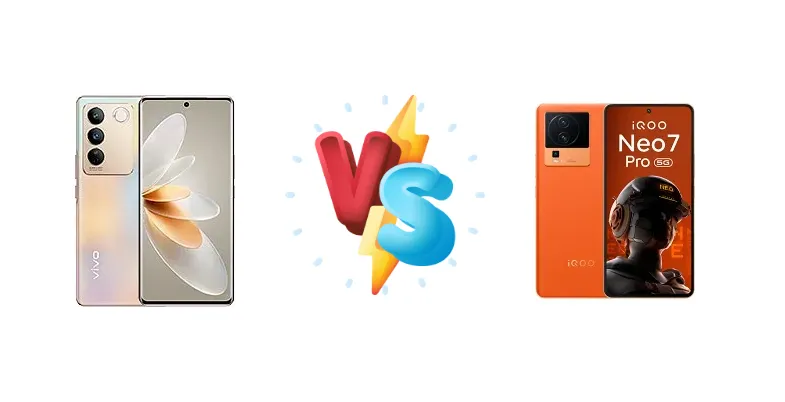
The vivo S16 and iQOO Neo 7 Pro represent distinct approaches to the mid-range flagship market. The S16 leverages the well-established Snapdragon 870, prioritizing efficiency and a balanced experience, while the iQOO Neo 7 Pro jumps to the more powerful Snapdragon 8+ Gen 1, aiming for raw performance and blazing-fast charging. This comparison dissects the key differences to help you choose the right device.
🏆 Quick Verdict
For most users, the iQOO Neo 7 Pro is the superior choice. Its Snapdragon 8+ Gen 1 offers a significant performance uplift over the S16’s Snapdragon 870, and the 120W charging is a game-changer, reaching 50% charge in just 8 minutes. While the S16 offers a respectable experience, the Neo 7 Pro delivers a more future-proof and responsive experience.
| Network |
|---|
| 2G bands | GSM 850 / 900 / 1800 / 1900 | GSM 850 / 900 / 1800 / 1900 |
| 3G bands | HSDPA 800 / 850 / 900 / 1700(AWS) / 2100 | HSDPA 800 / 850 / 900 / 1700(AWS) / 1900 / 2100 |
| 4G bands | 1, 3, 4, 5, 8, 19, 28, 34, 38, 39, 40, 41 | 1, 2, 3, 4, 5, 8, 28, 34, 38, 39, 40, 41 |
| 5G bands | 1, 3, 5, 8, 28, 41, 77, 78 SA/NSA | 1, 3, 5, 8, 28, 40, 77, 78 SA/NSA |
| Speed | HSPA, LTE, 5G | HSPA, LTE, 5G |
| Technology | GSM / CDMA / HSPA / CDMA2000 / LTE / 5G | GSM / HSPA / LTE / 5G |
| | CDMA2000 1x | - |
| Launch |
|---|
| Announced | 2022, December 22 | 2023, July 04 |
| Status | Available. Released 2022, December 30 | Available. Released 2023, July 15 |
| Body |
|---|
| Build | - | Glass front, plastic frame, glass or leather back |
| Dimensions | 164.1 x 74.8 x 7.4 mm (6.46 x 2.94 x 0.29 in) | 164.8 x 76.9 x 8.5 mm or 8.9 mm |
| SIM | Nano-SIM + Nano-SIM | Nano-SIM + Nano-SIM |
| Weight | 182 g (6.42 oz) | 197 g or 202 g (6.95 oz) |
| Display |
|---|
| Resolution | 1080 x 2400 pixels, 20:9 ratio (~388 ppi density) | 1080 x 2400 pixels, 20:9 ratio (~388 ppi density) |
| Size | 6.78 inches, 111.0 cm2 (~90.4% screen-to-body ratio) | 6.78 inches, 111.0 cm2 (~87.6% screen-to-body ratio) |
| Type | AMOLED, 120Hz, HDR10+ | AMOLED, 1B colors, 120Hz, HDR10+, 1300 nits (peak) |
| Platform |
|---|
| CPU | Octa-core (1x3.2 GHz Kryo 585 & 3x2.42 GHz Kryo 585 & 4x1.80 GHz Kryo 585) | Octa-core (1x3.19 GHz Cortex-X2 & 3x2.75 GHz Cortex-A710 & 4x2.0 GHz Cortex-A510) |
| Chipset | Qualcomm SM8250-AC Snapdragon 870 5G (7 nm) | Qualcomm SM8475 Snapdragon 8+ Gen 1 (4 nm) |
| GPU | Adreno 650 | Adreno 730 |
| OS | Android 13, OriginOS 3 | Android 13, Funtouch 13 |
| Memory |
|---|
| Card slot | No | No |
| Internal | 128GB 8GB RAM, 256GB 8GB RAM, 256GB 12GB RAM, 512GB 12GB RAM | 128GB 8GB RAM, 256GB 12GB RAM |
| | UFS 3.1 | - |
| Main Camera |
|---|
| Features | Color spectrum sensor, Ring-LED flash, panorama, HDR | LED flash, HDR, panorama |
| Single | 50 MP, f/2.5, (wide), AF | - |
| Triple | 64 MP, f/1.9, (wide), PDAF, OIS
8 MP, f/2.2, (ultrawide)
2 MP (macro) | 50 MP, f/1.9, 24mm (wide), 1/1.57", 1.0µm, PDAF, OIS
8 MP, f/2.2, 16mm (ultrawide), 1/4.0", 1.12µm
2 MP (macro) |
| Video | 4K@30fps, 1080p@30fps | 4K@30fps, 1080p@30fps |
| Selfie camera |
|---|
| Features | Dual-LED flash, HDR | HDR |
| Single | 50 MP, f/2.5, (wide), AF | 16 MP, f/2.5, (wide), 1/3.1", 1.0µm |
| Video | 1080p@30fps | 1080p@30fps |
| Sound |
|---|
| 3.5mm jack | No | - |
| 35mm jack | No | No |
| Loudspeaker | Yes | Yes, with stereo speakers |
| | 24-bit/192kHz audio | - |
| Comms |
|---|
| Bluetooth | 5.2, A2DP, LE, aptX HD, aptX Adaptive | 5.3, A2DP, LE, aptX HD, aptX Adaptive |
| Infrared port | - | Yes |
| NFC | Yes | No |
| Positioning | GPS, GLONASS, GALILEO, BDS | GPS, GLONASS, GALILEO, BDS, QZSS, NavIC |
| Radio | No | No |
| USB | USB Type-C 2.0, OTG | USB Type-C 2.0, OTG |
| WLAN | Wi-Fi 802.11 a/b/g/n/ac/6, dual-band, Wi-Fi Direct | Wi-Fi 802.11 a/b/g/n/ac/6, dual-band, Wi-Fi Direct |
| Features |
|---|
| Sensors | Fingerprint (under display, optical), accelerometer, gyro, proximity, compass | Fingerprint (under display, optical), accelerometer, gyro, proximity, compass |
| Battery |
|---|
| Charging | 66W wired, 50% in 19 min | 120W wired, 50% in 8 min |
| Type | 4600 mAh | 5000 mAh |
| Misc |
|---|
| Colors | Black, Mint, Gold | Fearless Flame, Dark Storm |
| Models | V2244A | I2217 |
| Price | About 340 EUR | About 380 EUR |
vivo S16
- Potentially more affordable price point.
- Efficient Snapdragon 870 processor for everyday tasks.
- Reliable and proven chipset.
- Significantly slower charging speed (66W vs 120W).
- Lower performance compared to the Snapdragon 8+ Gen 1.
vivo iQOO Neo 7 Pro
- Blazing-fast 120W charging.
- Superior performance with the Snapdragon 8+ Gen 1.
- Better thermal management for sustained performance.
- Potentially higher price.
- May experience slightly faster battery drain due to higher performance.
Display Comparison
While display specifications aren't provided, both phones likely feature AMOLED panels, common for this price bracket. However, the iQOO Neo 7 Pro, given its gaming focus, may boast a higher refresh rate (potentially 120Hz vs 90Hz on the S16) and potentially higher peak brightness. The Snapdragon 8+ Gen 1’s image signal processor (ISP) also contributes to potentially more accurate color reproduction. Bezels are likely comparable, but the Neo 7 Pro might prioritize a slightly more immersive experience.
Camera Comparison
Without specific camera specs, it’s difficult to make definitive claims. However, the iQOO Neo 7 Pro, positioned as a performance-focused device, is likely to feature a more advanced camera system. The Snapdragon 8+ Gen 1’s ISP supports more advanced image processing algorithms and potentially higher resolution video recording. Expect the Neo 7 Pro to excel in low-light photography and offer more dynamic range. The S16 will likely offer a competent camera, but may lack the advanced features and processing power of its counterpart.
Performance
The core difference lies in the chipsets. The iQOO Neo 7 Pro’s Snapdragon 8+ Gen 1 (4nm) is a substantial upgrade over the vivo S16’s Snapdragon 870 (7nm). The 8+ Gen 1 features a Cortex-X2 prime core clocked at 3.19 GHz, alongside Cortex-A710 performance cores, offering significantly improved single-core and multi-core performance. The 870’s Kryo 585 cores, while capable, are a generation behind. The 4nm process of the 8+ Gen 1 also translates to better thermal efficiency, reducing throttling during sustained workloads like gaming. The Neo 7 Pro will demonstrably outperform the S16 in graphically intensive tasks and multitasking.
Battery Life
The iQOO Neo 7 Pro’s 120W wired charging is a standout feature, achieving a 50% charge in just 8 minutes – a massive advantage over the S16’s 66W charging (50% in 19 minutes). While battery capacity isn’t specified, the efficiency gains of the Snapdragon 8+ Gen 1 could offset a potentially smaller battery size in the Neo 7 Pro, resulting in comparable or even better real-world battery life. The faster charging speed significantly reduces downtime and is a major convenience factor.
Buying Guide
Buy the vivo S16 if you prioritize a slightly more efficient processor for everyday tasks and value a potentially lower price point. It’s ideal for users who don’t heavily game or require the absolute fastest charging speeds. Buy the vivo iQOO Neo 7 Pro if you demand top-tier performance for gaming and demanding applications, and if minimizing charging time is a priority. This phone is geared towards power users and mobile gamers.
Frequently Asked Questions
❓ Will the Snapdragon 870 in the vivo S16 struggle with demanding games like Genshin Impact?
The Snapdragon 870 is capable of running Genshin Impact, but you’ll likely need to lower graphics settings to maintain a stable frame rate. The iQOO Neo 7 Pro’s Snapdragon 8+ Gen 1 will provide a significantly smoother experience at higher settings, with less thermal throttling during extended gaming sessions.
❓ How much faster is the 120W charging on the iQOO Neo 7 Pro compared to the 66W charging on the vivo S16 in real-world use?
The difference is substantial. The iQOO Neo 7 Pro can go from 0% to 50% in approximately 8 minutes, while the vivo S16 takes around 19 minutes for the same. This means you can quickly top up your iQOO Neo 7 Pro during short breaks, making it ideal for users who are always on the go.
❓ Does the Snapdragon 8+ Gen 1 in the iQOO Neo 7 Pro get noticeably hotter than the Snapdragon 870 in the vivo S16 during heavy use?
While the 8+ Gen 1 is more powerful, its 4nm process is more efficient, leading to better thermal management. The iQOO Neo 7 Pro is likely to run slightly warmer, but the improved efficiency and potentially better cooling solutions should prevent significant throttling, unlike older high-power chips.