
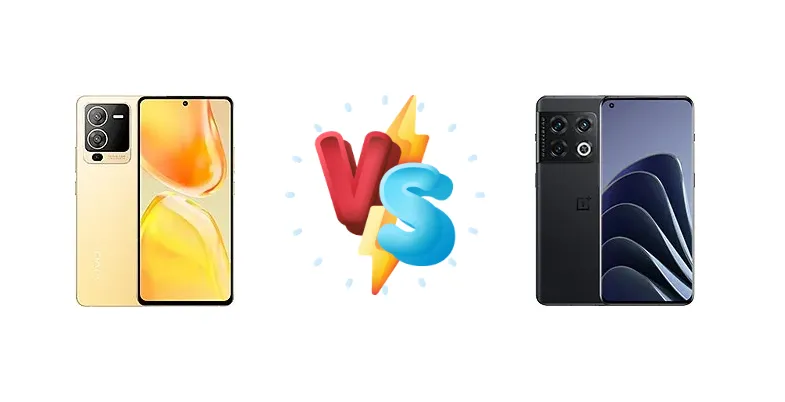
vivo S15 vs OnePlus 10 Pro: Which Snapdragon Flagship Reigns Supreme?
| Phones Images | |||||
|---|---|---|---|---|---|
|
🏆 Quick Verdict
For most users, the OnePlus 10 Pro offers a more compelling experience thanks to its superior processing power and faster 80W charging. However, the vivo S15 presents a strong value proposition, delivering excellent performance for its price point, making it ideal for budget-conscious users.
| PHONES | ||
|---|---|---|
| Phone Names | vivo S15 | OnePlus 10 Pro |
| Network | ||
|---|---|---|
| 2G bands | GSM 850 / 900 / 1800 / 1900 | GSM 850 / 900 / 1800 / 1900 |
| 3G bands | HSDPA 850 / 900 / 1700(AWS) / 2100 | HSDPA 800 / 850 / 900 / 1700(AWS) / 1900 / 2100 |
| 4G bands | 1, 2, 3, 4, 5, 7, 8, 19, 28, 34, 38, 39, 40, 41 | 1, 2, 3, 4, 5, 7, 8, 12, 13, 17, 18, 19, 20, 25, 26, 28, 30, 32, 38, 39, 40, 41, 46, 48, 66, 71 - International |
| 5G bands | 1, 3, 5, 8, 28, 41, 77, 78 SA/NSA | 1, 2, 3, 5, 7, 8, 20, 25, 28, 30, 38, 40, 41, 48, 66, 71, 77, 78 SA/NSA - International |
| Speed | HSPA, LTE, 5G | HSPA 42.2/5.76 Mbps, LTE (4CA) Cat18 1200/200 Mbps, 5G |
| Technology | GSM / CDMA / HSPA / CDMA2000 / LTE / 5G | GSM / CDMA / HSPA / EVDO / LTE / 5G |
| CDMA2000 1x | 1, 3, 5, 8, 28, 40, 41, 78, 79 SA/NSA - India | |
| Launch | ||
|---|---|---|
| Announced | 2022, May 19 | 2022, January 11 |
| Status | Available. Released 2022, May 27 | Available. Released 2022, January 13 |
| Body | ||
|---|---|---|
| Build | - | Glass front (Gorilla Glass Victus), glass back (Gorilla Glass 5), aluminum frame |
| Dimensions | 161.1 x 74.3 x 8 mm (6.34 x 2.93 x 0.31 in) | 163 x 73.9 x 8.6 mm (6.42 x 2.91 x 0.34 in) |
| SIM | Nano-SIM + Nano-SIM | · Nano-SIM· Nano-SIM + Nano-SIM |
| Weight | 197 g (6.95 oz) | 201 g (7.09 oz) |
| - | IP68 dust/water resistant - T-Mobile only (not for use underwater, liquid damage is not covered under warranty) | |
| Display | ||
|---|---|---|
| Protection | - | Corning Gorilla Glass Victus |
| Resolution | 1080 x 2400 pixels, 20:9 ratio (~398 ppi density) | 1440 x 3216 pixels, 20:9 ratio (~525 ppi density) |
| Size | 6.62 inches, 105.8 cm2 (~88.4% screen-to-body ratio) | 6.7 inches, 108.4 cm2 (~90.0% screen-to-body ratio) |
| Type | AMOLED, 120Hz, HDR10+, 1300 nits (peak) | LTPO2 Fluid AMOLED, 1B colors, 120Hz, HDR10+, 500 nits (typ), 800 nits (HBM), 1300 nits (peak) |
| - | Always-on display | |
| Platform | ||
|---|---|---|
| CPU | Octa-core (1x3.2 GHz Kryo 585 & 3x2.42 GHz Kryo 585 & 4x1.80 GHz Kryo 585) | Octa-core (1x3.00 GHz Cortex-X2 & 3x2.50 GHz Cortex-A710 & 4x1.80 GHz Cortex-A510) |
| Chipset | Qualcomm SM8250-AC Snapdragon 870 5G (7 nm) | Qualcomm SM8450 Snapdragon 8 Gen 1 (4 nm) |
| GPU | Adreno 650 | Adreno 730 |
| OS | Android 12, OriginOS Ocean | Android 12, upgradable to Android 14, OxygenOS 14 (International), ColorOS (China) |
| Memory | ||
|---|---|---|
| Card slot | No | No |
| Internal | 128GB 8GB RAM, 256GB 8GB RAM, 256GB 12GB RAM | 128GB 8GB RAM, 256GB 8GB RAM, 256GB 12GB RAM, 512GB 12GB RAM |
| UFS 3.1 | UFS 3.1 | |
| Main Camera | ||
|---|---|---|
| Features | Dual-LED dual-tone flash, HDR, panorama | Laser AF, color spectrum sensor, Hasselblad Color Calibration, Dual-LED dual-tone flash, HDR, panorama |
| Single | 32 MP, f/2.0, (wide) | 32 MP, f/2.2, (wide), 1/2.74", 0.8µm |
| Triple | 64 MP, f/1.9, 25mm (wide), 1/1.72", PDAF, OIS 8 MP, f/2.2, 16mm, 120˚ (ultrawide) 2 MP (macro) | 48 MP, f/1.8, 23mm (wide), 1/1.43", 1.12µm, multi-directional PDAF, OIS 8 MP, f/2.4, 77mm (telephoto), 1.0µm, PDAF, OIS, 3.3x optical zoom 50 MP, f/2.2, 14mm, 150˚ (ultrawide), 1/2.76", 0.64µm |
| Video | 4K@30fps, 1080p@30fps | 8K@24fps, 4K@30/60/120fps, 1080p@30/60/240fps, Auto HDR, gyro-EIS |
| Selfie camera | ||
|---|---|---|
| Features | HDR | HDR |
| Single | 32 MP, f/2.0, (wide) | 32 MP, f/2.2, (wide), 1/2.74", 0.8µm |
| Video | 1080p@30fps | 1080p@30fps, gyro-EIS |
| Sound | ||
|---|---|---|
| 3.5mm jack | No | No |
| 35mm jack | No | No |
| Loudspeaker | Yes | Yes, with stereo speakers |
| 24-bit/192kHz audio | 24-bit/192kHz audio | |
| Comms | ||
|---|---|---|
| Bluetooth | 5.2, A2DP, LE, aptX HD, aptX Adaptive | 5.2, A2DP, LE, aptX HD |
| NFC | Yes | Yes |
| Positioning | GPS, GLONASS, GALILEO, BDS, QZSS | GPS (L1+L5), GLONASS (G1), BDS (B1), GALILEO (E1+E5a) |
| Radio | No | No |
| USB | USB Type-C 2.0, OTG | USB Type-C 3.1, OTG |
| WLAN | Wi-Fi 802.11 a/b/g/n/ac/6, dual-band, Wi-Fi Direct | Wi-Fi 802.11 a/b/g/n/ac/6, dual-band, Wi-Fi Direct |
| Features | ||
|---|---|---|
| Sensors | Fingerprint (under display, optical), accelerometer, gyro, proximity, compass | Fingerprint (under display, optical), accelerometer, gyro, proximity, compass, barometer |
| Battery | ||
|---|---|---|
| Charging | 66W wired, 50% in 18 min | 80W wired, PD, 100% in 32 min (International) 65W wired, PD, 58% in 15 min (North America) 50W wireless Reverse wireless |
| Type | 4500 mAh | Li-Po 5000 mAh |
| Misc | ||
|---|---|---|
| Colors | Blue, Black, Yellow | Volcanic Black, Emerald Forest, Panda White (Extreme Edition) |
| Models | V2203A | NE2210, NE2211, NE2213, NE2215, NE2217 |
| Price | About 380 EUR | $ 264.39 / C$ 349.99 / £ 360.00 / € 399.99 |
| SAR | - | 1.16 W/kg (head) 0.70 W/kg (body) |
| Tests | ||
|---|---|---|
| Battery life | - | Endurance rating 107h |
| Camera | - | Photo / Video |
| Display | - | Contrast ratio: Infinite (nominal) |
| Loudspeaker | - | -25.2 LUFS (Very good) |
| Performance | - | AnTuTu: 886248 (v9) GeekBench: 3447 (v5.1) GFXBench: 48fps (ES 3.1 onscreen) |
vivo S15
- Excellent value for money
- Smooth performance for everyday tasks
- Fast 66W wired charging
- Older Snapdragon 870 chipset
- Limited display information
OnePlus 10 Pro
- Powerful Snapdragon 8 Gen 1 chipset
- Brighter display with infinite contrast
- Faster 80W wired and 50W wireless charging
- Higher price point
- Potential for thermal throttling under sustained load
Display Comparison
The OnePlus 10 Pro boasts a brighter display, reaching a measured 780 nits, compared to an unspecified brightness for the vivo S15. While both likely utilize high-refresh-rate panels, the OnePlus 10 Pro’s infinite contrast ratio suggests a superior OLED panel. The lack of detailed display specs for the S15 makes a direct comparison difficult, but the 10 Pro’s brightness advantage is significant for outdoor visibility.
Camera Comparison
Both phones feature capable camera systems, but detailed sensor information is limited. The OnePlus 10 Pro likely benefits from a more advanced image signal processor (ISP) within the Snapdragon 8 Gen 1, enabling superior image processing. Without specific sensor details for the vivo S15, it’s difficult to assess its low-light performance or dynamic range capabilities. The OnePlus 10 Pro’s Hasselblad partnership suggests a focus on color accuracy and image quality, potentially giving it an edge in photography.
Performance
The core difference lies in the chipsets. The OnePlus 10 Pro’s Snapdragon 8 Gen 1 (4nm) offers a substantial performance leap over the vivo S15’s Snapdragon 870 (7nm). The 8 Gen 1 features a Cortex-X2 prime core clocked at 3.00 GHz, versus the 870’s Kryo 585 at 3.2 GHz. While the 870’s clock speed is higher, the 8 Gen 1’s architectural improvements and 4nm process provide greater efficiency and sustained performance. The 8 Gen 1’s Cortex-A710 cores (2.50 GHz) also outperform the 870’s Kryo 585 cores (2.42 GHz). This translates to faster app loading, smoother multitasking, and better gaming performance on the OnePlus 10 Pro.
Battery Life
Both devices achieve an endurance rating of 107 hours, suggesting similar overall battery life despite differing battery capacities (not specified for the S15). However, the charging speeds are significantly different. The OnePlus 10 Pro offers 80W wired charging (international) or 65W (North America), reaching 100% in 32 minutes (international) or 58% in 15 minutes (North America). It also supports 50W wireless and reverse wireless charging. The vivo S15 offers 66W wired charging, reaching 50% in 18 minutes. While the S15’s charging is fast, the OnePlus 10 Pro’s faster wired and wireless options provide greater convenience.
Buying Guide
Buy the vivo S15 if you prioritize a smooth, responsive experience for everyday tasks and light gaming, and value a more affordable price. You'll benefit from a capable chipset and fast 66W charging without breaking the bank. Buy the OnePlus 10 Pro if you demand the highest possible performance for demanding games and applications, require the fastest charging speeds (especially the international 80W version), and appreciate a more premium overall experience.