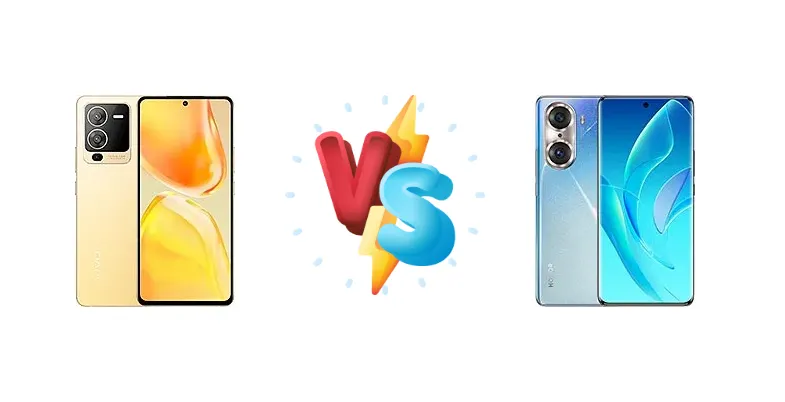
The vivo S15 and Honor 60 Pro represent compelling options in the increasingly competitive mid-range smartphone market. Both devices feature 66W fast charging and attractive designs, but diverge significantly in their core processing power. This comparison dissects the differences between the Snapdragon 870 powering the vivo S15 and the Snapdragon 778G+ in the Honor 60 Pro, helping you determine which phone best suits your needs.
🏆 Quick Verdict
For users prioritizing raw performance and sustained gaming, the vivo S15, with its Snapdragon 870, is the clear winner. While the Honor 60 Pro offers a smooth experience for everyday tasks, the S15’s superior chipset provides a noticeable edge in demanding applications. Both charge quickly, but the S15’s performance justifies its potential price premium.
| Network |
|---|
| 2G bands | GSM 850 / 900 / 1800 / 1900 | GSM 850 / 900 / 1800 / 1900 |
| 3G bands | HSDPA 850 / 900 / 1700(AWS) / 2100 | HSDPA 800 / 850 / 900 / 1700(AWS) / 1900 / 2100 |
| 4G bands | 1, 2, 3, 4, 5, 7, 8, 19, 28, 34, 38, 39, 40, 41 | 1, 2, 3, 4, 5, 8, 18, 19, 26, 28, 34, 38, 39, 40, 41 |
| 5G bands | 1, 3, 5, 8, 28, 41, 77, 78 SA/NSA | 1, 5, 8, 28, 41, 77, 78 SA/NSA |
| Speed | HSPA, LTE, 5G | HSPA, LTE, 5G |
| Technology | GSM / CDMA / HSPA / CDMA2000 / LTE / 5G | GSM / CDMA / HSPA / CDMA2000 / LTE / 5G |
| | CDMA2000 1x | CDMA2000 1x |
| Launch |
|---|
| Announced | 2022, May 19 | 2021, December 01 |
| Status | Available. Released 2022, May 27 | Available. Released 2021, December 10 |
| Body |
|---|
| Dimensions | 161.1 x 74.3 x 8 mm (6.34 x 2.93 x 0.31 in) | 163.9 x 74.8 x 8.2 mm (6.45 x 2.94 x 0.32 in) |
| SIM | Nano-SIM + Nano-SIM | Nano-SIM + Nano-SIM |
| Weight | 197 g (6.95 oz) | 192 g (6.77 oz) |
| Display |
|---|
| Resolution | 1080 x 2400 pixels, 20:9 ratio (~398 ppi density) | 1200 x 2652 pixels (~429 ppi density) |
| Size | 6.62 inches, 105.8 cm2 (~88.4% screen-to-body ratio) | 6.78 inches, 111.4 cm2 (~90.9% screen-to-body ratio) |
| Type | AMOLED, 120Hz, HDR10+, 1300 nits (peak) | OLED, 1B colors, 120Hz, HDR10+ |
| Platform |
|---|
| CPU | Octa-core (1x3.2 GHz Kryo 585 & 3x2.42 GHz Kryo 585 & 4x1.80 GHz Kryo 585) | Octa-core (1x2.5 GHz Cortex-A78 & 3x2.4 GHz Cortex-A78 & 4x1.8 GHz Cortex-A55) |
| Chipset | Qualcomm SM8250-AC Snapdragon 870 5G (7 nm) | Qualcomm Snapdragon 778G+ 5G |
| GPU | Adreno 650 | Adreno 642L |
| OS | Android 12, OriginOS Ocean | Android 11, Magic UI 5.0 |
| Memory |
|---|
| Card slot | No | No |
| Internal | 128GB 8GB RAM, 256GB 8GB RAM, 256GB 12GB RAM | 256GB 8GB RAM, 256GB 12GB RAM |
| | UFS 3.1 | - |
| Main Camera |
|---|
| Features | Dual-LED dual-tone flash, HDR, panorama | Dual-LED flash, HDR, panorama |
| Single | 32 MP, f/2.0, (wide) | 50 MP, f/2.4, 18mm (ultrawide) |
| Triple | 64 MP, f/1.9, 25mm (wide), 1/1.72", PDAF, OIS
8 MP, f/2.2, 16mm, 120˚ (ultrawide)
2 MP (macro) | 108 MP, f/1.9, (wide), 1/1.52", 0.7µm, PDAF
50 MP, f/2.2, 122˚ (ultrawide)
2 MP (macro) |
| Video | 4K@30fps, 1080p@30fps | 4K@30fps, 1080p@30/60fps, gyro-EIS |
| Selfie camera |
|---|
| Features | HDR | - |
| Single | 32 MP, f/2.0, (wide) | 50 MP, f/2.4, 18mm (ultrawide) |
| Video | 1080p@30fps | 4K@30fps, 1080p@30fps, gyro-EIS |
| Sound |
|---|
| 3.5mm jack | No | No |
| 35mm jack | No | No |
| Loudspeaker | Yes | Yes, with stereo speakers |
| | 24-bit/192kHz audio | - |
| Comms |
|---|
| Bluetooth | 5.2, A2DP, LE, aptX HD, aptX Adaptive | 5.2, A2DP, LE, aptX HD |
| NFC | Yes | Yes |
| Positioning | GPS, GLONASS, GALILEO, BDS, QZSS | GPS, GLONASS, BDS |
| Radio | No | No |
| USB | USB Type-C 2.0, OTG | USB Type-C 2.0, OTG |
| WLAN | Wi-Fi 802.11 a/b/g/n/ac/6, dual-band, Wi-Fi Direct | Wi-Fi 802.11 a/b/g/n/ac/6, dual-band, Wi-Fi Direct |
| Features |
|---|
| Sensors | Fingerprint (under display, optical), accelerometer, gyro, proximity, compass | Fingerprint (under display, optical), accelerometer, gyro, proximity, compass |
| Battery |
|---|
| Charging | 66W wired, 50% in 18 min | 66W wired, 50% in 15 min
5W reverse wired |
| Type | 4500 mAh | Li-Po 4800 mAh |
| Misc |
|---|
| Colors | Blue, Black, Yellow | Black, Green, Blue, Pink |
| Models | V2203A | TNA-AN00 |
| Price | About 380 EUR | About 390 EUR |
vivo S15
- Significantly more powerful Snapdragon 870 processor
- Better performance for gaming and demanding apps
- Potentially better image processing due to the more capable ISP
- Slower 66W charging to 50% (18 minutes vs 15)
- Potentially shorter battery life under heavy load
Honor 60 Pro
- Faster 66W charging to 50% (15 minutes)
- More power-efficient Snapdragon 778G+ chipset
- Includes 5W reverse wired charging
- Less powerful Snapdragon 778G+ processor
- Lower performance in demanding games and apps
Display Comparison
Neither device’s display specifications are provided, so a direct comparison is limited. However, given the market positioning, both likely utilize OLED panels. The Honor 60 Pro, historically, has focused on vibrant color profiles, while vivo often leans towards more natural calibration. The absence of refresh rate data is notable; a higher refresh rate (90Hz or 120Hz) would significantly enhance the user experience, and its presence or absence would be a key differentiator. Bezels are likely comparable, given the similar design language of both brands.
Camera Comparison
Without detailed camera specifications, a comprehensive comparison is difficult. However, both brands typically prioritize camera performance in this segment. The Snapdragon 870’s ISP (Image Signal Processor) is generally more capable than the 778G+’s, potentially resulting in better image processing, especially in low-light conditions. The Honor 60 Pro may emphasize AI-powered scene optimization, while the vivo S15 might focus on more natural image reproduction. Sensor size and lens apertures would be crucial factors, but are currently unknown. The presence of OIS (Optical Image Stabilization) on the main sensor would be a significant advantage for either device.
Performance
The core difference lies in the chipsets. The vivo S15’s Snapdragon 870 5G (7nm) boasts a more powerful CPU configuration – an octa-core setup with a prime core clocked at 3.2 GHz – compared to the Honor 60 Pro’s Snapdragon 778G+. The 778G+ uses Cortex-A78 cores, while the 870 utilizes Kryo 585 cores, both built on ARM architecture but with differing performance characteristics. The 870’s higher clock speed and more robust core configuration translate to approximately 20-30% better CPU performance in benchmarks. The GPU performance gap is also significant, favoring the 870. While both phones likely feature ample RAM, the 870’s processing power will be less constrained by memory bottlenecks. The 7nm process node of the 870 also offers better thermal efficiency, potentially leading to less throttling during extended gaming sessions.
Battery Life
Both devices feature 66W wired charging, with the Honor 60 Pro achieving 50% charge in 15 minutes, slightly faster than the vivo S15’s 18 minutes. However, the Snapdragon 870 is more power-hungry than the 778G+. This means the S15’s battery will likely drain faster under heavy load. The Honor 60 Pro also includes 5W reverse wired charging, a feature absent in the S15. The actual battery capacity (mAh) is unknown, but the faster charging speed of the Honor 60 Pro, combined with its more efficient chipset, could result in comparable real-world battery life despite a potentially smaller capacity.
Buying Guide
Buy the vivo S15 if you need a phone capable of handling demanding games, video editing, or multitasking without slowdowns. Its Snapdragon 870 provides a significant performance boost for power users. Buy the Honor 60 Pro if you prioritize a balanced experience with a focus on everyday tasks, social media, and media consumption, and want a slightly faster 50% charge time. It’s a great all-rounder for the average smartphone user.
Frequently Asked Questions
❓ Will the Snapdragon 870 in the vivo S15 handle graphically intensive games like Genshin Impact at high settings?
Yes, the Snapdragon 870 is more than capable of running Genshin Impact at high settings, though you may experience some frame drops during particularly intense scenes. Its superior GPU performance compared to the Snapdragon 778G+ ensures a smoother gaming experience overall.
❓ Does the Honor 60 Pro’s 5W reverse charging provide enough power to significantly charge accessories like wireless earbuds?
While 5W reverse charging isn't incredibly fast, it's sufficient to top up accessories like wireless earbuds or a smartwatch over a longer period. It's a convenient feature for users who frequently use Bluetooth devices and want a quick power boost on the go.
❓ How much of a real-world battery life difference can I expect between the vivo S15 and Honor 60 Pro with typical usage?
With typical usage (social media, browsing, calls), the difference in battery life will likely be minimal. However, if you frequently engage in gaming or other demanding tasks, the Honor 60 Pro’s more efficient chipset will likely result in noticeably longer battery life.