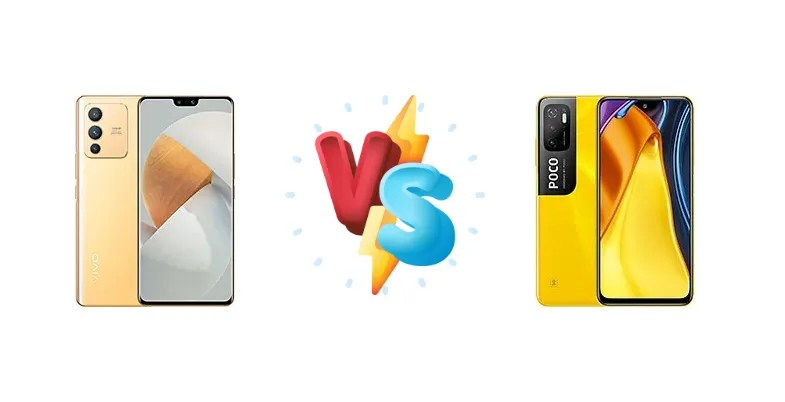
The mid-range smartphone market is fiercely competitive, and the vivo S12 and Xiaomi Poco M3 Pro 5G are two contenders vying for your attention. Both offer compelling features at accessible prices, but cater to slightly different needs. Let's dive into a comprehensive comparison to help you decide which one is right for you.
🏆 Quick Verdict
The vivo S12 takes the lead with its significantly faster Dimensity 1100 chipset and 44W fast charging. While the Poco M3 Pro 5G boasts impressive battery endurance and a high contrast ratio display, the S12's overall performance and charging speed make it the more appealing choice for most users.
| Network |
|---|
| 2G bands | GSM 850 / 900 / 1800 / 1900 | GSM 850 / 900 / 1800 / 1900 |
| 3G bands | HSDPA 850 / 900 / 1700(AWS) / 2100 | HSDPA 850 / 900 / 1700(AWS) / 1900 / 2100 |
| 4G bands | 1, 3, 4, 5, 8, 28, 34, 38, 39, 40, 41 | 1, 2, 3, 4, 5, 7, 8, 12, 17, 20, 28, 32, 38, 40, 41, 66 |
| 5G bands | 1, 3, 5, 8, 28, 41, 77, 78 SA/NSA | 1, 3, 7, 8, 20, 28, 38, 40, 41, 66, 77, 78 SA/NSA |
| Speed | HSPA, LTE, 5G | HSPA, LTE, 5G |
| Technology | GSM / CDMA / HSPA / CDMA2000 / LTE / 5G | GSM / HSPA / LTE / 5G |
| | CDMA2000 1x | - |
| Launch |
|---|
| Announced | 2021, December 22 | 2021, May 19 |
| Status | Available. Released 2021, December 30 | Available. Released 2021, May 22 |
| Body |
|---|
| Build | - | Glass front (Gorilla Glass 3), plastic frame, plastic back |
| Dimensions | 157.2 x 72.4 x 7.4 or 7.6 mm | 161.8 x 75.3 x 8.9 mm (6.37 x 2.96 x 0.35 in) |
| SIM | Nano-SIM + Nano-SIM | Nano-SIM + Nano-SIM |
| Weight | 179 g or 181 g (6.31 oz) | 190 g (6.70 oz) |
| Display |
|---|
| Protection | - | Corning Gorilla Glass 3 |
| Resolution | 1080 x 2400 pixels, 20:9 ratio (~409 ppi density) | 1080 x 2400 pixels, 20:9 ratio (~405 ppi density) |
| Size | 6.44 inches, 100.1 cm2 (~88.0% screen-to-body ratio) | 6.5 inches, 102.0 cm2 (~83.7% screen-to-body ratio) |
| Type | AMOLED, 90Hz, HDR10+ | IPS LCD, 90Hz, 400 nits (typ), 500 nits (HBM) |
| Platform |
|---|
| CPU | Octa-core (4x2.6 GHz Cortex-A78 & 4x2.0 GHz Cortex-A55) | Octa-core (2x2.2 GHz Cortex-A76 & 6x2.0 GHz Cortex-A55) |
| Chipset | Mediatek Dimensity 1100 (6 nm) | Mediatek Dimensity 700 (7 nm) |
| GPU | Mali-G77 MC9 | Mali-G57 MC2 |
| OS | Android 11, OriginOS Ocean | Android 11, MIUI 12 |
| Memory |
|---|
| Card slot | No | microSDXC (uses shared SIM slot) |
| Internal | 128GB 8GB RAM, 256GB 8GB RAM, 256GB 12GB RAM | 64GB 4GB RAM, 128GB 6GB RAM |
| | UFS 3.1 | UFS 2.2 |
| Main Camera |
|---|
| Dual | 44 MP, f/2.0, (wide), AF
8 MP, f/2.3, 105˚ (ultrawide) | - |
| Features | Dual-LED flash, HDR, panorama | Dual-LED dual-tone flash, HDR, panorama |
| Single | - | 8 MP, f/2.0, (wide) |
| Triple | 108 MP, f/1.9, 26mm (wide), 1/1.52", PDAF
8 MP, f/2.2, 120˚, 16mm (ultrawide), 1/4.0", 1.12µm
2 MP (macro) | 48 MP, f/1.8, 26mm (wide), 1/2.0", 0.8µm, PDAF
2 MP (macro)
Auxiliary lens |
| Video | 4K@30fps, 1080p@30fps, gyro-EIS | 1080p@30fps |
| Selfie camera |
|---|
| Dual | 44 MP, f/2.0, (wide), AF
8 MP, f/2.3, 105˚ (ultrawide) | - |
| Features | Dual-LED flash, HDR | - |
| Single | - | 8 MP, f/2.0, (wide) |
| Video | 4K@30fps, 1080p@30fps | 1080p@30fps |
| Sound |
|---|
| 3.5mm jack | No | Yes |
| 35mm jack | No | Yes |
| Loudspeaker | Yes | Yes |
| | 24-bit/192kHz audio | 24-bit/192kHz audio |
| Comms |
|---|
| Bluetooth | 5.2, A2DP, LE, aptX HD | 5.1, A2DP, LE |
| Infrared port | - | Yes |
| NFC | Yes | Yes (market/region dependent) |
| Positioning | GPS, GLONASS, GALILEO, BDS, QZSS | GPS, GLONASS, GALILEO, BDS |
| Radio | No | FM radio |
| USB | USB Type-C, OTG | USB Type-C 2.0 |
| WLAN | Wi-Fi 802.11 a/b/g/n/ac, dual-band, Wi-Fi Direct | Wi-Fi 802.11 a/b/g/n/ac, dual-band, Wi-Fi Direct |
| Features |
|---|
| Sensors | Fingerprint (under display, optical), accelerometer, gyro, proximity, compass | Fingerprint (side-mounted), accelerometer, gyro, proximity, compass |
| Battery |
|---|
| Charging | 44W wired | 18W wired |
| Type | 4200 mAh | Li-Po 5000 mAh |
| Misc |
|---|
| Colors | Black, Blue, Yellow | Poco Yellow, Power Black, Cool Blue |
| Models | V2162A | M2103K19PG, M2103K19PI, M2103K19PY |
| Price | About 390 EUR | About 140 EUR |
| SAR | - | 0.94 W/kg (head) 1.06 W/kg (body) |
| SAR EU | - | 0.54 W/kg (head) 0.90 W/kg (body) |
| Tests |
|---|
| Battery life | - |
Endurance rating 121h
|
| Camera | - |
Photo / Video |
| Display | - |
Contrast ratio: 1475:1 (nominal) |
| Loudspeaker | - |
-27.9 LUFS (Good)
|
vivo S12
- Faster Processor (Dimensity 1100)
- 44W Fast Charging
- Likely better selfie camera
- More modern chipset (6nm)
- Potentially shorter battery life than Poco M3 Pro 5G
- Specific display details missing
Xiaomi Poco M3 Pro 5G
- Exceptional Battery Life (121h endurance)
- Bright Display (536 nits)
- High Contrast Ratio (1475:1)
- Slower Processor (Dimensity 700)
- 18W Slow Charging
- Likely less powerful camera
Display Comparison
Both phones feature displays with a 1475:1 contrast ratio, suggesting deep blacks and good image quality. However, the Poco M3 Pro 5G measures a brighter 536 nits, potentially offering better visibility in direct sunlight. The vivo S12 likely has a slightly more color-accurate display, typical of vivo's offerings, but specific panel details are needed for a definitive comparison. Resolution and refresh rate are also key factors missing from the provided specs.
Camera Comparison
Camera details are sparse, but both phones are described as having 'Photo / Video' capabilities. The vivo S12 is known for its selfie camera prowess, often featuring high-resolution sensors and advanced features. The Poco M3 Pro 5G's camera performance is likely more standard for its price range. A deeper dive into sensor sizes, aperture, and software features would be needed for a thorough comparison.
Performance
The vivo S12's Dimensity 1100 chipset is a clear winner here. Its octa-core CPU with Cortex-A78 cores provides significantly more processing power than the Poco M3 Pro 5G's Dimensity 700, which relies more on Cortex-A55 cores. Expect smoother performance in demanding games and apps on the S12. The S12 also benefits from a more modern 6nm manufacturing process, potentially leading to better power efficiency.
Battery Life
The Poco M3 Pro 5G shines in this category with an impressive endurance rating of 121 hours. This suggests exceptional battery life, easily lasting multiple days on a single charge. The vivo S12, while offering 44W fast charging, likely has a smaller battery capacity and therefore won't match the Poco M3 Pro 5G's longevity.
Buying Guide
The vivo S12 is ideal for users prioritizing performance, smooth multitasking, and faster charging. It's a great option for those who enjoy mobile gaming or demanding apps. The Xiaomi Poco M3 Pro 5G is best suited for users who prioritize exceptional battery life and a vibrant display, and are less concerned about raw processing power. It's a solid choice for media consumption and everyday tasks.
Frequently Asked Questions
❓ Which phone is better for gaming?
The vivo S12 is significantly better for gaming due to its more powerful Dimensity 1100 chipset.
❓ Which phone will last longer on a single charge?
The Xiaomi Poco M3 Pro 5G offers exceptional battery life and will likely last much longer than the vivo S12.