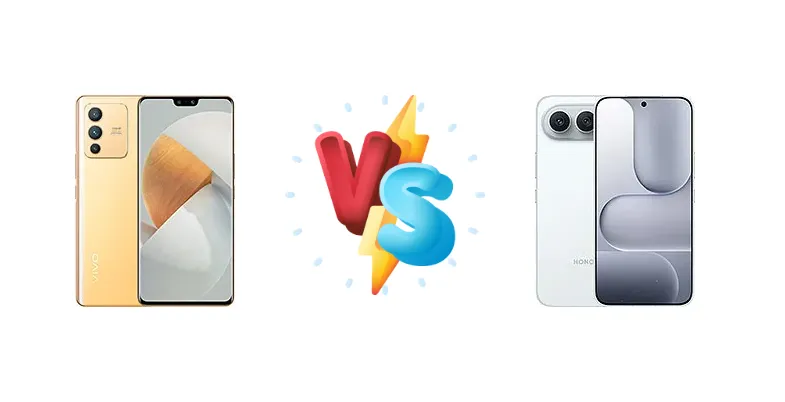
The mid-range smartphone market is fiercely competitive, and the Honor 500 and vivo S12 represent compelling options. The vivo S12, leveraging the Mediatek Dimensity 1100, aims for a balance of features and affordability. The Honor 500, however, arrives with Qualcomm’s newer Snapdragon 8s Gen 4, promising a significant leap in processing power and efficiency. This comparison will dissect the key differences to help you determine which device best suits your needs.
🏆 Quick Verdict
For the average user prioritizing performance and future-proofing, the Honor 500 is the clear winner. Its Snapdragon 8s Gen 4 chipset offers a substantial upgrade over the Dimensity 1100 in the vivo S12, coupled with significantly faster 80W charging. While the S12 remains a capable device, the 500 delivers a more premium experience.
| Network |
|---|
| 2G bands | GSM 850 / 900 / 1800 / 1900 | GSM 850 / 900 / 1800 / 1900 |
| 3G bands | HSDPA 850 / 900 / 1700(AWS) / 2100 | HSDPA 800 / 850 / 900 / 1700(AWS) / 1900 / 2100 |
| 4G bands | 1, 3, 4, 5, 8, 28, 34, 38, 39, 40, 41 | LTE |
| 5G bands | 1, 3, 5, 8, 28, 41, 77, 78 SA/NSA | SA/NSA |
| Speed | HSPA, LTE, 5G | HSPA, LTE, 5G |
| Technology | GSM / CDMA / HSPA / CDMA2000 / LTE / 5G | GSM / HSPA / LTE / 5G |
| | CDMA2000 1x | - |
| Launch |
|---|
| Announced | 2021, December 22 | 2025, November 24 |
| Status | Available. Released 2021, December 30 | Available. Released 2025, November 27 |
| Body |
|---|
| Build | - | Glass front, aluminum frame |
| Dimensions | 157.2 x 72.4 x 7.4 or 7.6 mm | 155.8 x 74.2 x 7.8 mm (6.13 x 2.92 x 0.31 in) |
| SIM | Nano-SIM + Nano-SIM | Nano-SIM + Nano-SIM |
| Weight | 179 g or 181 g (6.31 oz) | 198 g (6.98 oz) |
| Display |
|---|
| Protection | - | Aluminosilicate glass |
| Resolution | 1080 x 2400 pixels, 20:9 ratio (~409 ppi density) | 1264 x 2736 pixels, 19.5:9 ratio (~460 ppi density) |
| Size | 6.44 inches, 100.1 cm2 (~88.0% screen-to-body ratio) | 6.55 inches, 105.4 cm2 (~91.2% screen-to-body ratio) |
| Type | AMOLED, 90Hz, HDR10+ | AMOLED, 1B colors, 120Hz, 3840Hz PWM, HDR Vivid, 6000 nits (peak) |
| Platform |
|---|
| CPU | Octa-core (4x2.6 GHz Cortex-A78 & 4x2.0 GHz Cortex-A55) | Octa-core (1x3.21 GHz Cortex-X4 & 3x3.0 GHz Cortex-A720 & 2x2.8 GHz Cortex-A720 & 2x2.0 GHz Cortex-A720) |
| Chipset | Mediatek Dimensity 1100 (6 nm) | Qualcomm SM8735 Snapdragon 8s Gen 4 (4 nm) |
| GPU | Mali-G77 MC9 | Adreno 825 |
| OS | Android 11, OriginOS Ocean | Android 16, MagicOS 10 |
| Memory |
|---|
| Card slot | No | No |
| Internal | 128GB 8GB RAM, 256GB 8GB RAM, 256GB 12GB RAM | 256GB 12GB RAM, 512GB 12GB RAM, 512GB 16GB RAM |
| | UFS 3.1 | - |
| Main Camera |
|---|
| Dual | 44 MP, f/2.0, (wide), AF
8 MP, f/2.3, 105˚ (ultrawide) | 200 MP, f/1.9, (wide), 1/1.4", 0.56µm, PDAF, OIS
12 MP, f/2.2, 117˚ (ultrawide), AF |
| Features | Dual-LED flash, HDR, panorama | LED flash, HDR, panorama |
| Triple | 108 MP, f/1.9, 26mm (wide), 1/1.52", PDAF
8 MP, f/2.2, 120˚, 16mm (ultrawide), 1/4.0", 1.12µm
2 MP (macro) | - |
| Video | 4K@30fps, 1080p@30fps, gyro-EIS | 4K, 1080p, gyro-EIS, OIS |
| Selfie camera |
|---|
| Dual | 44 MP, f/2.0, (wide), AF
8 MP, f/2.3, 105˚ (ultrawide) | - |
| Features | Dual-LED flash, HDR | HDR |
| Single | - | 50 MP, f/2.0, (wide) |
| Video | 4K@30fps, 1080p@30fps | 4K, 1080p, gyro-EIS |
| Sound |
|---|
| 3.5mm jack | No | - |
| 35mm jack | No | No |
| Loudspeaker | Yes | Yes, with stereo speakers |
| | 24-bit/192kHz audio | - |
| Comms |
|---|
| Bluetooth | 5.2, A2DP, LE, aptX HD | 6.0, A2DP, LE, aptX HD, aptX Adaptive, aptX Lossless, LHDC 5, Auracast, ASHA |
| Infrared port | - | Yes |
| NFC | Yes | Yes |
| Positioning | GPS, GLONASS, GALILEO, BDS, QZSS | GPS (L1+L5), GLONASS (L1), BDS (B1I+B1c+B2a+B2b), GALILEO (E1+E5a+E5b), QZSS (L1+L5), NavIC (L5) |
| Radio | No | No |
| USB | USB Type-C, OTG | USB Type-C 2.0, OTG |
| WLAN | Wi-Fi 802.11 a/b/g/n/ac, dual-band, Wi-Fi Direct | Wi-Fi 802.11 a/b/g/n/ac/6/7, dual-band, Wi-Fi Direct |
| Features |
|---|
| Sensors | Fingerprint (under display, optical), accelerometer, gyro, proximity, compass | Fingerprint (under display, optical), accelerometer, gyro, proximity, compass (ultrasound) |
| Battery |
|---|
| Charging | 44W wired | 80W wired
5W reverse wired |
| Type | 4200 mAh | Si/C Li-Ion 8000 mAh |
| Misc |
|---|
| Colors | Black, Blue, Yellow | Black, Silver, Blue, Pink |
| Models | V2162A | MEY-AN00 |
| Price | About 390 EUR | About 330 EUR |
vivo S12
- Established Brand Reputation
- Balanced Feature Set
- Competitive Price Point
- Older Chipset (Dimensity 1100)
- Slower Charging (44W)
Honor 500
- Powerful Snapdragon 8s Gen 4
- Ultra-Fast 80W Charging
- Improved Power Efficiency
- Potentially Higher Price
- Honor Brand Still Building Trust in Some Markets
Display Comparison
Neither device's display specifications are provided, so a direct comparison is limited. However, given the Honor 500's positioning as a more premium device, it's reasonable to expect a higher peak brightness and potentially a higher refresh rate. The vivo S12 likely targets a balance between cost and visual quality. Color accuracy will likely be similar, relying on standard AMOLED calibration techniques.
Camera Comparison
Without specific camera sensor details, a detailed comparison is challenging. However, the Honor 500’s positioning suggests a greater investment in camera technology. We can anticipate a larger main sensor and potentially more advanced image processing algorithms. The Snapdragon 8s Gen 4’s ISP (Image Signal Processor) is also more capable than the Dimensity 1100’s, leading to better dynamic range, noise reduction, and overall image quality. The presence or absence of Optical Image Stabilization (OIS) on the main sensor would be a critical differentiator, favoring the device that includes it.
Performance
The core difference lies in the chipsets. The Honor 500’s Snapdragon 8s Gen 4 (4nm) represents a significant architectural upgrade over the vivo S12’s Dimensity 1100 (6nm). The 4nm process node inherently offers better power efficiency, translating to less heat generation and potentially sustained performance during prolonged tasks like gaming. The Snapdragon 8s Gen 4’s CPU configuration – a 1x3.21 GHz Cortex-X4 prime core alongside three Cortex-A720 cores and four Cortex-A720 cores – is designed for superior single-core and multi-core performance compared to the Dimensity 1100’s 4x2.6 GHz Cortex-A78 and 4x2.0 GHz Cortex-A55 setup. This means faster app loading, smoother multitasking, and a more responsive user experience on the Honor 500.
Battery Life
The Honor 500’s 80W wired charging is a game-changer, allowing for a full charge in a fraction of the time compared to the vivo S12’s 44W charging. While battery capacity isn’t specified, the faster charging speed significantly mitigates any potential capacity disadvantage. The 5W reverse wired charging on the Honor 500 adds a convenient feature for topping up accessories. The Snapdragon 8s Gen 4’s improved power efficiency also contributes to potentially longer battery life on the Honor 500, despite potentially similar battery capacities.
Buying Guide
Buy the vivo S12 if you prioritize a more established brand reputation within the vivo ecosystem and are looking for a solid all-rounder without demanding the absolute highest performance. Buy the Honor 500 if you prioritize raw processing power for gaming or demanding applications, and value the convenience of incredibly fast 80W charging. The Honor 500 is the better choice for users who want a phone that will remain responsive for years to come.
Frequently Asked Questions
❓ Will the Snapdragon 8s Gen 4 in the Honor 500 handle demanding games like Genshin Impact at high settings?
Yes, the Snapdragon 8s Gen 4 is specifically designed for gaming. Its Cortex-X4 prime core and Adreno GPU provide ample power to run Genshin Impact and other graphically intensive games at high settings with smooth frame rates. The improved thermal efficiency will also help prevent throttling during extended gaming sessions.
❓ How long does it realistically take to charge the Honor 500 from 0% to 100% with the 80W charger?
With 80W charging, the Honor 500 can realistically charge from 0% to 100% in approximately 30-40 minutes, depending on battery capacity. This is significantly faster than the vivo S12’s 44W charging, which would likely take over an hour.
❓ Is the Dimensity 1100 in the vivo S12 still capable of handling everyday tasks and social media apps smoothly?
Absolutely. The Dimensity 1100 is a capable chipset that will handle everyday tasks like browsing, social media, and video streaming without issue. However, it will struggle more with demanding games or heavy multitasking compared to the Snapdragon 8s Gen 4.
❓ Does the Honor 500 support 5G connectivity?
Yes, the Snapdragon 8s Gen 4 includes an integrated 5G modem, ensuring the Honor 500 supports both Sub-6GHz and mmWave 5G networks, provided your carrier supports them.